APOD spotlights NGC 474’s shells, revealing hidden galaxy mergers
NGC 474 turns galaxy imaging into archaeology, where deep exposures reveal shells, tidal debris, and merger scars hidden in a smooth elliptical.
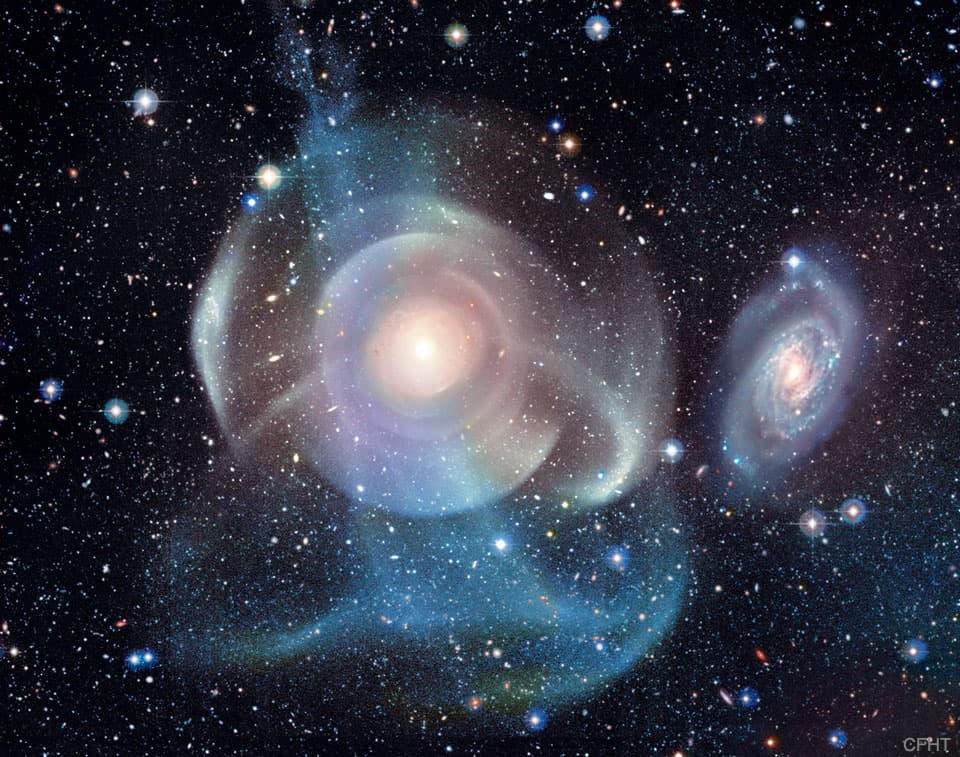
NGC 474 is the kind of target that changes what a deep-sky frame is for. At a quick glance it can look like a smooth elliptical in Pisces, but with enough depth it opens into shells, arcs, and star streams that read like the debris field of a long, messy merger history. The featured image, credited to CFHT, Coelum, MegaCam, J.-C. Cuillandre, and G. A. Anselmi, puts that hidden structure front and center.
Why NGC 474 pulls in faint-detail imagers
This galaxy sits about 100 million light-years away and spans roughly 250,000 light-years, so the frame has the scale to support very large, low-contrast structure. The most interesting part is not the bright center, but the way the outer light breaks into multiple layers that become visible only when the background is pushed hard enough. That makes NGC 474 a textbook target for anyone who wants to test whether a setup can recover ultra-low-surface-brightness detail instead of just bright cores.
The astrophotography lesson is simple: the galaxy’s visual drama lives in what shallow images suppress. A quick exposure will flatten it into something nearly featureless, while a deep integration can pull out the shell system and reveal how much is hidden in the halo. For imagers, that puts the focus on signal depth, background control, and patience rather than sheer brightness.
What the shells are telling you
The shells around NGC 474 are not decorative. APOD’s framing points to a galaxy that may have absorbed numerous smaller galaxies over the past billion years, leaving behind tidal tails and debris that now appear as curved shells. Another explanation is that the shells behave like ripples in a pond, driven by ongoing interaction with the nearby spiral NGC 470.
That second galaxy matters. NASA’s Hubble coverage places NGC 474 in a relatively empty part of space, with only the much smaller spiral NGC 470 nearby, and notes that NGC 470 will likely be drawn into NGC 474’s gravitational influence billions of years from now. In other words, the system is not frozen in a finished state. It is a live example of galaxy evolution still writing itself in the outer halo.
NOIRLab adds a useful scale cue: the unusual structures around NGC 474 are made up of hundreds of millions of stars. It also ties those features to recent mergers within the last billion years or close interactions with smaller infalling dwarf galaxies. That is why shell galaxies matter so much in deep imaging. They are not just pretty arcs. They are the visible residue of repeated gravitational violence.
How to capture a shell galaxy like this
NGC 474 rewards the same habits that separate a good deep-sky frame from a convincing one. The goal is not to make the galaxy bright. The goal is to let the faint structure survive long enough to be seen.
- Go after dark skies. Shells and streams are low-contrast by nature, so sky brightness will erase the very features you came to record.
- Build long total integration time. A single clean subframe is not enough for this kind of target. The shells only emerge when the stacked signal has real depth.
- Keep calibration frames disciplined. Good flats, darks, and bias or dark-flats matter because uneven backgrounds and pattern noise can masquerade as structure in a shell galaxy.
- Watch gradients aggressively. Large-scale background unevenness can either hide the outer arcs or invent false ones, and NGC 474 depends on the difference between the two.
- Favor careful focusing and stable tracking. The bright core is not the story here. You need the outer halo to stay smooth so the shells can be recovered later.
The point is not theoretical. A galaxy like this is a direct check on how well your optics, sky conditions, and calibration chain hold up when the subject itself is almost invisible until the stack is pushed.
Stretching without wrecking the galaxy
This is where the real craft comes in. The APOD treatment highlights exactly the kind of stretch work that advanced imagers do in PixInsight, Siril, and similar software, because the shells only stand out when background control and noise management are handled with care. A heavy-handed stretch can blow out the core, crush the halo, or turn the faint arcs into ugly blotches.
The cleanest approach is to stretch in stages and keep the galaxy’s inner and outer regions balanced. You want enough midtone lift to expose the shells, but not so much that the smooth ellipticals and streams lose their shape. If the outer light starts looking artificial, the stretch has gone too far.
That restraint matters because the structure in NGC 474 is subtle by design. The whole payoff is in seeing a galaxy that looks ordinary at first and then realizing the frame is packed with faint signatures of past mergers. When the processing is done well, the shells do not look added on. They look inevitable.
Why the wider field matters
NGC 474 is often discussed together with NGC 470 as Arp 227, the interacting pair that sits in Pisces. APOD’s earlier framing describes the faint wide arcs or shells as likely the result of gravitational encounters with NGC 470, while the more recent explanation emphasizes accretion of a smaller galaxy during close encounters that began over a billion years ago. Both views point to the same imaging reality: the outer halo is an archive of interaction.
That is what makes this target so satisfying for deep-sky work. You are not just photographing a galaxy in the usual sense, you are extracting evidence of its history from the light itself. NGC 474 proves that some of the most compelling galaxy images are not the ones with the brightest cores, but the ones that force you to chase down the faintest possible structure and leave it intact.
In the end, NGC 474 is a reminder that a smooth-looking elliptical can still carry the scars of a violent past. The shell system only appears when depth, calibration, and careful stretching all line up, which is exactly why it belongs on the short list for imagers who want their frames to reveal more than a bright center.
This article was produced by Prism’s automated news system from verified source data, official records, and press releases, then run through automated quality and moderation checks before publishing. The system is built and supervised by the people who set the standards it runs under. Read our full AI policy.
Did this article answer your question?