How many chickens should you start with for fresh eggs?
Start with the eggs you actually eat, not the number of cute chicks you can fit. Four good layers can cover about 21 eggs a week if your coop and budget hold.
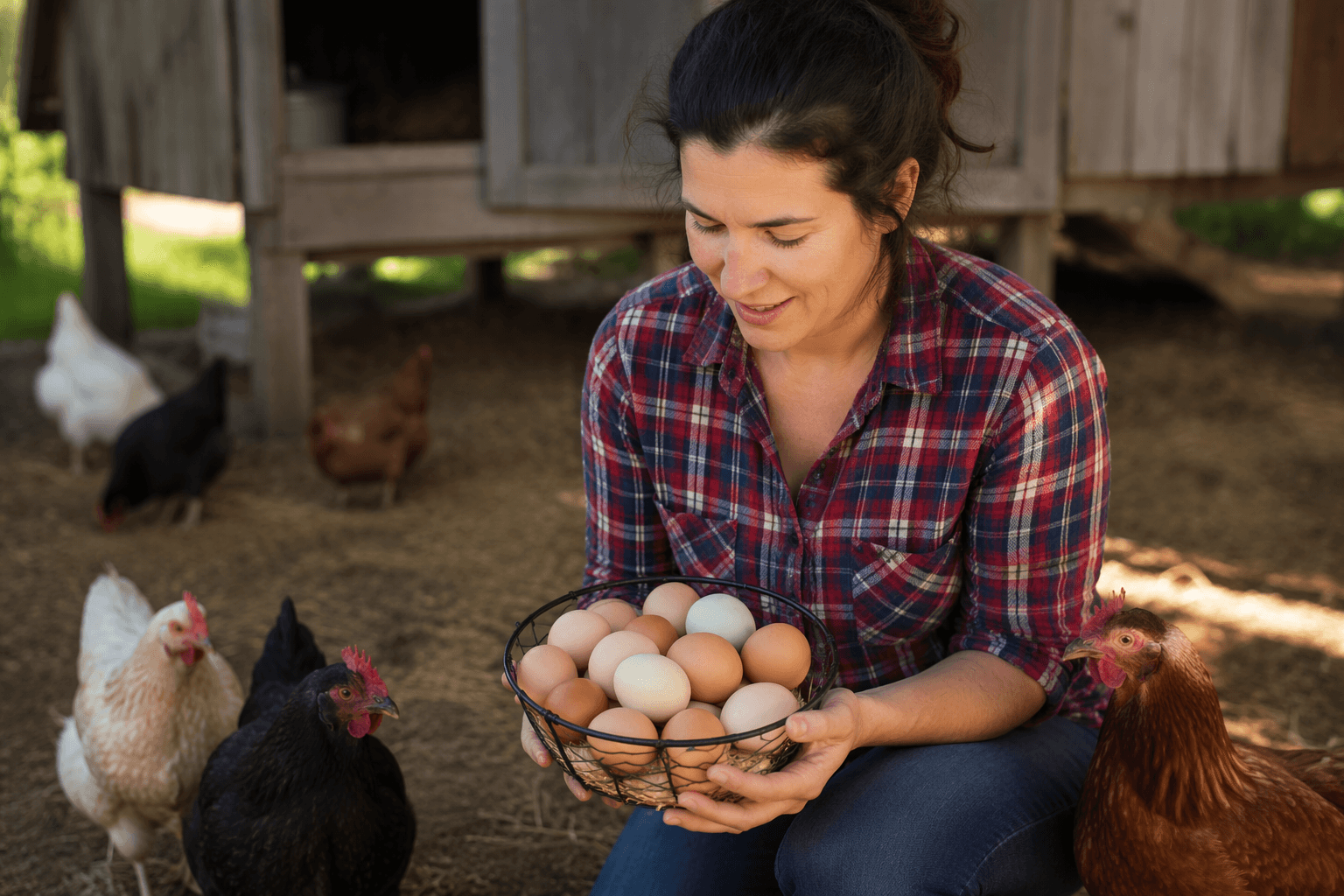
A hen can lay only one egg in a day, and it takes about 26 hours for a single egg to form fully. New keepers often make the same mistake: they start with too many birds for the eggs they actually use, the coop they actually have, and the feed bill they can actually live with. The cleanest way to avoid that trap is to size the flock backward from your kitchen, not forward from a feed store wish list. A quick fridge audit, where you track how many eggs your household really goes through over a couple of weeks, gives you a much better starting point than guessing.
Start with the egg count, not the chick count
If you want fresh eggs, the first question is not “How many hens look manageable?” It is “How many eggs do I need each week, and how steady do I want that supply to be?” No bird is going to turn into a two-egg machine just because you ran out at breakfast.
That is why breed choice and flock size have to be tied to household use. High-production hens such as Rhode Island Reds and Leghorns may lay almost every day during their prime, while dual-purpose breeds usually average around 3 to 4 eggs a week and ornamental or rare birds often land closer to 2 to 3. If your fridge audit shows a family of four is burning through about 21 eggs a week, four high-production hens can make sense, because 4 birds at roughly 5 eggs each is right at 20 eggs a week.
A smaller household should think the same way. If a 2-person home does not use many eggs, starting with two good layers is often plenty, and three gives you more cushion without jumping straight into a feed-heavy flock. In a tiny urban yard, where the legal limit may be tight and every square foot of coop space counts, that math matters even more. The wrong move is buying six birds because they sound like a nice round number, then discovering you only need half that many eggs.
Know what one hen can really do
Egg production usually starts around 18 to 22 weeks of age, depending on breed and season, then ramps up toward peak lay. University of Florida IFAS Extension puts flock production at about 90% and later about 65% after 12 months of lay, which is why a flock that looks fantastic in its first year can feel a lot less generous later.
That change is normal. Good layers may produce for about 50 to 60 weeks before a molt, and many home flocks lay on and off for three to four years. Daylight, season, and molt all affect the count, so the number of eggs you get in May may not match what you get in November. That is also why it pays to think in ranges, not fantasies: a bird that lays 5 to 6 eggs a week in its prime is a very different investment from one that only turns out 2 to 3.
Make the coop math work before you buy the birds
Egg needs are only half the decision. The other half is whether your coop can house the flock without turning chores into a daily wrestling match. One nest box for every four to five hens is a common guideline, so a flock of four birds can get by with one box, while eight birds should have two. Roost space is usually recommended at about 8 to 10 inches per bird, which means those same four hens need roughly 32 to 40 inches of roost bar.
Four hens are one thing, but four hens plus extra “just in case” birds quickly start demanding more nest space, more roost room, more feed, more bedding, and more cleaning time. Legal limits can also stop the flock count long before your enthusiasm does, especially in smaller yards and town lots. If your ordinance caps you at three hens, then the right question is not how to sneak in a fourth, but whether three well-chosen layers fit your egg target.
Budget works the same way. Every additional bird adds recurring cost, and the cheapest flock on paper is not the one that looks cute in a brooder, it is the one that still feels reasonable when you are buying feed, replacing bedding, and cleaning the coop every week.
Plan for surplus, because some weeks hens outpace the kitchen
Even a well-sized flock will have weeks when the eggs pile up faster than your family can eat them. That is not a failure, it is normal production. The smart move is to decide in advance what happens when the cartons start filling up: share with neighbors, cook a quiche, bake ahead, or preserve the surplus another way.
If your household really uses 12 eggs a week, then four high-production hens may give you extra. If you use about 21 eggs a week, four good layers may land almost exactly where you want them.
Keep the health part in the decision
Fresh eggs are only part of backyard poultry keeping. Backyard poultry can carry germs even when they look healthy and clean, and children younger than 5 should not touch chicks, ducklings, or other backyard poultry. Wash hands after handling birds, eggs, feed, or anything in their environment.
On Sept. 29, 2025, the CDC’s backyard-poultry Salmonella outbreak page listed 559 cases, 125 hospitalizations, and 2 deaths across 48 states.
This article was produced by Prism’s automated news system from verified source data, official records, and press releases, then run through automated quality and moderation checks before publishing. The system is built and supervised by the people who set the standards it runs under. Read our full AI policy.
Did this article answer your question?