FreshSkin Guide Helps Bath Bomb Makers Choose the Right Citric Acid Grade
The wrong citric acid grade can kill your fizz before the bomb hits water. Here's how to source, store, and substitute correctly.

The bath bomb's origin is deceptively simple: in 1989, Mo Constantine, co-founder of Lush Cosmetics, pressed together citric acid, sodium bicarbonate, and essential oils in her Dorset garden shed and created what would become a global bathing staple. The chemistry she stumbled onto is the same chemistry every maker works with today: an acid-base reaction that produces carbon dioxide on contact with water. What has changed is how much we understand about making that reaction consistent, controllable, and skin-safe. A guide published by FreshSkin, a UK-based family-run beauty and botanical retailer, pulls together the sourcing and formulation detail that most beginner-focused resources gloss over, and it's worth unpacking for anyone serious about reproducible results.
Why Citric Acid Grade Is Not a Minor Detail
Most recipes treat citric acid as a single ingredient. It isn't. The distinction between anhydrous and monohydrate forms is the first variable that catches new makers off guard. Anhydrous citric acid contains no bound water molecules; monohydrate citric acid contains one water molecule per citric acid molecule. That difference matters because the monohydrate form introduces a small but real moisture load into your dry mix, which can begin activating the baking soda reaction before your bomb ever sees a bath. FreshSkin's guide is explicit on this: use the anhydrous form, sourced at food-grade or USP purity, for any bath bomb intended for skin contact.
Particle size is the second variable. Finer citric acid crystals dissolve faster and distribute more evenly through the dry mix, which translates to a more uniform fizz across the surface of the bomb. Coarser granules can create hot spots in the mix, where the reaction is faster in one area than another, and the resulting bomb may fizz unevenly or develop surface cracking during curing. If you've ever had a batch that fizzled weakly on one side while fizzing strongly on the other, coarse particle size or uneven mixing is often the culprit, not your ratio.
The 2:1 Ratio and What Actually Changes Around It
FreshSkin anchors its recipe guidance on the standard 2:1 baking soda to citric acid ratio. This is the industry baseline for good reason: two parts sodium bicarbonate to one part citric acid produces a complete enough reaction to give a satisfying fizz without leaving either ingredient sitting unreacted in the water. What most recipes don't explain is that the ratio is a starting point, not a fixed law. Adjusting cornstarch percentage upward (a common move to get a smoother, silkier feel) can slow down fizz and change how firmly the bomb holds its shape during pressing. Adjusting the binder spritz, typically a small amount of oil or witch hazel applied in short bursts, changes how quickly the mix activates during pressing and how dense the finished bomb is.
The practical takeaway from FreshSkin's framing is to treat your formula as a set of variables you change one at a time, not all at once. Switch to finer citric acid. Log what happens to fizz timing. Then adjust cornstarch. Then adjust binder. Stacking multiple changes across a single batch is the fastest way to lose track of what actually improved or degraded your results.
Moisture Is the Invisible Enemy: What Clumping Actually Tells You
Here is the detail that experienced makers know but rarely explain explicitly: small clumps in your citric acid are not just a texture inconvenience. They are a signal. Citric acid is hygroscopic, meaning it actively pulls moisture from the surrounding air. When you open a bag of citric acid and find lumps that weren't there before, the powder has already begun absorbing ambient humidity. In a batch, that absorbed moisture can trigger a slow, low-level acid-base reaction with your baking soda before the bombs are even pressed, releasing just enough CO₂ to compromise the structure and leaving you with bombs that crack during curing, expand unevenly, or produce a weak fizz in the tub.
The fix is upstream: store citric acid in airtight containers, away from the bathroom or any steam-producing environment. If you're working in a humid climate, consider working in small batches and keeping unmixed powders sealed until the moment you need them. Sifting both baking soda and citric acid before mixing removes existing clumps and helps produce a more uniform reaction rate across the batch. FreshSkin recommends gloves and a dust mask when handling powders, both for skin protection and to prevent inhaling fine particulate during the sifting and mixing stages.
Sourcing: What to Look For and What to Avoid
Food-grade or USP-grade citric acid is the minimum standard for any product that contacts skin. Industrial-grade citric acid is produced for water treatment, descaling, and manufacturing applications; it may contain impurities or heavy metal residuals that are not acceptable in a rinse-off cosmetic product. FreshSkin stresses supplier traceability as a non-negotiable, particularly for makers who plan to sell or gift their products. Knowing where your citric acid was produced and processed, and having documentation to back it up, matters both for your own confidence and for any consumer trust claims you make on your packaging.
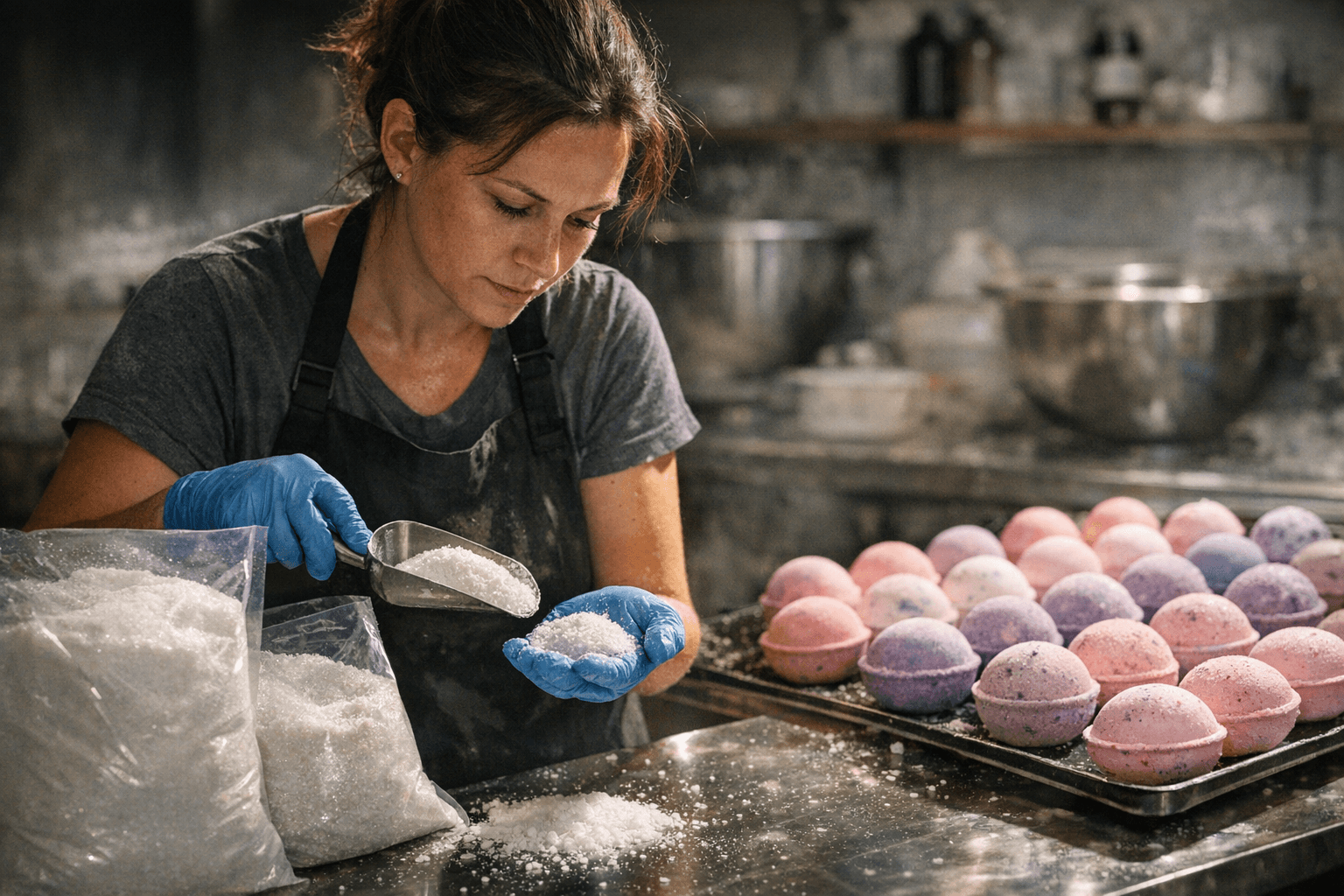
When evaluating suppliers, look for:
- A clear grade declaration (food-grade, USP, or BP in the UK/EU context)
- Confirmation that the product is anhydrous, not monohydrate
- A stated particle size or mesh designation if you need consistent fine crystal
- Proper packaging that seals completely and protects against humidity in transit
Citric Acid as a Skin Ingredient, Not Just a Fizz Agent
One aspect of FreshSkin's guide that distinguishes it from most bath bomb tutorials is its treatment of citric acid as an active skin ingredient rather than a purely functional fizzing agent. Citric acid is an alpha-hydroxy acid (AHA), and in rinse-off applications like bath bombs, it functions as both a pH adjuster and a mild exfoliant. As dermatologist Alok Vij, MD, has noted, baking soda and citric acid largely neutralize each other when the bomb hits water, which limits but does not eliminate the AHA activity at the skin surface. For most users with healthy skin, this is a benefit: the slightly acidic bath water can help support the skin's natural acid mantle. For makers formulating for sensitive skin or for children, it's a reason to test finished bombs on a small skin area before wider use.
When Not to Substitute: Malic and Tartaric Acid as Alternatives
The DIY community occasionally floats malic acid or tartaric acid as citric acid substitutes, and both are legitimate AHA acids that can produce fizz with baking soda. The differences are real enough to matter in practice. Malic acid has a lower melting point and can produce a softer bomb that's more prone to crumbling. Tartaric acid reacts somewhat more slowly than citric, which can change fizz duration and intensity. Neither delivers identical results to anhydrous citric acid at the same ratio, which means substituting requires retesting your entire formula from the 2:1 baseline up. For makers chasing consistency across batches, especially for sale or gifts, FreshSkin's implicit guidance is sound: fix your sourcing of the right citric acid rather than substituting around it. Substitution makes sense if you have a specific skin-chemistry reason or a local sourcing constraint, not simply because one acid is cheaper or more available at a given moment.
A Pre-Batch Checklist Worth Keeping
Before starting any batch where you've changed grade, supplier, or storage conditions since your last make, run through these checks:
- Open the citric acid bag and check for clumping. Any lumps mean moisture uptake has occurred; sift before use.
- Confirm the form is anhydrous, especially if you've switched suppliers.
- Check your workspace humidity. High humidity days are bad batch days unless you're working in a climate-controlled space.
- Do a small test batch of two to four bombs before scaling up, particularly if you're changing particle size or switching to a new dye.
- Log every change. Particle size, cornstarch percentage, oil percentage, binder spritz count: all of it. A batch that fails without a log is just a loss; a batch that fails with a log is data.
The consistency that makes bath bomb making genuinely satisfying, rather than frustrating, comes from treating the chemistry seriously. FreshSkin's guide is useful precisely because it refuses to treat citric acid as a generic commodity. Grade, form, particle size, and storage all pull on the same lever: whether your bombs fizz the way you intended, from the first batch to the hundredth.
This article was produced by Prism’s automated news system from verified source data, official records, and press releases, then run through automated quality and moderation checks before publishing. The system is built and supervised by the people who set the standards it runs under. Read our full AI policy.
Did this article answer your question?