Montclair Bath Bomb Classes Celebrate a Craft Born in 1989 Dorset Shed
Mo Constantine invented the bath bomb in a Dorset shed in 1989; Montclair craft classes now teach her exact chemistry. Here's whether a ticket is worth your time and money.
Two ounces of citric acid, four ounces of baking soda. Add Epsom salts, a carrier oil, a fragrance, and you have the core of every bath bomb recipe taught in workshops from Montclair, New Jersey to Manhattan. The chemistry is simple: sodium bicarbonate meets citric acid in water, carbon dioxide escapes, and the bath fizzes. What is less obvious is that this exact reaction was first coaxed into a pressed sphere by one person, in one garden shed, in 1989, and has since become the engine of a $1.99 billion global industry.
Where the Bath Bomb Began
The bath bomb is not an ancient remedy or a slow-burning folk craft. It has a precise birthday: 1989, Dorset, England, a garden shed belonging to Mo Constantine, co-founder of what would become Lush Cosmetics. Constantine was fascinated by the fizzing action of Alka-Seltzer tablets and set about recreating it in a bathable, skin-conditioning form. She pressed citric acid, sodium bicarbonate, and a blend of essential oils together and named her creation the Aqua Sizzler.
The following year, Lush was awarded the trademark for "bath bombs" on April 27, 1990, a date the company now marks annually as World Bath Bomb Day. Today, Lush sells 48 bath bombs globally every minute. The product filling craft class studios across the New York metro area took just 37 years to travel from proprietary novelty to mainstream DIY curriculum, which makes the current workshop boom one of the faster cultural arcs in modern craft history.
What the Montclair Class Actually Teaches
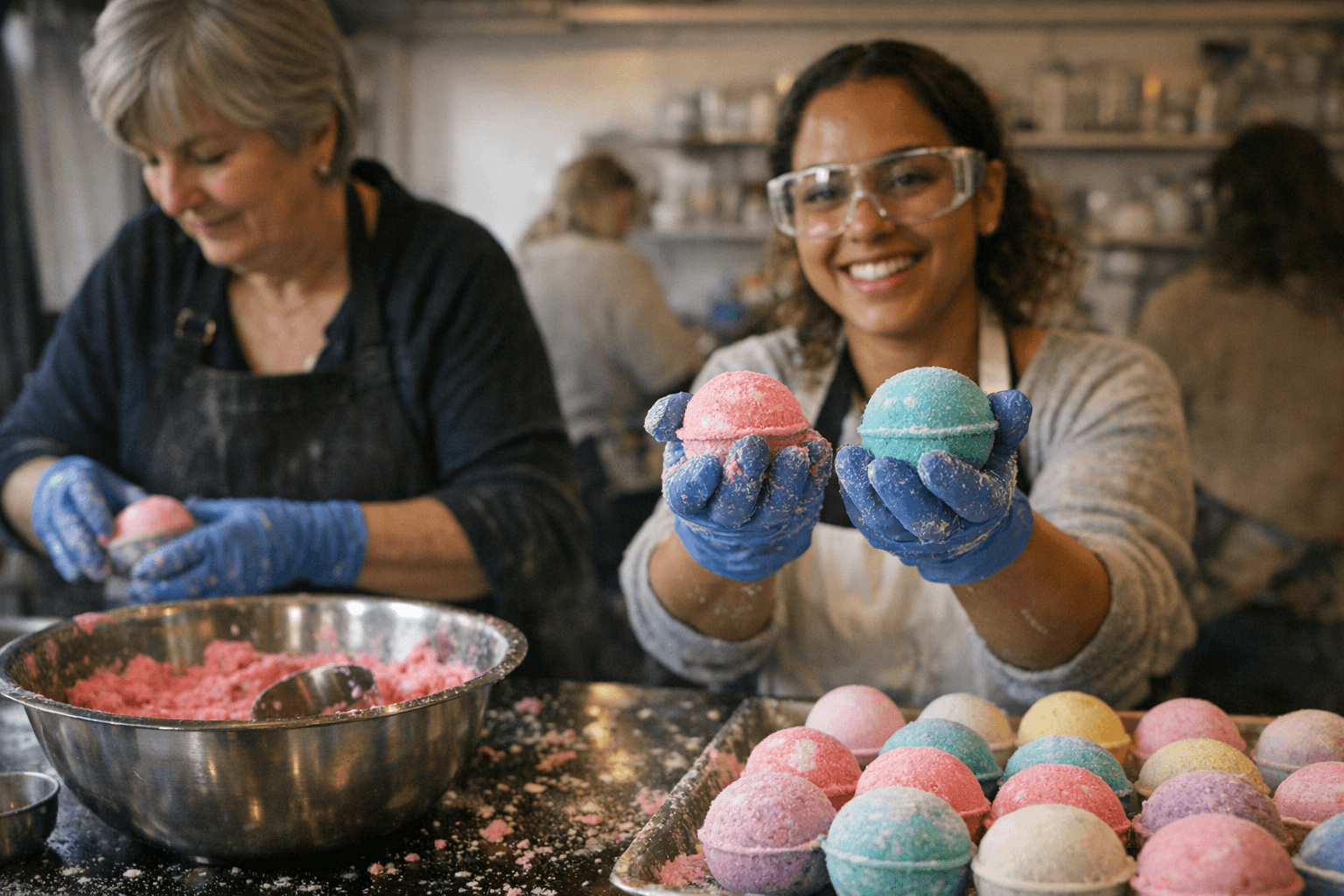
The Bath Bomb Making Class listed and reviewed on TripAdvisor in Montclair, New Jersey, is a hands-on, operator-led session covering the practical fundamentals of bath bomb formulation. Participants work through ingredient basics covering baking soda, citric acid, Epsom salt, and cornstarch before moving into the measuring, mixing, and molding sequence. The session concludes with finish and gifting techniques, so you leave with a takeable product, not just theoretical knowledge.
The listing's consistent user impressions describe the hosting venue as a small, charming shop in historic Montclair run with warmth and accessible to all ages. Reviewers highlight the variety of creative workshops on offer and the quality of locally-made handcrafted goods alongside the class experience. That accessibility is deliberate: the class-as-retail-funnel model is well-established in the craft industry, where beginner-friendly trial workshops serve as a demand-testing mechanism before students invest in their own materials.
The Chemistry You Will Actually Learn
The single most important lesson in any bath bomb beginner session is the acid-to-base ratio. Industry formulators recommend approximately 2 parts baking soda to 1 part citric acid, sometimes nudged to a 2.25:1 ratio to reduce material costs. Together, this acid-base pair should make up between 60% and 90% of the total recipe by weight. Get it right and you get a controlled, satisfying fizz. Get it wrong and your bombs either activate prematurely in the mold or crumble before they reach the tub.
Beyond the core pair, modifiers do the cosmetic work. Epsom salts contribute a magnesium soak benefit and slow the fizz speed. Cornstarch smooths the skin feel and buffers the reaction. Milk powder and skin butters, common in more advanced recipes, add a conditioning finish. A competent beginner class walks you through why each ingredient is there, not just what to throw in the bowl, and that distinction is exactly what separates a single guided session from a morning of frustrated solo trial runs.
Should You Pay for the Class? The Real Cost Breakdown
Here is the honest comparison. A bath bomb making class in the New York metro area, whether the TripAdvisor-listed Montclair offering or ClassBento's Bridgerton Bath Bomb Making Class in Englewood Cliffs (which runs in the $55 to $75 per person range), costs significantly more per bomb than home production. Factor in transit time and travel costs for anyone coming in from outside Montclair, and the economics per fizzy sphere are clearly not the pitch.
What the class actually delivers is compressed learning. A quality DIY starter kit like Bramble Berry's Natural Bath Bomb Kit, which runs $43.99 for approximately 15 bombs at roughly $2.93 each, will produce more product for less money. What it will not do is give you immediate feedback when your mix looks wrong, show you firsthand why the oil phase goes in last, or put you in a room with a local maker who's been sourcing colorants from the same supplier for years. The TripAdvisor listing's repeat themes confirm this: people value the guided session, not just the finished bomb. A class compresses what typically consumes two or three failed solo batches into a single afternoon with a knowledgeable instructor in the room.
A Regional Cluster of Workshops
Montclair is not alone. ClassBento's listings show a distinct concentration of bath bomb workshops across the New York metropolitan region. In addition to the Montclair offering, ClassBento lists the Bridgerton Bath Bomb Making Class in Englewood Cliffs, New Jersey, where the Regency-era theming is a clever hook for group bookings, and the Ultimate Bath Bomb Workshop in New York City, a beginner-friendly format open to adults and children as young as six. All three are within a short drive or train ride of each other, suggesting the demand cluster is dense enough to support competing operators without cannibalizing attendance.
Venues like Sugared Mango Soaps operate the recurring-class model at a higher frequency, running weekly make-and-take bath bomb and candle classes with private after-hours options for groups. That weekly cadence confirms bath bomb instruction is commercially self-sustaining, not a side project attached to a soap shop.
Why the Market Is Pushing People Into Studios
The broader numbers explain the boom. According to Straits Research, the global bath bomb market was valued at $1.99 billion in 2024 and is projected to reach $3.34 billion by 2033, growing at a compound annual rate of 6.2%. GM Insights points to TikTok and Instagram as major accelerants: fizzing-bath video content has natural algorithmic virality, and that surfacing creates aspirational demand that flows directly into both retail purchases and DIY exploration.
Consumer values are shifting inside the category too. Some 48% of key bath bomb companies launched vegan-certified product lines in 2024, a signal that ingredient transparency matters to buyers. That same concern drives class participation: when you formulate your own bomb, you know exactly what goes in it. The wider craft economy is moving in the same direction. According to Business Research Insights, demand for custom and DIY craft kits grew 35% in 2024, and the global arts and crafts market is projected to grow from $47.97 billion in 2025 to $87.38 billion by 2035.
Who Should Actually Sign Up
Three types of people get clear value from the Montclair format:
- Absolute beginners who want hands-on instruction rather than a YouTube tutorial. The class compresses what typically requires two or three failed solo batches into a single guided session with real-time feedback on ratios and technique.
- Gift-experience seekers looking for something to do together rather than something to unwrap. The boutique setting, themed class options, and make-and-take structure make it a natural fit for birthdays, bachelorette parties, and low-key team outings.
- Aspiring sellers who need to understand ingredient economics, product finish standards, and batch consistency before committing to bulk supply orders. One class session is far cheaper than discovering at scale that your 2:1 ratio is off.
If you are already confident at the bench with a baseline recipe dialed in, the better investment is a bulk citric acid order and a new mold set. But Mo Constantine had to start somewhere in that Dorset shed too, and the fastest route from curious beginner to competent maker has always been a knowledgeable person standing next to you at the bench.
This article was produced by Prism’s automated news system from verified source data, official records, and press releases, then run through automated quality and moderation checks before publishing. The system is built and supervised by the people who set the standards it runs under. Read our full AI policy.
Did this article answer your question?