Lush's Yoshi Egg Bath Bomb Goes Viral, Delighting and Confusing Fans
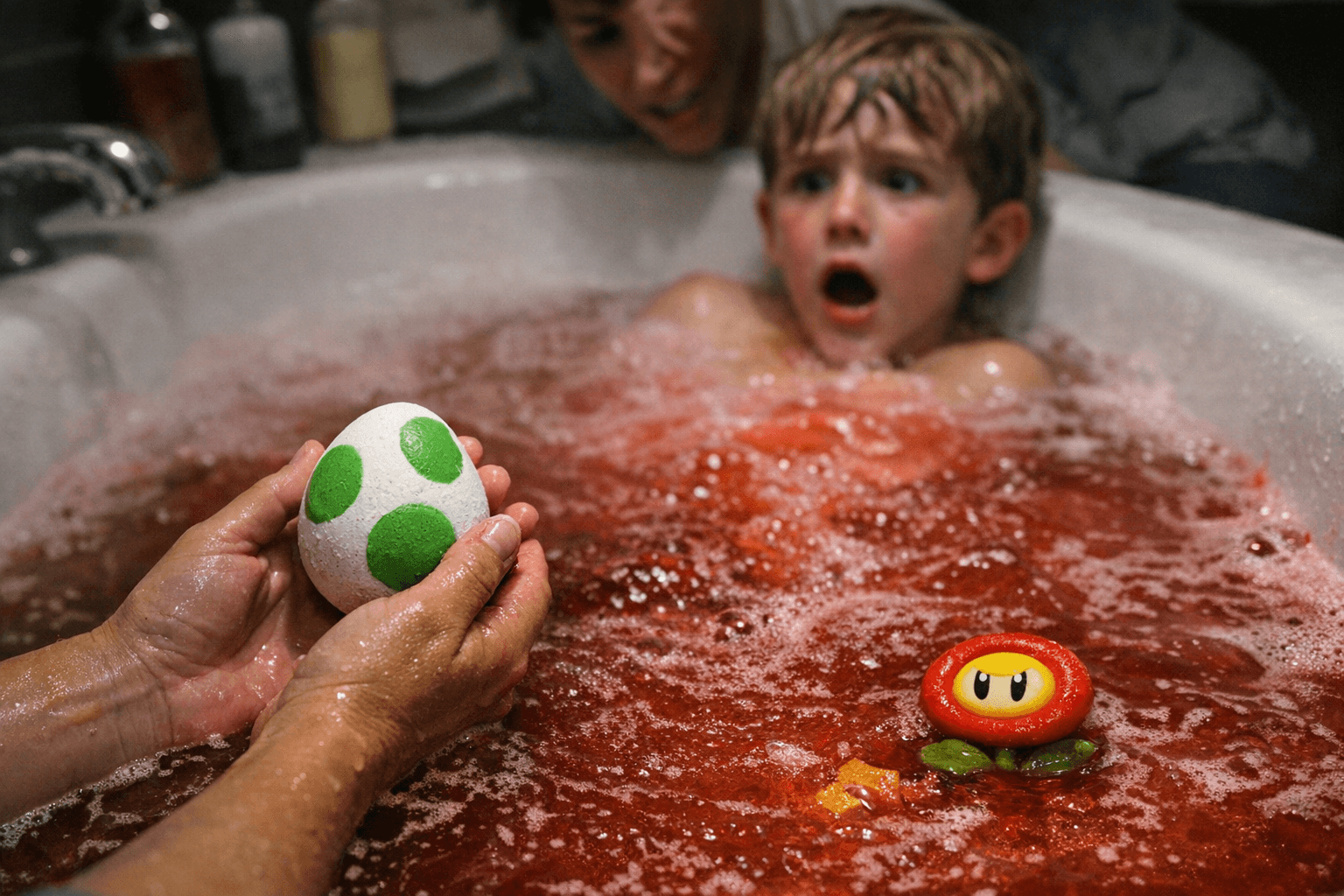
Lush's Yoshi Egg hides one of four collectible power-up gummies inside, but the red fire flower version turns bathwater crimson, racking up 1.8 million views and traumatized kids.
The bath bomb itself is faultless in concept: a large white sphere with green spots, scented with orange and lemon oils under Lush's "Crackle" fragrance profile, engineered to dissolve and drop one of four collectible shower gummies shaped like Mario power-ups. Three of those four reveals land beautifully. The fourth, a red fire flower, turns the bathwater the color of a wound, and that is the entire story.
Launched on March 10, 2026 (otherwise known as Mar10 Day in Nintendo fandom), the Yoshi Egg Bath Bomb is the centerpiece of Lush's collaboration with Nintendo, Universal Products and Experiences, and Illumination for The Super Mario Galaxy Movie. The full collection spans twelve products, including a Protect The Galaxy Shower Gel, a Lumas shower jelly, and a collectible Question Block gift box. But the Yoshi Egg, with its promise of a hidden gummy sealed beneath a crackle-scented shell, is what the algorithm found.
A TikTok video captioned "We got the Giant Yoshi bath bomb from Lush and now our kids are traumatized forever" accumulated 475,000 likes and 2,000 comments by late March. A Facebook video showing the red fire flower reveal in real time hit 1.8 million views, with commenters converging on one observation: the egg looks like it is bleeding. "Imagine giving this to your kid and five minutes into bath time you hear them crying because they think they killed Yoshi?" wrote one commenter. Another parent added: "I was going to buy one for my kiddo until I saw all the red. That'd traumatize him."
So what went wrong formulation-wise, and how do you avoid it in your own surprise-inside builds?
Start with the color bleed problem. Red lake and red oxide dyes are notoriously aggressive in water. At even modest concentrations, they diffuse faster and more evenly than blues or greens, which tend to produce gentler gradients. When you embed a red gummy in a bomb with a white shell, the dissolve sequence becomes a reveal sequence, and red hitting white bathwater reads as blood before it reads as "fire flower." The fix is straightforward: test your embed colors in a clear glass of warm water before they ever go inside a bomb. Watch the first thirty seconds. If the color hits the water and spreads uniformly without gradation, you need either a lower dye concentration, a slower-release coating on the embed, or a base coat on your bomb shell that tints the water first and establishes visual context before the surprise arrives.
Lush's gummies are made with carrageenan, a seaweed-derived hydrocolloid that gives them the firm-but-flexible texture needed to survive inside a dry bomb during shipping and handling. For DIY makers, carrageenan is accessible and inexpensive, but getting the texture right for bath embeds requires careful testing of your bloom concentration. Too stiff and the gummy won't feel hydrating against the skin; too soft and it deforms during pressing. A firm 1.5 to 2 percent carrageenan concentration in your gummy batch will survive the embed process without cracking under moderate compression.
On crack resistance: character-shaped and egg-format bombs fail most often at the seam and at the base of any embedded object. The Yoshi Egg's rounded geometry is actually structurally favorable, since a true sphere distributes pressure evenly. Flat-bottomed or ovoid molds introduce stress points. If you're pressing a character-shaped bomb with a prominent feature (ears, limbs, a raised nose), expect your first batch to crack at exactly those points. Pressing in stages, filling the feature cavity first and allowing a brief set before adding the body fill, reduces that failure rate significantly.
Fizz timing is the other variable that separates a memorable reveal from a frustrating one. The Yoshi Egg is a large-format bomb based on its described visual scale, which means the outer shell takes longer to dissolve than a standard 130-gram bath bomb. The embed needs to stay dry through that full dissolve window. If your fizz is too fast (high citric acid ratio, fine-milled baking soda), you risk exposing the embed before the bomb has finished performing. Slowing your fizz by coarsening your baking soda grind, reducing citric acid to below 30 percent of the dry weight, or adding a small percentage of cream of tartar to buffer the reaction all help time the reveal to the final dissolve stage rather than the midpoint.
Scent throw in a large bomb risks running either too faint in the bath or overpowering in the package. Lush's "Crackle" fragrance, built on orange and lemon oils, delivers bright top notes that travel well in steam but fade quickly. For a bomb this size, anchoring those citrus notes with a small percentage of a fixative, such as a light floral or a skin-safe resin, extends scent life through the full bath duration rather than peaking in the first two minutes of fizz.
Replicating the Yoshi Egg concept at home costs significantly less than the licensed version. A commercial specialty bath bomb with licensed IP, collectible inserts, and retail packaging typically prices between $12 and $18 per unit. A DIY equivalent built with baking soda, citric acid, cornstarch, carrageenan gummies, fragrance oil, and mica colorants lands closer to $1.80 to $2.50 per bomb at hobbyist quantities when buying ingredients in two-pound lots. The gap between those numbers is mostly IP, packaging, and margin. The formulation itself is well within reach.
For a simple test plan before your first surprise-inside batch: press three bombs with your chosen embed, store one at room temperature for seven days, one in a warm environment, and one in a humid bathroom. After seven days, cut each open. If your embed is still dry, your sealing and pressing technique is sound. If any show moisture penetration or premature fizz, tighten your press, reduce your fragrance oil load (free oils accelerate premature reaction), and check that your mold closures are properly sealed.
When a surprise-inside design goes sideways in a live reaction video, the problem is almost always traceable to one of five things. Your embed color is too aggressive for the water volume, as the red fire flower demonstrated at scale. Your bomb dissolved too quickly, exposing the embed before the theatrical moment landed. Your embed deformed during pressing or shipping, so the reveal is a flattened mystery object rather than a recognizable shape. Your fragrance oil load is too high, causing premature surface fizzing in humid environments. Or your packaging failed to communicate the reveal sequence clearly enough, leaving the visual entirely up to chance.
Fix the color first. Swatch every embed in water before it goes inside a bomb. Slow your fizz and test your timing against a full dissolve cycle. Stress-test your embeds for deformation at pressing pressure. Keep fragrance oil under six percent of your dry weight if shelf stability matters. And think hard about what a first-time user sees in the first thirty seconds of dissolution, because that is the frame that ends up on TikTok.
This article was produced by Prism’s automated news system from verified source data, official records, and press releases, then run through automated quality and moderation checks before publishing. The system is built and supervised by the people who set the standards it runs under. Read our full AI policy.
Did this article answer your question?