how to make theme and mechanics feel inseparable in board games
The cleanest theme test is brutal: swap the setting, and if the decisions do not change, the theme is only paint. Sarah Shipp's framework turns that into a table-ready diagnostic.
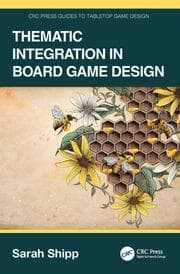
A board game’s theme is doing real work only when it changes the decisions players make. Sarah Shipp’s Thematic Integration in Board Game Design, listed by Routledge as a first edition in the CRC Press Guides to Tabletop Game Design, gives designers a blunt test: if you can reskin the game and keep every choice intact, the theme is not driving play. It is just on the box.
Theme is the reason the rules exist
The book’s own description starts from a simple idea: theme is often the "why" of a game. That matters because theme helps with rules comprehension by giving players a reason for each mechanism, instead of forcing them to memorize a list of abstract permissions and costs. In practice, theme also shapes pacing and memory, because players remember what they felt they were doing, not just what icon they clicked in their heads.
Routledge’s listing gives the book a precise home inside a series built for design literacy. The CRC Press Guides to Tabletop Game Design are described as "tightly focused looks at topics relating to game design," which is exactly the right frame for this discussion. The print and retailer listings surface the ISBNs 9781032584058, 9781032592442, and 9781003831730, a reminder that this is a formal design text, not a loose conversation about flavor text.
Use the mechanics as a lie detector
Shipp’s book examines thematic integration from three angles: technical structure, narrative building, and the design process. That trio is the most useful diagnostic tool in the whole discussion, because it forces you to ask whether the mechanics, the play arc, and the development path are all pointing at the same fiction.
- Technical structure: does a worker-placement slot, a card-drafting decision, or a resource conversion map cleanly onto the imagined activity, or is it just a generic optimization engine wearing a costume?
- Narrative building: do turns create a visible chain of cause and effect, with player identity and progression that make sense in the fiction, or are players simply cycling through efficient moves with no sense of place?
- Design process: are you testing the theme while the system is still flexible, or are you hoping art, naming, and a glossy rulebook can fix a disconnect after the fact?
That last point is where a lot of projects go sideways. If the theme only shows up once you start labeling cubes and writing flavor text, you are not integrating theme, you are decorating a completed mechanism. Shipp’s framing makes the safer move obvious: let the theme shape the design early enough that the rules can carry the fiction, not just describe it afterward.
Look for resonance, not just decoration
Shipp’s 2021 Board Game Design Summit talk, Creating Resonance with Thematic Tabletop Game Design, pushes the same idea in a more player-facing direction. She focuses on what makes tabletop games resonate with players and how themes can be tweaked to be more resonant. That word matters, because resonance is what you get when the table experience and the fiction line up so tightly that the player stops translating between them.
BoardGameGeek’s coverage gets at the most useful public test of this problem by contrasting a game that feels thematic with one that has a pasted-on theme. That is the practical difference designers should be hunting. In a thematic game, the action you take feels like the thing the setting says you are doing. In a pasted-on game, the same action would work unchanged if you stripped away the premise and renamed the components.
BoardGameGeek is not a tiny corner of the hobby either. It describes itself as "the world’s largest website for the board gaming hobby," and its official X account says it joined in December 2008. That reach matters because this is the exact kind of argument the hobby keeps returning to: why one trading game feels alive on the table while another feels like a spreadsheet with a coat of paint.
Run the swap test before the art pass
The fastest way to tell whether theme is driving player decisions is to run a deliberate swap test during development. Keep the same rules and ask what breaks when you change the setting, because the answer tells you whether the theme is structural or cosmetic.
1. Strip the fiction down to a neutral outline and see whether the core decisions still feel inevitable.
2. Rename the actions and components to something unrelated and check whether any choice changes meaning.
3. Put the original theme back in and ask whether the players now understand the tradeoffs faster, not just whether the game looks better.
If the answer stays the same through every version, the theme is not carrying decision-making. If the answer changes, especially at moments where players weigh risk, timing, or resource conversion, the theme is probably doing real design work. That is the point where the fiction is no longer interchangeable.
Why this framework has weight
Geoff Engelstein’s role as series editor helps explain why this topic is being treated as a design problem rather than a style preference. Routledge describes him as an award-winning tabletop game designer whose titles include Space Cadets, The Fog of War, Pit Crew, Versailles: 1919 and Super Skill Pinball. The same profile notes that he is an adjunct professor of game design at the NYU Game Center, has contributed to The Dice Tower since 2007, and has hosted Ludology since 2011.
That background matters because the series itself is framed around craft. Routledge says the history of games goes back at least 5,000 years and that game materials are routinely found in archaeological digs around the world. Put Shipp’s book inside that context and the argument becomes clear: thematic integration is not a garnish for modern hobby games. It is part of the same long design conversation that has always asked how rules, meaning, and player behavior fit together.
When a game’s theme is working, the player never has to wonder whether the fiction is getting in the way of the system. The fiction is the system’s explanation. If swapping the setting leaves the decision tree untouched, the theme is still paint. The moment a draft choice, a resource trade, or a worker placement stops making sense without the fiction, the game has crossed from decoration into design.
This article was produced by Prism’s automated news system from verified source data, official records, and press releases, then run through automated quality and moderation checks before publishing. The system is built and supervised by the people who set the standards it runs under. Read our full AI policy.
Did this article answer your question?