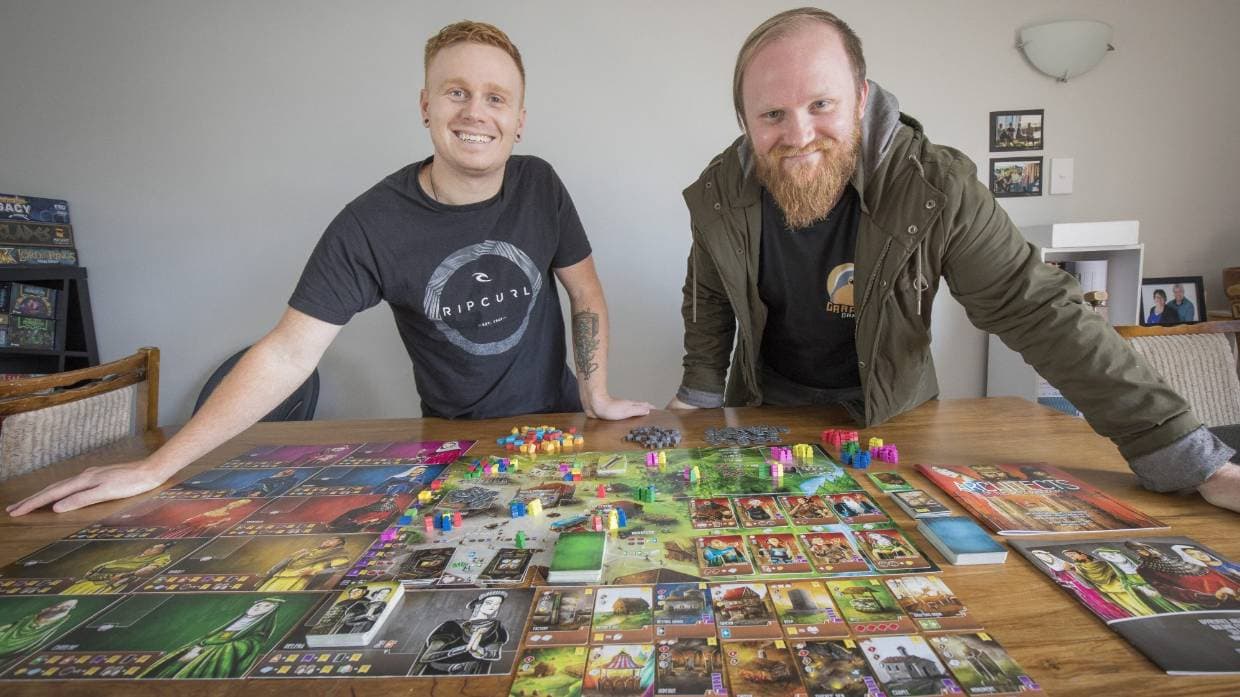
Shem Phillips and Sam Macdonald on refreshing worker placement design
Worker placement still surprises designers when scarcity, blocking, and hybrid turn structures do the real work, not just the meeple drop.
Worker placement keeps earning new tricks because the mechanism is never really about putting a wooden worker on a space. It is about how a board creates pressure, how turns get squeezed, and how much friction a design can add before the whole thing turns to mud. Board Game Design Lab’s mechanics overview puts worker placement in the same family as drafting, deck building, engine building, cooperative play, trick taking, and legacy design, which is exactly where it belongs: as one of the hobby’s core systems for moving a game from first move to final scoring.
What the best worker placement games are actually solving
The best worker placement designs do not ask, “Where can I place this meeple?” They ask, “How expensive should that decision feel, and what does it do to the rest of the round?” That is why action blocking, worker refresh speed, and the total number of meaningful spaces matter so much. If the board has too much room, the tension evaporates; if it is too tight, the game starts feeling punitive instead of strategic.
That is the useful lens in the June 17, 2020 Board Game Design Lab interview with Shem Phillips and Sam Macdonald. The episode description points straight at the real pressure points in the genre: creating unique mechanisms, board design, and player interaction. Those are the levers that decide whether a worker-placement game feels like a fresh spatial puzzle or just another exercise in taking the last open slot before someone else does.
Scarcity is the engine, not the decoration
Worker placement works because it turns limited action space into immediate competition. BoardGameGeek’s mechanic page traces the line back to Keydom, published in 1998 and sometimes treated as the first worker-placement game, then to early experiments like Bus in 1999 and Way Out West in 2000. By the time Caylus arrived in 2005, followed by Agricola in 2007 and Stone Age in 2008, the framework had already shown its range, but those games made the genre legible to the wider hobby.
Caylus and Agricola are still useful reference points because they show two different kinds of squeeze. Caylus builds tension through a system of workers, payments, and an official who can be bribed, so the economy of placement matters as much as the placement itself. Agricola makes the scarcity even more brutal, since each available action can only be taken by one player each round, which means every choice carries the threat of being cut off before your next turn comes around. That is the real lesson: worker placement is at its sharpest when the board makes your plan collide with everyone else’s plan.
The genre keeps mutating instead of standing still
The reason worker placement still feels fertile is that designers keep changing what a “worker” even is. BoardGameGeek has a separate mechanic entry for worker placement with dice workers, where the die face or pip value changes how the action behaves. Kingsburg and Alien Frontiers sit in that space, and the variation matters because it replaces a static body on a space with a worker that carries its own strength, timing, or efficiency.
That kind of variation is exactly why the genre does not feel solved. Once workers can be dice, the puzzle shifts from simple occupancy to resource management and timing. You are no longer only racing for the best spot; you are also deciding whether the value of the worker you commit is strong enough to justify taking that route at all. That adds another layer of tension without throwing away the clean logic that makes worker placement readable in the first place.
Iteration is where the real design work happens
Luke Laurie’s June 19, 2019 Board Game Design Lab interview is another good signal that the genre rewards repeated passes, not one clever gimmick. Laurie, the designer of Energy Empire, discussed worker placement while also having four more worker-placement games planned over the next two years. That matters because it frames the mechanism as a design language you keep learning to speak more fluently, not a one-time trick you use once and retire.
Stonemaier’s Expeditions design diary pushes that same point even further. Jamey Stegmaier says he explored worker placement on locations, mech mats, cards, and even workers as resources before settling on the final version of the design. That is the sort of experimentation that keeps the mechanic alive: the placement system can migrate from a single board to player mats, from a fixed worker pool to a resource economy, or from a rigid turn structure to something that bends around the rest of the game.
Scythe is a clean example of that hybrid mindset. Stonemaier describes it as an engine-building, asymmetric, competitive game set in an alternate-history 1920s period, and it shows how worker-placement logic can live inside a broader machine instead of carrying the whole game by itself. In that environment, placement is not just about claiming a space, it is about feeding an economy, shaping asymmetry, and deciding how much room to leave for everyone else.
Why the mechanism still has room to breathe
Stonemaier’s public profile also makes the broader point clear. The company lists Jamey Stegmaier’s designs as Viticulture, Euphoria, Scythe, Charterstone, Tapestry, Red Rising, Rolling Realms, Smitten, Expeditions, Vantage, and Duel of Meloch, and says its goal is to create games that include experienced gamers, new gamers, solo gamers, partners, larger groups, and people of all backgrounds. That is a reminder that worker-placement thinking is not confined to one niche audience or one era of euro design.
The mechanism keeps surviving because it still solves real design problems. It can make spatial competition legible, it can create nasty indirect interaction without combat, and it can turn a simple turn structure into a race for tempo. Shem Phillips and Sam Macdonald are interesting here not because they explain worker placement away, but because their interview gets at the exact point where the genre keeps surprising designers: the moment a board stops being a grid of slots and starts becoming a live argument over time, space, and opportunity.
This article was produced by Prism’s automated news system from verified source data, official records, and press releases, then run through automated quality and moderation checks before publishing. The system is built and supervised by the people who set the standards it runs under. Read our full AI policy.
Did this article answer your question?