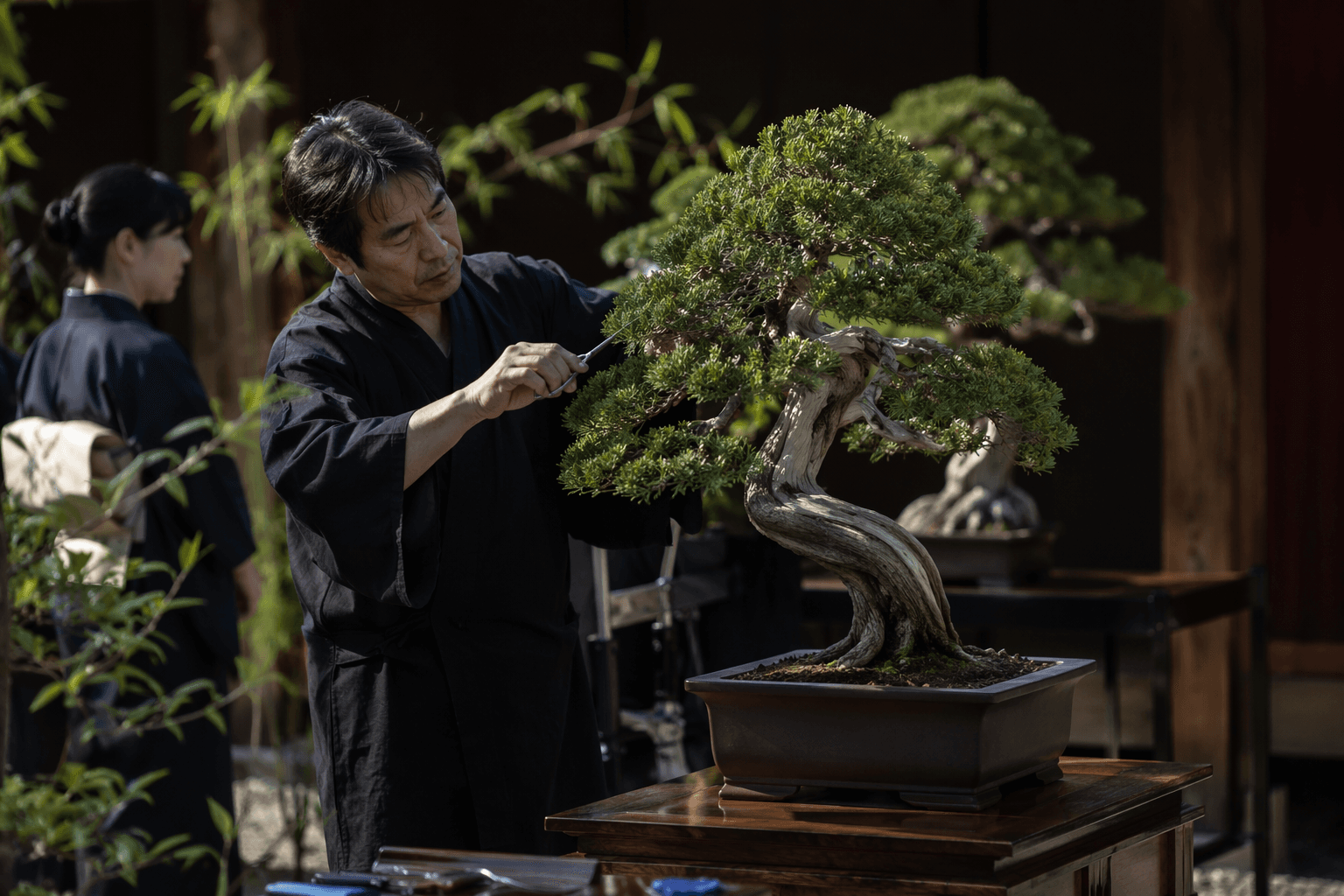
Masahiko Kimura transforms a special juniper in bonsai feature
Masahiko Kimura's special juniper feature turns a gated teaser into a lesson in elite design, from deadwood and live vein placement to bold structural risk.
A special juniper becomes more than a handsome tree when Masahiko Kimura is involved. The June 4 Bonsai Today feature signals exactly the kind of work advanced bonsai readers chase: not just a finished image, but the transformation logic that turns raw material into an exhibition-level composition.
Why this juniper matters
Kimura’s name carries weight because his work helped define a more sculptural, risk-aware language for modern juniper bonsai. That matters here because junipers are among the most expressive species in the art, but they also demand more technical judgment than many trees. When a feature frames a tree as “special,” it is usually pointing to material with the kind of trunk movement, live-vein potential, and aged character that can justify bold design decisions.
That is the real draw of a Kimura juniper story. You are not looking at a simple styling exercise. You are looking at the meeting point between raw material and expert choices, where deadwood, line, foliage placement, and timing all have to support one another if the tree is going to hold together as a convincing image.
What Kimura’s involvement signals
Kimura remains a reference point because his work has long been associated with dramatic juniper transformations and strong visual punctuation. His influence is especially visible in the way deadwood is used not as decoration, but as structure, rhythm, and memory. In elite juniper styling, shari and jins do more than add age effects: they create tension against the living line and give the design a backbone.
That is why his involvement changes how you read the piece. A juniper handled in this tradition asks for a clear relationship between the live vein and the dead features. If the live vein is weakly placed or the deadwood overwhelms the composition, the tree loses its internal logic. If the relationship is balanced, the result feels inevitable, even when the design is daring.
The design choices that matter most
For advanced readers, the most useful part of a Kimura juniper transformation is the decision-making behind the structure. Trunk movement is never just about creating curves; it is about setting a line that can carry the viewer through the composition without flattening the tree into a trick. The best juniper work uses movement to establish direction, then lets the deadwood and foliage reinforce that direction rather than compete with it.
You can study several linked choices in that process:
- Deadwood placement: Shari and jins need to support the story of age and survival, not simply decorate the tree. Their placement should clarify the trunk’s history and the current flow of energy.
- Live-vein placement: The live vein has to be legible. If it is hidden or scattered, the design can lose clarity; if it is too obvious, the tree can feel mechanical.
- Foliage placement: Pads are not filler. They frame movement, reveal trunk lines, and control how much of the structure the viewer reads at once.
- Wiring strategy: Wiring is where the long view shows up. The branch structure has to be set so the composition can age into itself rather than collapse into a temporary pose.
- Timing of heavy structural changes: Junipers can take major reshaping, but timing matters. The transformation has to respect the tree’s ability to recover and continue building refinement after the dramatic work is done.
This is where Kimura’s style stays relevant. The boldness is not random. It is disciplined risk-taking, built on a deep understanding of what the tree can survive and what the final image needs to communicate.
Why junipers are the proving ground
Junipers keep returning to the center of advanced bonsai education because they reward precision and punish vague thinking. A broadleaf tree can sometimes tolerate softer solutions, but junipers expose every weak decision in line, tension, and balance. If the deadwood is empty gesture, you see it. If the foliage is placed without regard to the trunk’s movement, you see that too.
That is why a special juniper feature carries so much teaching value. It concentrates several advanced problems into one tree. You can study how an experienced artist uses movement to establish character, how deadwood creates age without clutter, and how foliage is kept subordinate to the larger structure while still giving the tree life and volume.
What the gated format says about the audience
The membership-gated format tells you a lot about the intended readership. This is not casual bonsai browsing. It is content aimed at people who already understand the vocabulary and want to see how the vocabulary gets used at the highest level.
That kind of specialist circulation matters because it keeps the standards of the field moving. Bonsai discourse stays alive when readers are given not only inspiration, but also the logic behind the transformation. A tree like this becomes a compact lesson in what elite bonsai values: clarity, control, patience, and the willingness to make hard choices when the material warrants them.
Kimura’s continued presence in this conversation is the point. A “special juniper” is special because it can carry those decisions without losing coherence. The tree becomes memorable when deadwood, line, foliage placement, and risk all point in the same direction, and that is exactly the kind of work that still defines the highest level of juniper styling.
This article was produced by Prism’s automated news system from verified source data, official records, and press releases, then run through automated quality and moderation checks before publishing. The system is built and supervised by the people who set the standards it runs under. Read our full AI policy.
Know something we missed? Have a correction or additional information?
Submit a Tip