Otago Bonsai Society Brings Decades-Old Specimens to Dunedin Annual Show
A 46-year-old juniper cascade and a president with 60 years in the craft showed Dunedin what bonsai patience actually looks like.
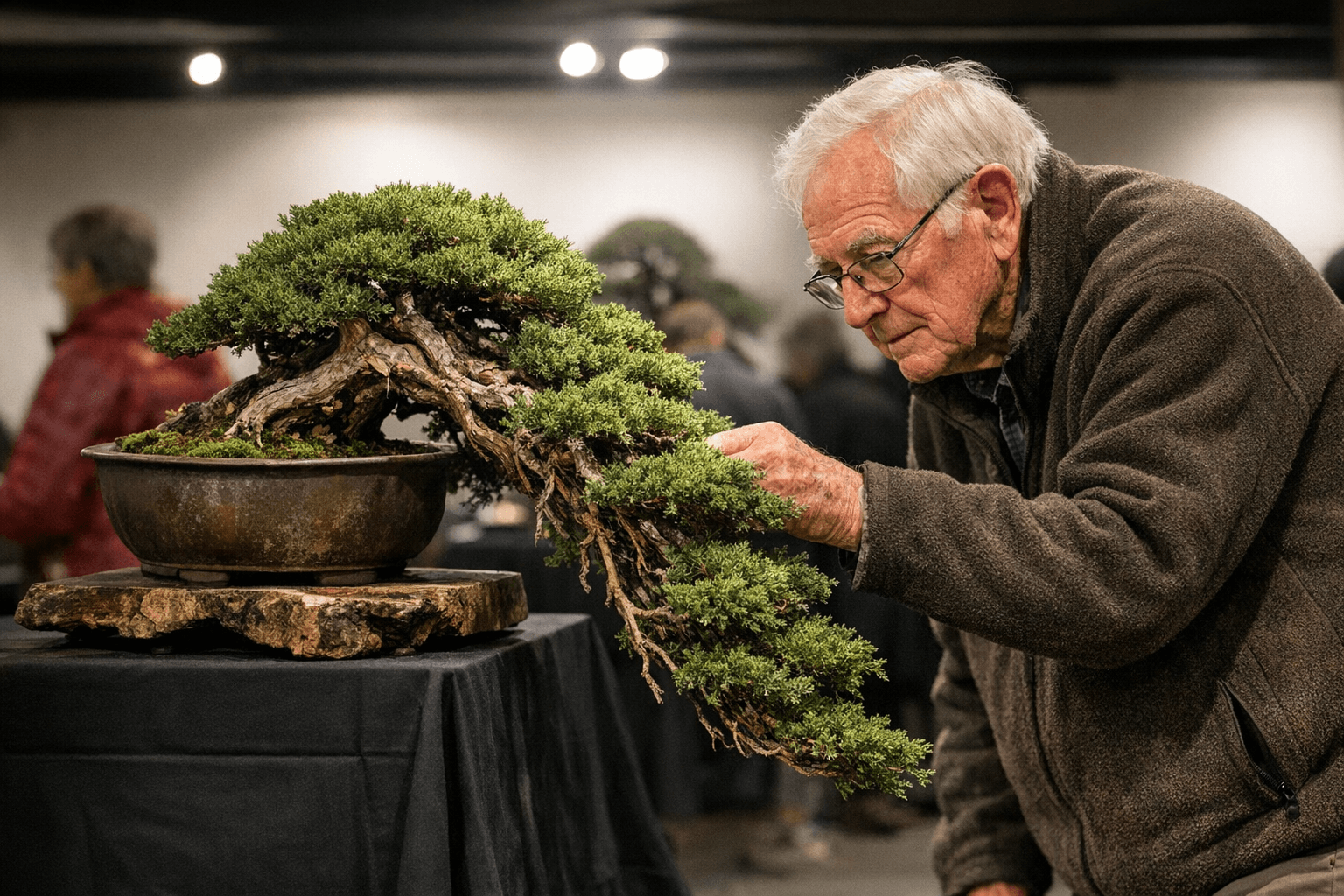
A 46-year-old juniper cascade was among the most arresting specimens on display at the Otago Bonsai Society's annual exhibition, held at the Dunedin Community Gallery on Princes Street. The tree belongs to exhibitor Ludwig Jansen, and its arc-shaped trunk, trained across nearly five decades, encapsulates what the club's roughly 50 members gathered to demonstrate: that bonsai is never finished, only handed forward.
Jansen described the pull of the practice in deliberately dual terms. "Personally, for me, it's that artistic side of changing a tree and the horticulture of it, where you need to really know how trees grow and how to get them to do what you want them to do," he said. A cascade style makes particular demands on both grower and display: the container must allow the primary line to fall cleanly below the pot rim without interrupting the downward flow, and the depth of that pot shapes how viewers read the tree's movement before they've registered anything else. What Jansen's juniper shows in fine ramification, the delicate, multiply-divided branching at the canopy's outer edges, is the accumulated result of seasonal pruning, wiring, and careful reading of the tree's response across half a century of growing seasons.
Society president Joy Morton brought equivalent weight to the exhibition floor. A practitioner for close to 60 years, Morton is among the longest-serving members in the club, and her trees carry a full career's worth of repotting decisions, styling choices, and aftercare discipline. "I don't sell my trees lightly. I've been doing this for a long, long time. Nearly 60 years," she said. The remark points to something any experienced grower recognizes: a bonsai is not a product but a relationship, and parting with a specimen means parting with its entire training history.
The exhibition ran across April 3 and 4 and displayed dozens of specimens spanning a wide developmental range, from younger club-trained material to the kind of mature work that Morton and Jansen represent. Club committee member Brian Ellis used his time with visitors to dismantle the misconceptions that consistently follow bonsai into public spaces. "There is a myth that you keep it small by trimming the roots. That's not true," he said. The second correction was blunter still: "The other myth is you put them on the dining room table. You put them on the dining room table — in two months, it will be dead." In Otago, where light levels and temperature gradients differ sharply from New Zealand's warmer northern regions, placement is not an aesthetic decision; it determines whether a tree clears its first winter.
Alongside the display benches, the club ran small pot and plant sales and a raffle, with members fielding questions throughout. For a society of 50 operating in a mid-sized southern city, the annual show serves as a public accounting of what long-term bonsai practice produces and a low-friction point of entry for growers at the start of their own timelines.
What the Dunedin show made visible is the full scope of commitment the art requires. Jansen's juniper began its training when much of this year's visiting public had not yet been born. Morton's trees hold 60 years of decisions inside their nebari and branch structure. That depth cannot be conveyed in a care guide or a YouTube tutorial; it has to be seen on the bench, in person, in a community gallery on Princes Street.
This article was produced by Prism’s automated news system from verified source data, official records, and press releases, then run through automated quality and moderation checks before publishing. The system is built and supervised by the people who set the standards it runs under. Read our full AI policy.
Did this article answer your question?