Integrel Sea Trial Data Shows E-Drive Efficiency Gains on Balance Catamarans
Integrel's sea-trial data shows E-Drive charging a 48 kWh bank in under an hour and outperforming a conventional genset by 68% on fuel efficiency.
Generating at approximately 26 kW while underway, Integrel Solutions' E-Drive system pushed a 48 kWh lithium bank from 20 percent charge to 80 percent in roughly one hour during sea trials on Balance catamarans. That measurement, the centrepiece of the E-Drive Performance Series Part 3 published March 31, anchors a dataset that replaces speculative hybrid claims with concrete numbers owners can actually use.
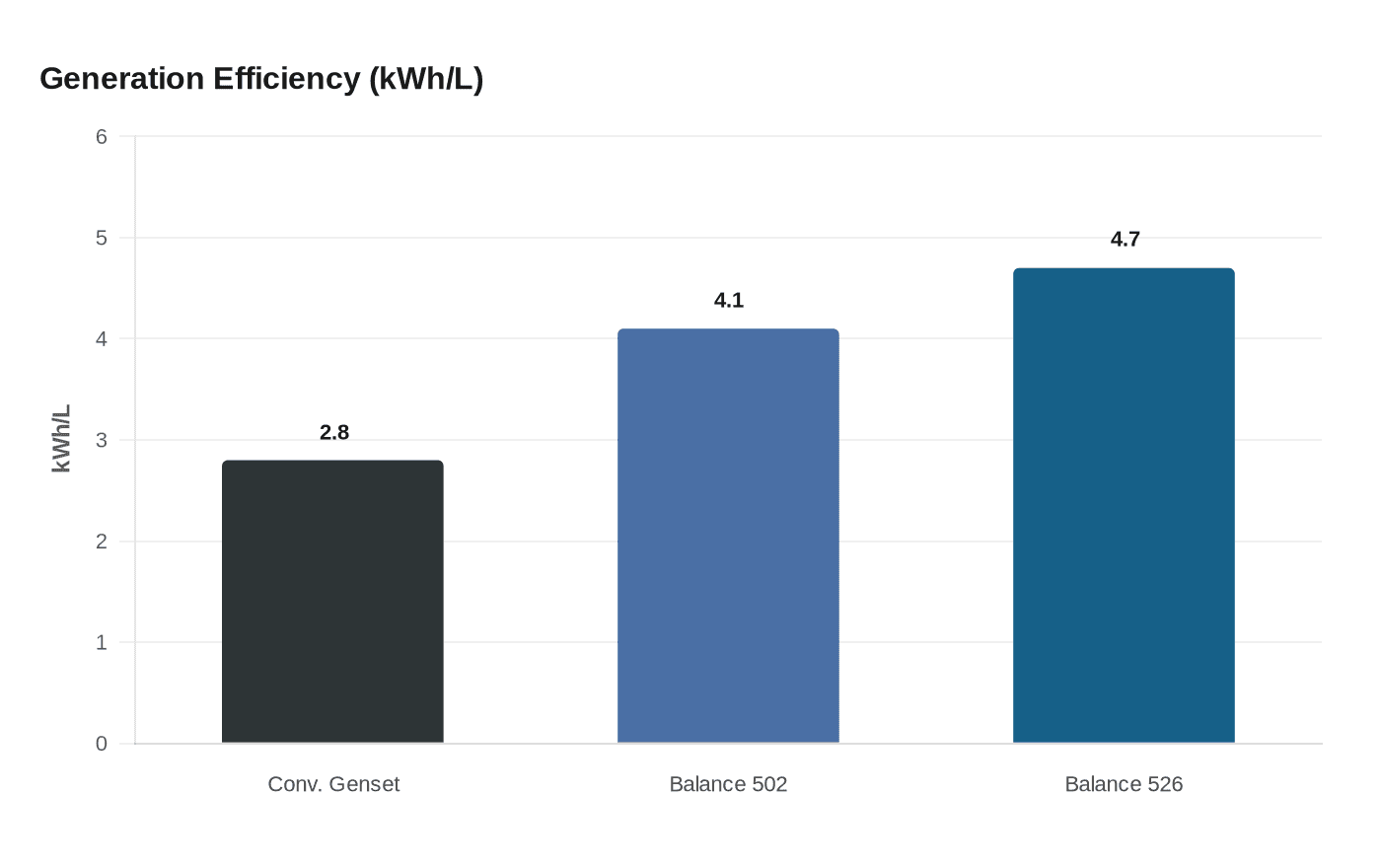
The generation efficiency figures are equally striking. Integrel recorded 4.1 kWh per litre on the Balance 502 and 4.7 kWh per litre on the Balance 526, against a benchmark of 2.8 kWh per litre for a conventional marine genset. That gap represents a 46 percent efficiency advantage on the 502 and a 68 percent improvement on the 526: every litre of diesel burned in an E-Drive installation delivers substantially more stored energy than the same litre run through a traditional genset.
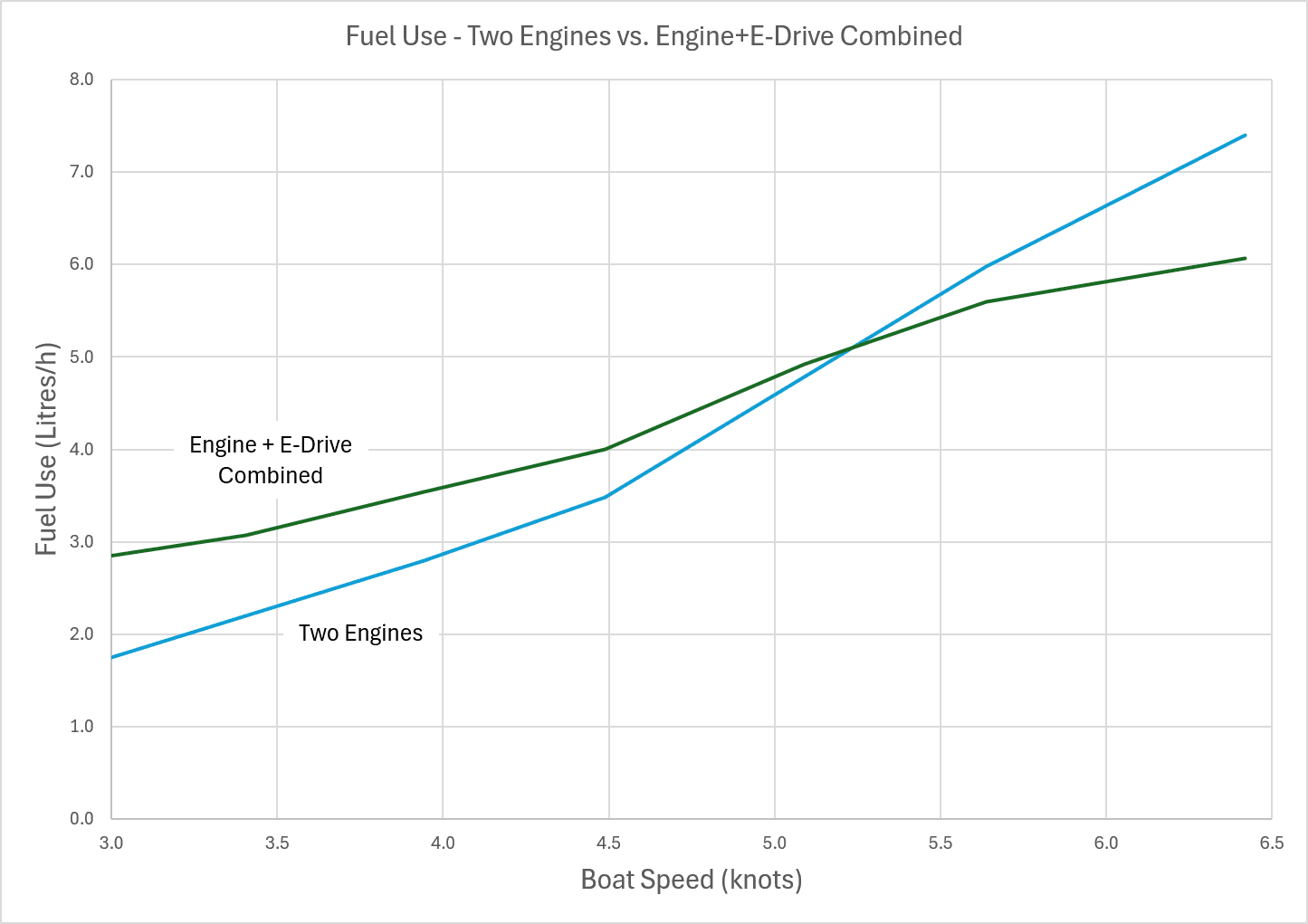
On the electric-only side, Balance 502 and 482 hulls fitted with twin 30 kW E-Drives and a 36 kWh battery bank returned 27 to 28 nautical miles of range at a 3-knot loiter. That window covers a harbour transit, an anchorage approach, or a silent marina departure. Range drops steeply above that speed, which is exactly where the hybrid motoring mode earns its place: one hull driven by diesel, the opposite hull propelled electrically. Trial data from the Balance 482 "Breakaway", whose owner Chris Rouzie completed a 10,000-kilometre Atlantic crossing with the system, showed the one-diesel-plus-one-E-Drive combination consistently adding roughly one knot of boat speed over a single diesel while cutting total fuel burn by around 30 percent. For an owner trying to make a weather window across a stretch of light air, or hold 7 knots through a calm rather than dropping to 5, that combination translates directly into passage-planning confidence.
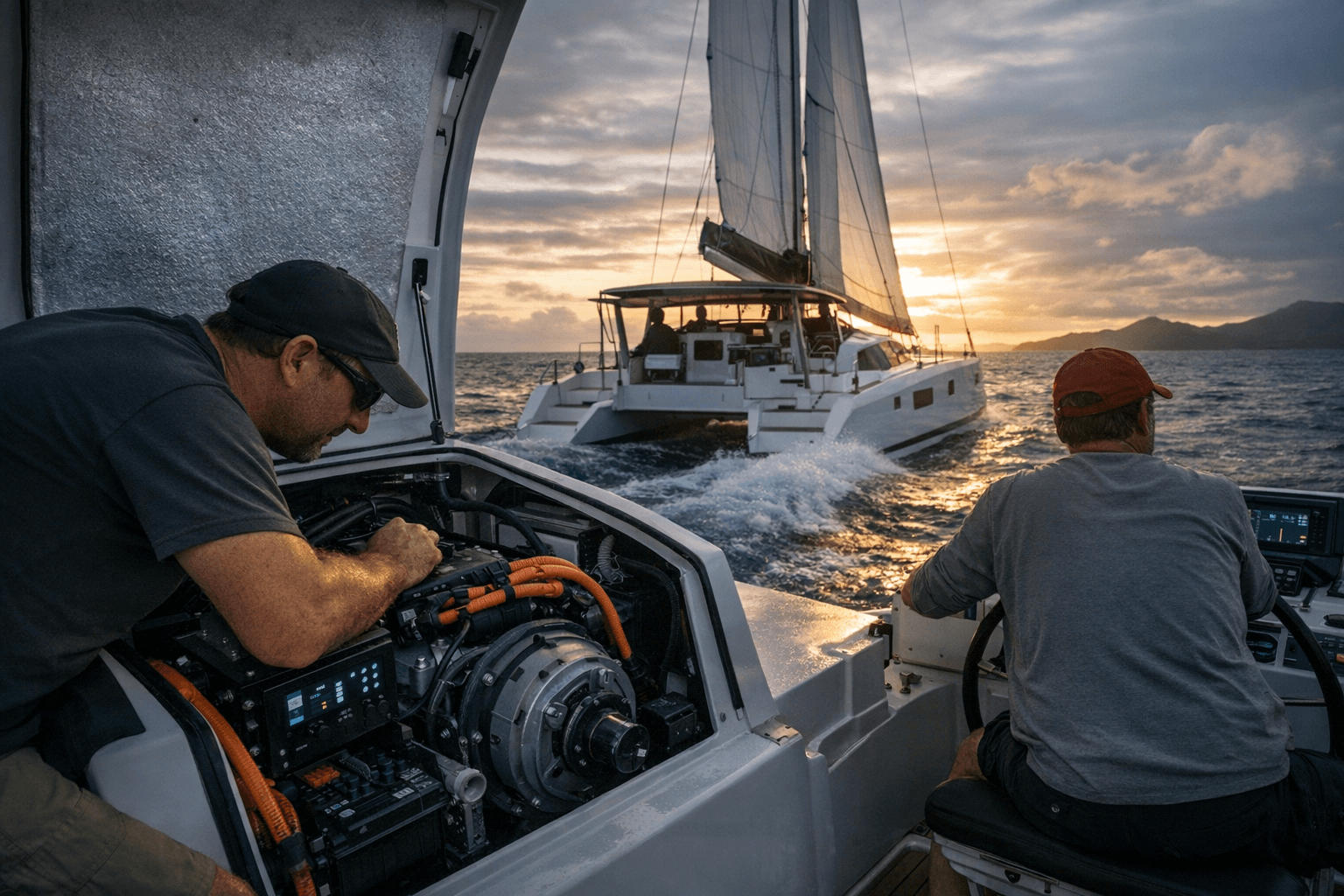
Noise is a dimension that efficiency plots cannot capture. One delivery skipper who tested a Balance 580 described it as "the quietest boat I've ever sailed", a verdict that points to what rapid recharging means at anchor: air conditioning, watermakers, and instruments can run overnight off a bank that takes less than an hour to replenish while underway.
The E-Drive architecture also introduces a redundancy layer that conventional twin-diesel cats cannot match. With one engine out on passage, the motor on the working hull shifts to propulsion mode, keeping the vessel moving while the crew troubleshoots.
Integrel and Balance both note that all figures are configuration-dependent: battery size, hull form, engine output, sea state, and hotel load shift the outcomes. That caveat makes the sea trial itself the most useful tool in any buyer's process. When evaluating a VersaDrive-equipped build, confirm the generation rate in kWh per litre at your typical cruising RPM, watch the battery display cycle up from a depleted state at normal cruise speed, run electric-only mode at 3 knots and track actual range per battery percentage point, then engage hybrid motoring and compare GPS speed and fuel flow against a diesel-only baseline. Those four checks determine whether the results Integrel achieved on the Balance 502 and 482 will hold on the specific boat under consideration.
With several more 464s and 502s moving through the production pipeline, the real-world dataset behind these numbers will keep growing with every passage logged.
This article was produced by Prism’s automated news system from verified source data, official records, and press releases, then run through automated quality and moderation checks before publishing. The system is built and supervised by the people who set the standards it runs under. Read our full AI policy.
Did this article answer your question?