Essential Pre-Departure Safety Checklist for Catamaran Owners and Operators
Dead batteries, mechanical failure, and fuel contamination cause 90% of all on-water towing calls — here's the catamaran-specific pre-departure checklist that keeps you off the rescue list.
The BoatUS Towing Dispatch center fields over 70,000 calls for on-water assistance every year. Almost 90 percent of those fall into five categories: mechanical breakdown, running aground, dead battery, out of fuel, and engine overheating. Every single one is largely preventable. On a catamaran, the stakes are amplified: you have two engine compartments to check, two bilges to monitor, two electrical systems that can fail independently, and a bridgedeck geometry that hides slow water ingress until it becomes a trim crisis. The checklist below is not generic boating advice — it's built around the specific failure modes that send cat owners calling for a tow.
Why Catamarans Demand a Different Routine
A catamaran is not a monohull with extra beam. The twin-hull layout creates redundancies that can quietly mask developing problems. Slow ingress in one hull can go unnoticed until it becomes a serious trim problem. The engines sit in relatively small, often poorly ventilated compartments in the aft sections of each hull, which means heat buildup and fuel vapor need to be managed carefully before every departure. Add hybrid or electric drive architectures, which are increasingly common on modern cruising cats, and you have layer upon layer of cross-system dependency that a standard checklist simply doesn't address.
"The biggest reason why we tow people is because of mechanical failure," says Sea Tow's Capt. Mike DeGenaro of Charlotte Harbor. "It all comes down to proper maintenance." For catamaran owners running twin diesels or a hybrid drivetrain, that maintenance window starts at the dock, every time.
Documentation and Communications
Before anyone steps aboard for a passage, confirm that vessel documentation and registration papers are aboard and valid. Program your MMSI number and VHF DSC settings correctly — a DSC distress call with a registered MMSI transmits your vessel identity and GPS position to the Coast Guard automatically, which is a meaningful difference in a fast-moving emergency. Test VHF transmit and receive, not just the squelch. Keep at least one charged cellphone in a waterproof case and a fully charged handheld VHF accessible in the cockpit, not buried in a nav station drawer.
Crew Briefing and Safety Equipment
Brief the crew on lifejacket locations before leaving the slip, not after clearing the breakwater. Ensure USCG-approved wearable PFDs are aboard for every passenger, sized correctly and in serviceable condition. Confirm that a throwable flotation device is within reach of the helm, and that visual distress signals — flares or USCG-approved LED alternatives — are in date and stored dry. Check every fire extinguisher for a full charge, secure mounting, and a valid service date. On a cat, fire in one hull engine compartment can spread faster than most owners expect given the enclosed aft hull geometry.
Propulsion, Steering, and Engine Checks
54 percent of all on-water assistance calls are attributed to mechanical breakdown, the single largest cause of recreational boat breakdowns, covering not just engine failures but steering systems, transmissions, and drives. This is where a catamaran's twin-engine arrangement requires deliberate attention. Start and warm up both engines independently. Verify oil pressure, alternator charging voltage, coolant temperatures, and alarm systems on each. If you have a hybrid or e-drive system, run through the manufacturer-specified power transfer modes and confirm the emergency shutoffs are accessible and functional.
Check the steering system for smoothness and free play on full lock-to-lock sweeps. Engage the autopilot and let it drive through a small correction to confirm it's not working against an over-tightened rudder or a binding cable. Test thrusters at low power in the slip before departure — a thruster that works at the dock is far better than discovering a fault while docking into a cross-wind berth at the other end.
Electrical Systems and Battery Banks
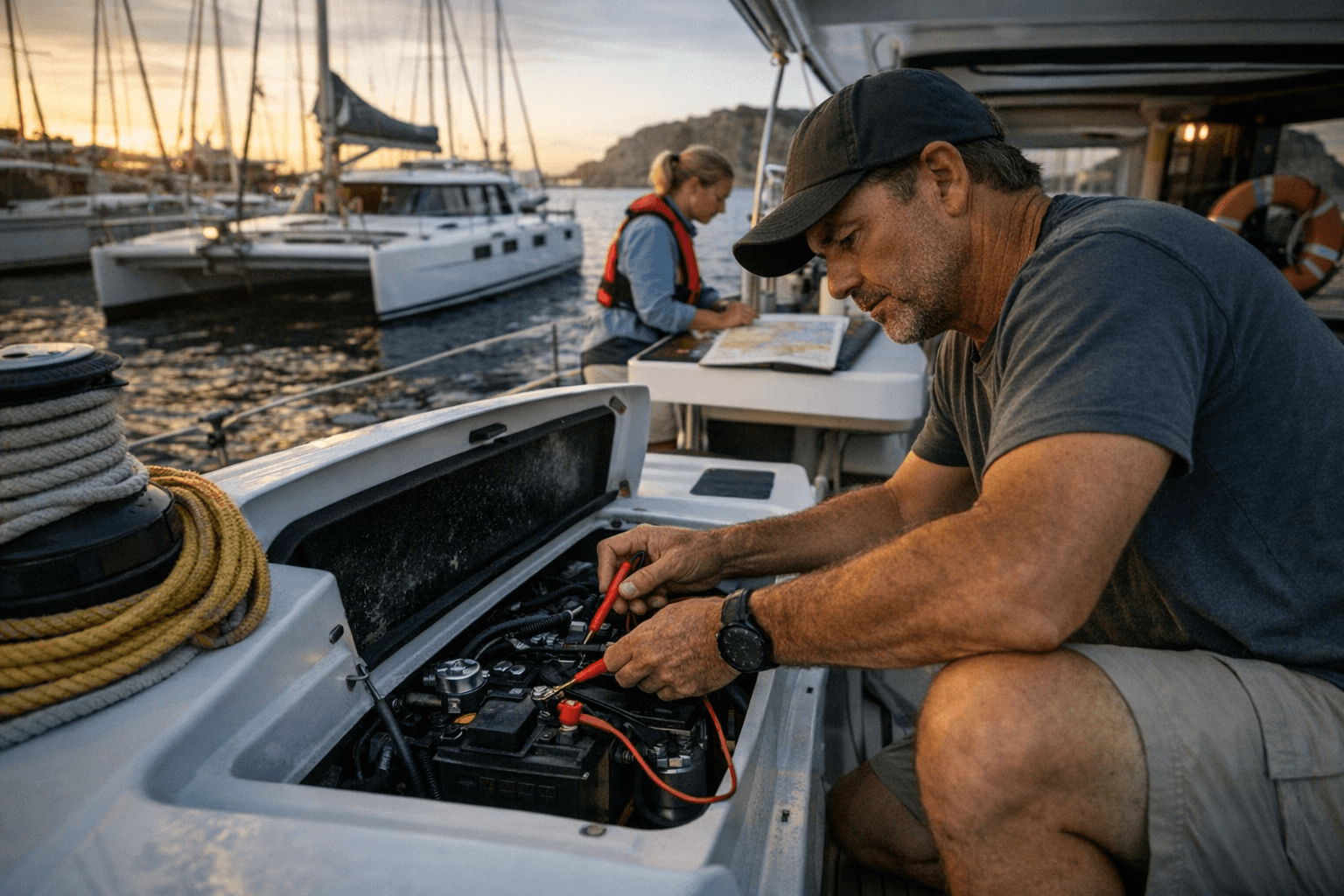
"Battery issues are our second largest call in the springtime, even on the newer boats," said Sea Tow's Capt. Chris. "I suggest plugging in a marine trickle charger during winter months and installing a new battery every three to five years." On a catamaran with separate house and propulsion banks — and potentially a third lithium bank for an electric drive — this problem multiplies. Check resting voltage and state of charge across all banks before departure. Verify charger and inverter operation, and confirm that shore-power interlocks have disengaged cleanly. Test navigation lights and both automatic and manual bilge pumps. A bilge pump that doesn't activate is invisible until it's critical.
Bilge Management: The Catamaran-Specific Risk
Walk both hulls and measure bilge water levels — not just a glance, but an actual measurement if you keep a log. Bridgedeck drain lines and cockpit scuppers can back-flow in certain sea states and quietly introduce water into the hull spaces. Verify that bilge pump alarm thresholds are set for seagoing conditions, not marina-flat conditions that trigger false alarms. Test smoke and CO detectors in all accommodation spaces; with twin engine rooms beneath berth spaces in many production cats, CO accumulation during a warm-up in a closed marina is a real hazard.
Sail, Rig, and Deck Gear
For sailing cats, a visual rig inspection is not optional. Walk the deck and check standing rigging for chafe, loose clevis pins, and cracked toggles — items that are easy to catch at the dock and catastrophic at sea. Check halyards and sheets at the clutches and turning blocks for wear, and run the furlers through a partial unfurl to confirm they're not binding. Confirm anchor windlass operation and inspect chain and rode condition. A snubber that's chafed through on a coral bottom anchorage is one of the most avoidable failures in cruising.
Navigation and Passage Planning
Update electronic chartplotter charts before every offshore passage; a waypoint that routes you through a recently charted shoal is not a theoretical risk in developing cruising areas. Keep paper backup charts and a working compass available as genuine navigation tools, not decorations. Brief the full passage plan with the crew, including alternate harbors and their entrance channels. File a float plan with a responsible person ashore: who you are, where you're going, what vessel you're on, and when to call for help if you haven't checked in.
2-Minute Dockside Triage: When Not to Go
Before casting off, run this fast mental checklist. If any answer is "no" or "unsure," hold the departure:
- Are both engine bilge compartments dry and fuel-vapor-free?
- Are both battery banks showing correct resting voltage?
- Is there enough fuel for the planned distance plus a 25 percent reserve?
- Are the weather forecast and sea state within the crew's demonstrated capability for this vessel?
- Does every person aboard know where the PFDs are and how to make a DSC distress call?
- Has a float plan been filed with someone ashore who will act on it?
One "no" doesn't mean turn around forever. It means don't leave until you can answer yes. A delayed departure is not a failed trip.
Post-Departure Checks and Ongoing Readiness
Re-check both bilges and confirm battery charging is active after the first hour underway. Monitor fuel consumption and engine temperatures against expected numbers — a subtle uptick in coolant temperature on one engine is easier to manage when you catch it at hour one than at hour six in deteriorating conditions. On short trips, run a man-overboard drill with the crew while you still have sea room. The catamaran's initial stability can create a false sense of security on deck; the low bridgedeck-to-water height that makes boarding easy in a marina also means water can board just as easily when conditions build.
The five failure modes that account for 90 percent of all towing calls are each addressable at the dock. On a catamaran, you just have twice the systems to check — which means twice the opportunity to find the problem before it finds you.
This article was produced by Prism’s automated news system from verified source data, official records, and press releases, then run through automated quality and moderation checks before publishing. The system is built and supervised by the people who set the standards it runs under. Read our full AI policy.
Did this article answer your question?