Coffee Chains Race Into China’s Smaller Cities With New Store Formats
China’s next coffee boom is moving beyond Beijing and Shanghai, where county-level demand is surging and chains are testing store formats built for speed, convenience, and lower prices.
China’s coffee map is tilting toward smaller cities
Coffee chains are pushing hard into China’s county seats, third-tier cities, and smaller towns because that is where the growth still looks real. In 2024, coffee delivery orders in county-level markets jumped 97% year on year, while the number of coffee shops in those areas rose 159%, a sign that the category is no longer just a big-city habit. With third-tier cities and smaller towns now accounting for close to 45% of China’s 216,044 coffee shops, the industry is chasing consumers who are only beginning to build daily coffee routines.
That shift matters because the big cities are crowded and brutally competitive. Starbucks and Luckin Coffee have both regained momentum by leaning harder into lower-tier markets, while newer players such as Lucky Cup are using low prices and rapid store expansion to lock in first-time drinkers. The result is a market where store formats are changing as fast as the geography.
Why the smaller-city play is working
The clearest reason is habit formation. Analysts cited in coverage say many county and township residents are still in the early stages of developing what one industry observer called “coffee consciousness,” and many still assume a cup costs around 30 yuan. That leaves room for chains that can sell coffee as an everyday purchase rather than a premium treat.
The online response points the same way. The hashtag #GoodCoffeeInSmallTowns has drawn more than 9 million views on rednote, showing that the story is not just about unit economics and store counts. It is also about a cultural shift: coffee is becoming visible in places that used to belong more to tea, milk drinks, and convenience-store beverages.
Starbucks is using scale, convenience, and new formats
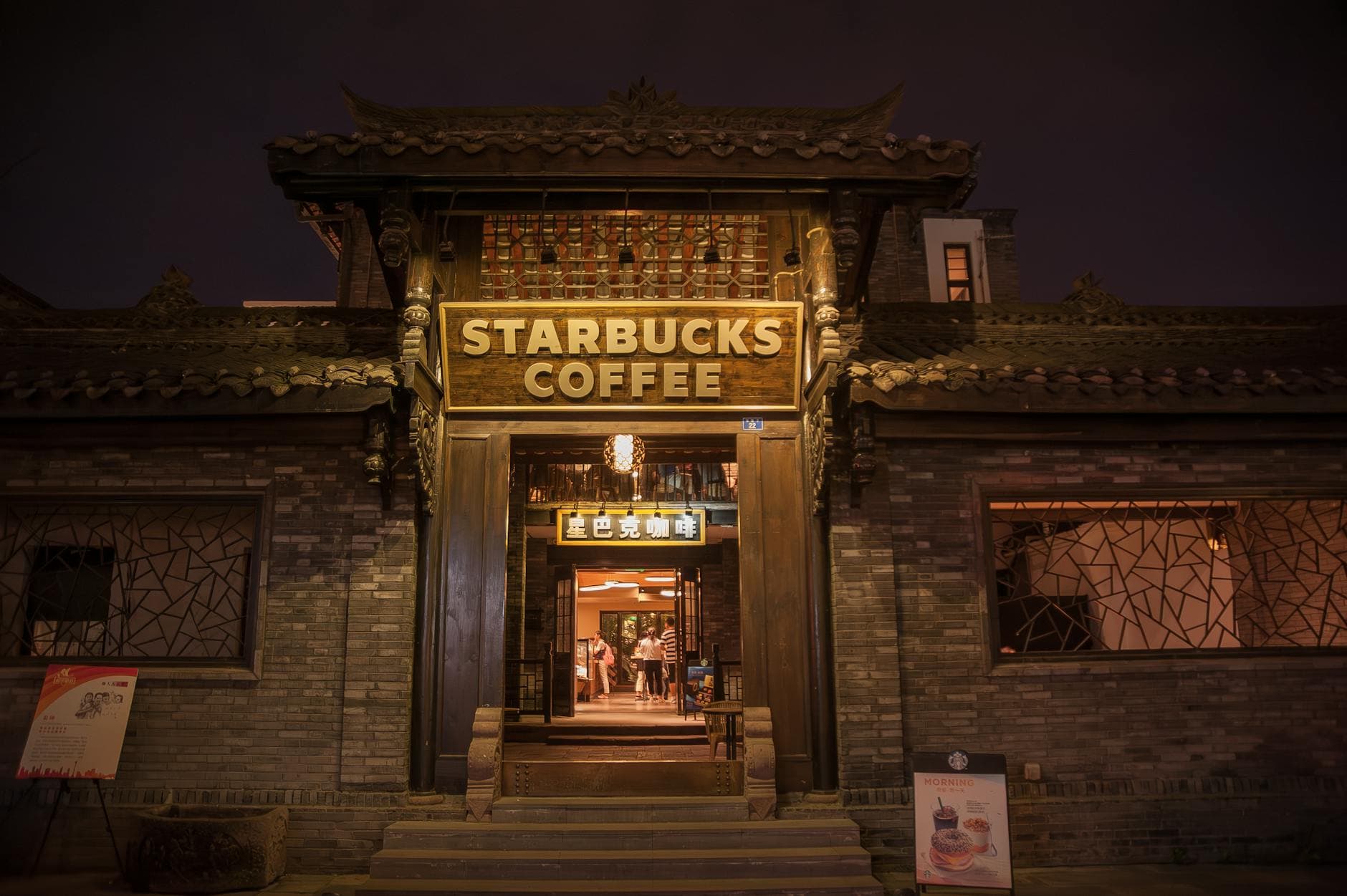
Starbucks remains the clearest example of how a global chain is adapting. The company said it added 665 stores in China over the past year, bringing its total to 7,758, and it now operates about 8,000 stores across more than 1,100 counties on the Chinese mainland. It has also said it has entered more than 1,000 county-level markets, a footprint that shows just how far the brand has moved beyond its original urban strongholds. Starbucks first entered mainland China in January 1999 with its first store in Beijing’s China World Trade Building.
The company is not only opening more stores; it is also experimenting with how those stores work. In March 2023, Starbucks China and Amap launched a curbside pickup service called in Beijing and Shanghai. The service was initially live at about 150 stores, with plans to expand to more than 1,000 stores within a year. That kind of format tells you exactly where the brand sees demand: customers who want Starbucks convenience without necessarily sitting inside a café for long.
There is also a sharp pricing read-through here. An analyst quoted in reporting said Starbucks trading a lower ticket size for better transaction volume was a positive sign for defending market share. In other words, the chain is willing to accept smaller individual sales if the result is more frequent visits and broader reach.
Luckin is betting on density and lower-tier penetration
Luckin Coffee is taking a different but equally aggressive route. On its February 20, 2025 earnings call, the company said its 2024 total net revenues rose 38% year on year to RMB 34.5 billion, while operating profit climbed 17% to RMB 3.5 billion. Management said in February 2025 that Luckin was pursuing higher store density in higher-tier cities while also deepening penetration in lower-tier markets.
That dual strategy fits the current market perfectly. In top-tier cities, more stores can still capture traffic through convenience and proximity. In smaller cities, the goal is often to become the default coffee name before habits fully harden. Luckin’s numbers show it has the cash flow to keep pushing that model, and its expansion strategy suggests it sees the same opening as Starbucks, just through a different operational lens.
Lucky Cup shows how low-price coffee is reshaping county markets
If Starbucks represents reach and Luckin represents density, Lucky Cup shows how low prices can build rapid scale outside the biggest urban centers. Xinhua reported that the chain, founded by Mixue Bingcheng in 2017, has expanded to more than 5,000 outlets nationwide, with 61.5% located in third-tier or smaller cities. That geographic mix is the clearest proof yet that the next phase of coffee growth is not confined to the coastal megacities.
The pricing can be startling. In Huojia County, Henan province, one Lucky Cup café reportedly averaged 6 yuan per order and generated nearly 800,000 yuan in turnover in less than 10 months. That kind of price point changes the social meaning of coffee. It stops being a luxury beverage and becomes a routine grab-and-go purchase, especially for young consumers and office workers in places where premium café culture is still emerging.
A Shanghai Food Association coffee committee official described third- and fourth-tier cities as the industry’s next “blue ocean,” which captures the stakes neatly. The opportunity is not just in selling more cups. It is in defining what coffee means in cities that are still deciding whether it belongs in daily life.
What the new store formats reveal about the next coffee communities
The format experiments matter as much as the store counts. Curbside pickup, faster service models, and low-priced neighborhood stores all point to the same conclusion: China’s coffee culture is spreading through convenience, not just ambience. In Beijing and Shanghai, coffee was once tied closely to central business districts, premium malls, and specialty cafés. In smaller cities, it is increasingly about errands, commuting, and repeat purchases.
That is why the next big coffee communities may form outside Beijing and Shanghai. The evidence is already there in the numbers: 97% growth in county-level delivery orders, 159% growth in coffee shops in those areas, 45% of shops now in third-tier cities and smaller towns, and more than 9 million views for a hashtag celebrating coffee in small towns. The chains racing into those markets are not simply expanding their footprints. They are following the earliest signs of a broader reset in Chinese coffee culture, where the next meaningful battleground is no longer the center of the map but the places beyond it.
This article was produced by Prism’s automated news system from verified source data, official records, and press releases, then run through automated quality and moderation checks before publishing. The system is built and supervised by the people who set the standards it runs under. Read our full AI policy.
Did this article answer your question?