Hawaii Kona Low Storms Batter Coffee Farms, Causing Millions in Damage
Greenwell Farms, one of America's oldest coffee operations, faces $10 million in losses after Kona low storms carved trenches through its South Kona fields and destroyed 24,000 nursery plants.
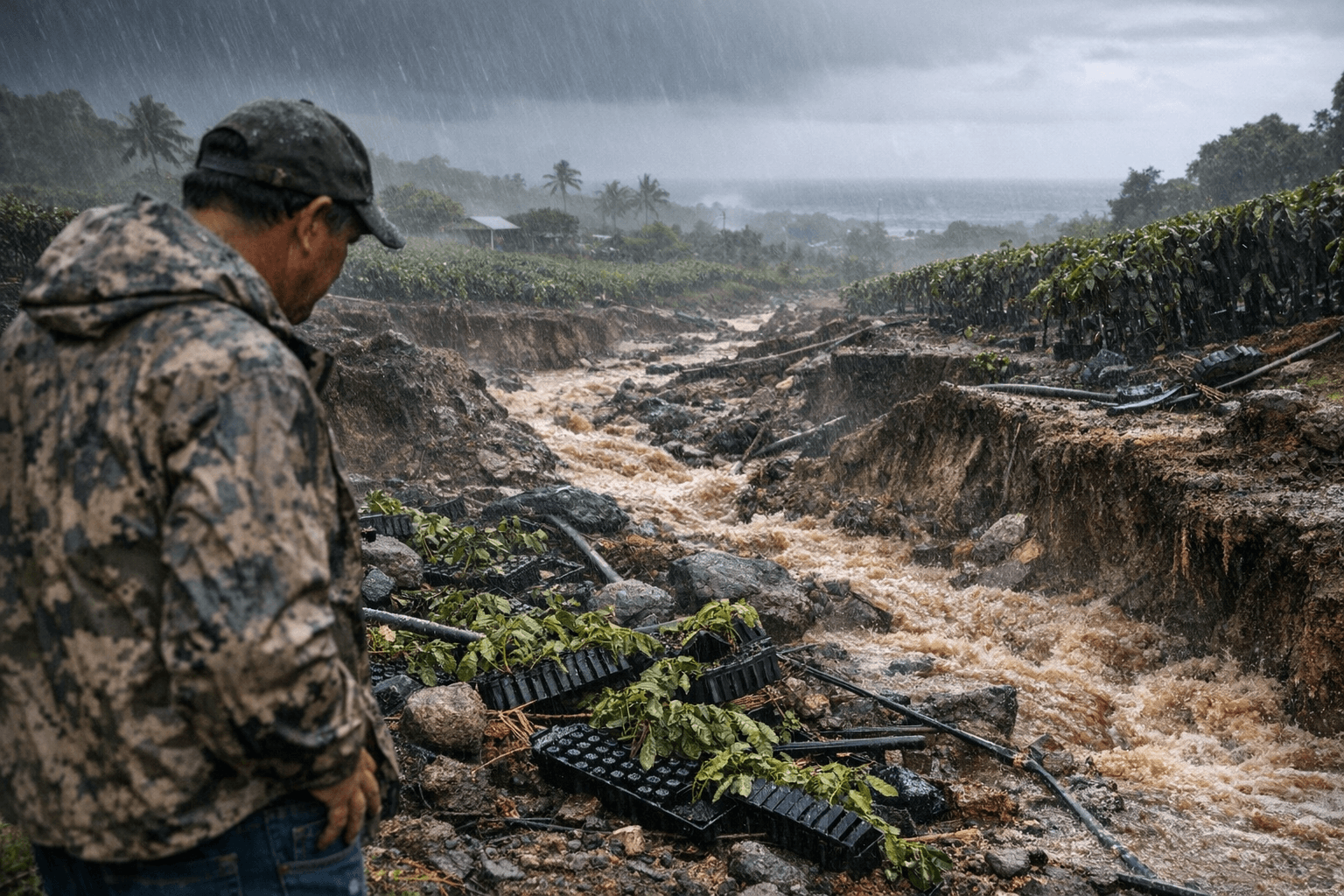
Greenwell Farms on the Big Island, a 176-year-old Kona coffee operation, suffered an estimated $10 to $11 million in damage after a series of Kona low storms hammered Hawai'i in mid-March, laying bare an industry with almost no safety net and exposing how quickly one historic weather event can erase generations of work.
Two back-to-back Kona low storms resulted in agricultural losses worth approximately $11 million to $15 million, including millions in losses to the coffee sector. The two storms hit the state beginning March 10 and again March 19; Kona lows are weather systems that can bring unusually heavy rain, flooding and strong winds to Hawaii. By the time assessments caught up with the damage, the storms had caused more than an estimated $15.3 million in damage at 265 farms, according to self-reported data tracked by Agriculture Stewardship Hawaii.
The most dramatic coffee-specific loss documented so far is Greenwell Farms in South Kona, one of the oldest continuously operating coffee operations in the United States. The March 14 storm was the worst in the farm's history, according to owner Tom Greenwell. Floodwaters destroyed decades-old trees and about 24,000 nursery plants, some of which were destined for other growers. The storm carved three trenches through one of the farm's three South Kona locations, wiping out trees that had stood for decades. "I think we're going to lose half our crop," Greenwell said.
The damage did not stop at the field's edge. Greenwell's home, located on the farm property that took the most flooding damage, was severely impacted by the storm: water flowed under and into the house, silt is caked inside, making it currently unlivable. "We're just taking everything off the floor right now," Greenwell said, estimating personal damages of about $1 million. The Hawai'i County Civil Defense Agency visited the property on March 19 to inspect damage to both the farm and the retail location off Māmalahoa Highway in Kealakekua, where Greenwell Farms normally offers tours and coffee samples. The Greenwell Farms website states the farm is "closed until further notice."
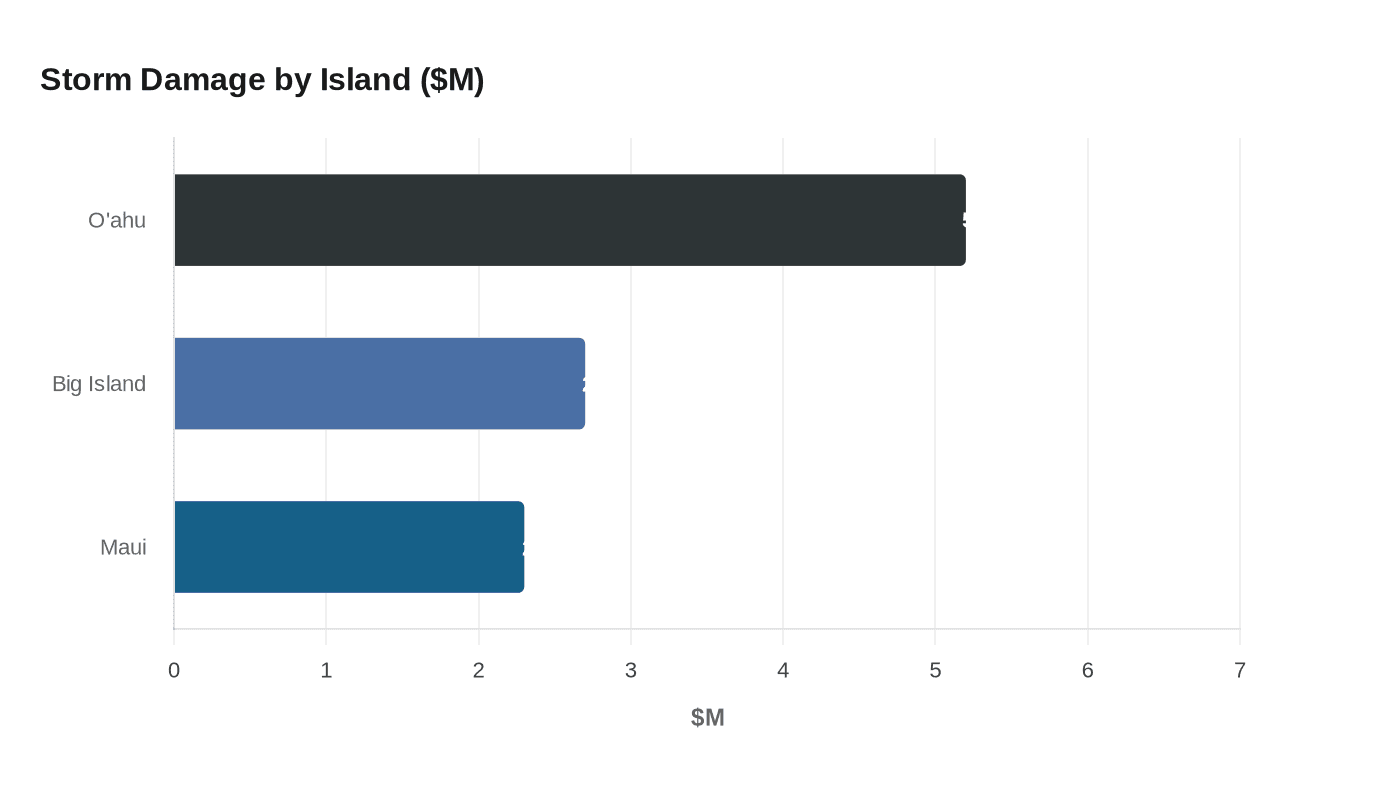
The statewide breakdown shows how broadly the damage spread. The storms wreaked havoc on more than 1,000 acres of Hawaii farms statewide, from small farms growing fruits on Oahu's North Shore to longtime coffee farms on Hawaii island, wiping out entire crops, drowning livestock, and knocking over nurseries, sheds, greenhouses and homes across the islands. Island-level estimates place at least $5.2 million in farm damage on O'ahu since March 14, $2.7 million on the Big Island, and about $2.3 million on Maui.
The insurance picture makes the recovery harder. Crops are largely uninsurable at the federal level, with only pasture, nurseries, banana, coffee, macadamia and papaya carrying established USDA policies. Only about 225 of the state's farms hold such a policy, roughly 3 percent. USDA coverage for diversified crops can run up to about $2,000 per year, a cost many small operations simply cannot absorb, according to Kona coffee farmer Suzanne Shriner. The scarcity of local private insurers compounds the problem by driving premiums higher.
The Hawaiʻi Department of Agriculture and Biosecurity opened applications March 24 for an Emergency Farmer Relief Program, offering one-time $1,500 grants to farms, ranches and agricultural businesses statewide. The state authorized $500,000 for the program, with a priority deadline of March 27 and awards expected the week of March 30. "While the full impacts from the Kona Low 1 and Kona Low 2 storms are still being assessed, we know our agricultural producers have been severely impacted by these events," said Sharon Hurd, chairperson of the Hawaii Board of Agriculture. The Hawaii Board of Agriculture is also weighing an emergency loan program that, if approved, would make loans of up to $100,000 available at 3 percent interest.
"Hawaii's farmers are essential to our food security and our future," said Denise Yamaguchi, executive director of the Hawaii Agricultural Foundation. "Through our partnership with the Hawaii Farm Bureau Federation, we are committed to getting resources directly to impacted farmers."
Recovery is expected to be a long and slow process, particularly since many farmers are still in survival mode, processing their losses. The fear is that many of the farms will be unable to recover from the devastation. For a farm that has been producing Kona coffee for 176 years, the immediate question is whether $1,500 grants and community donations can bridge the gap while the deeper question of crop insurance reform works its way through the legislature.
This article was produced by Prism’s automated news system from verified source data, official records, and press releases, then run through automated quality and moderation checks before publishing. The system is built and supervised by the people who set the standards it runs under. Read our full AI policy.
Did this article answer your question?