India's Coffee Exports Cross $2 Billion as Premium Demand Soars
India's coffee exports crossed $2 billion in 2025 for the first time — and Indian Robusta is now commanding nearly $300/mt over London futures, making it one of the most sought-after origins on the green market.

India's coffee exports crossed the $2 billion mark in calendar 2025, more than doubling in five years as global prices surged amid supply concerns in top producing nations. For the specialty coffee community, that milestone is less a government headline and more a supply chain signal: Indian lots are getting harder to find, more expensive when you do, and substantially better than most roasters outside Europe have given them credit for.
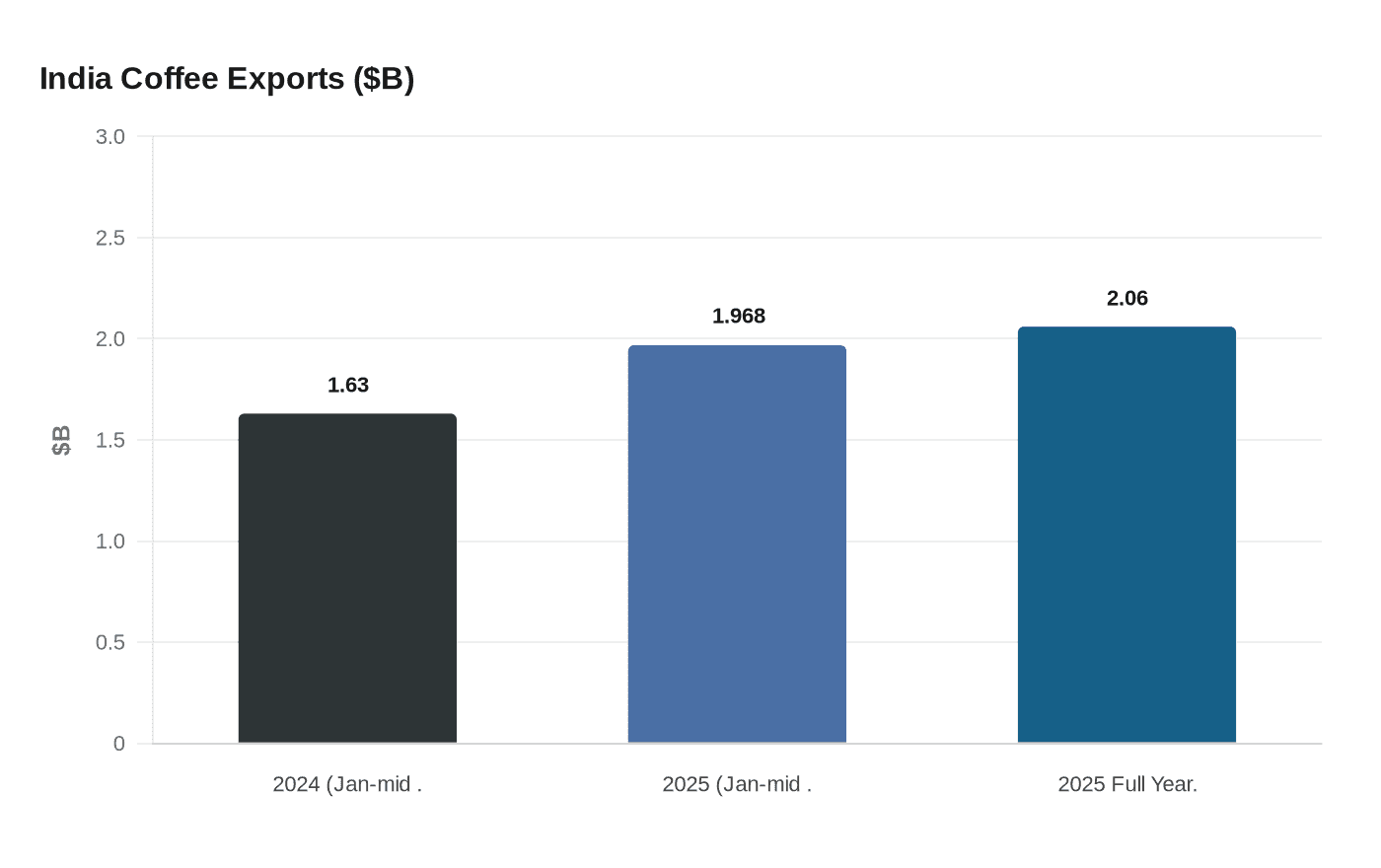
Data based on export permits issued by the Coffee Board of India shows shipments through mid-December stood at $1.968 billion, a 21 percent increase from $1.63 billion recorded over the same period the prior year. Provisional full-year figures from the Coffee Board and shipment permits put the final calendar-2025 tally at approximately $2.06 billion, up more than 20 percent year-on-year. On the fiscal-year side, official sources confirmed India would cross the $2 billion mark during the current financial year as well, with April-to-December exports valued at $1.42 billion, up from $1.223 billion over the corresponding period the year prior.
Kurma Rao M., chief executive and secretary of the Coffee Board of India, called the pace of growth striking even against recent strong baselines. "We have consistently recorded over $1 billion in coffee exports for the past four years, and this year marks the fifth," he said. "By February itself, we have already surpassed last year's export level of around $1.8 billion, which is a very positive sign."
The value surge is happening as physical volumes actually pulled back. Shipments through mid-December stood at 366,000 tonnes, compared to 391,000 tonnes during the equivalent period in 2024, a decline of about 6.4 percent. That's the number that matters to anyone sourcing green: India is earning more by shipping less, which tells you where price authority currently sits. The strong performance was supported by higher global prices, which have more than doubled in recent years on supply worries in key producers Brazil and Vietnam.
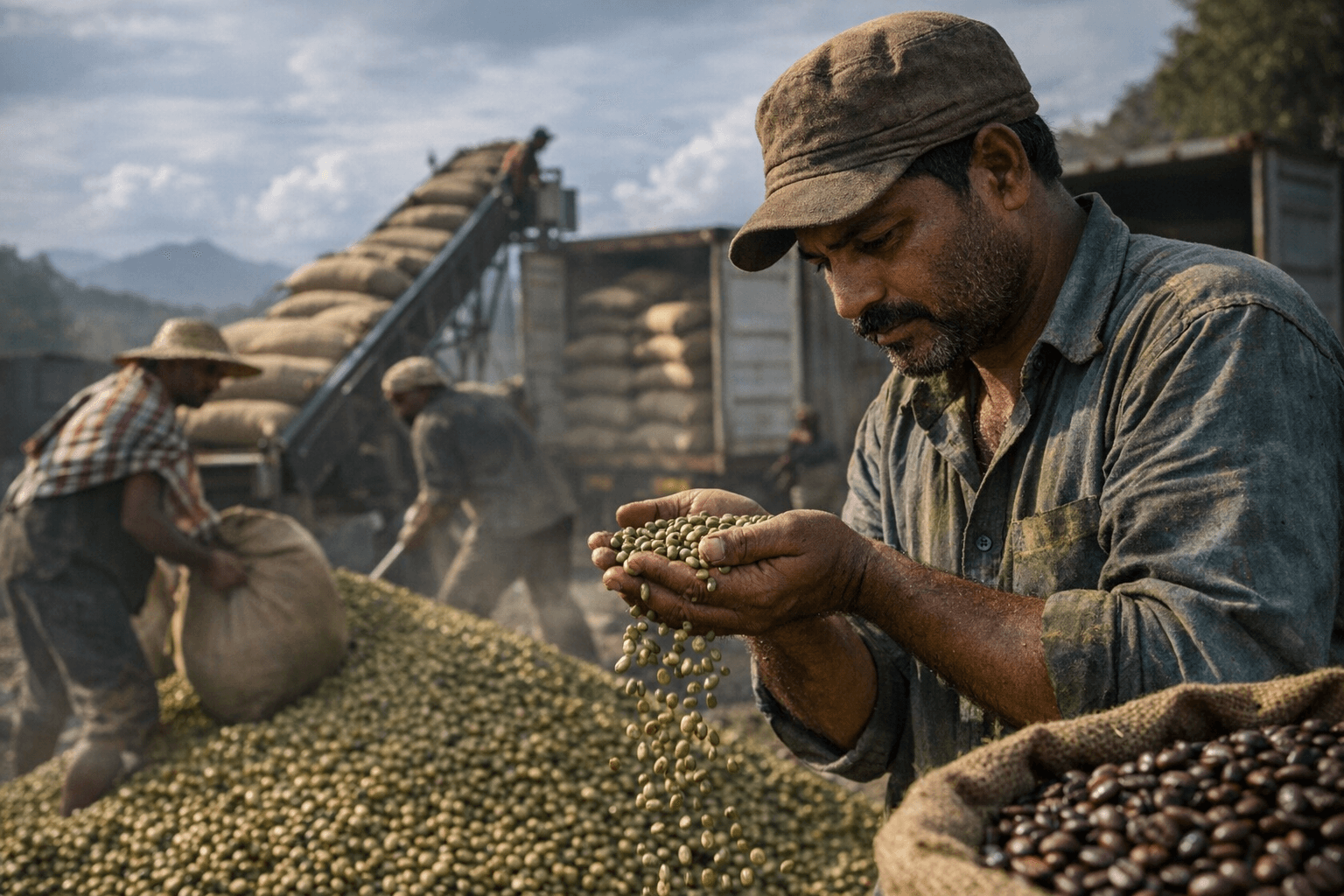
The premium story for Indian Robusta specifically is what roasters paying attention to London futures already know. The premium for Indian Robusta parchment AB is currently estimated at $1,000-$1,100 per tonne over London's LIFFE prices, while Robusta cherry AB is trading at a premium of $400-$450 per tonne. Those numbers dwarf the "nearly USD 300/mt over London futures" figure cited in earlier 2024 analysis, confirming that the premium trajectory has accelerated sharply. The underlying reason is straightforward: shade-grown, hand-picked cultivation across the Western Ghats produces a Robusta that is difficult to source elsewhere, with India being one of the few origins that can produce espresso-grade Robusta, separated from lower-quality counterparts by the high degree of care applied to cultivation, harvesting, and processing.
Indian Kaapi Royale Robusta is an international favorite for espresso blends, celebrated for its uniformity, clean cup profile, and screen-size 17 consistency. Indian Robusta beans provide a smooth, mellow cup with intense aroma and a chocolate-like fragrance, with cup qualities that are actually quite Arabica-like. For roasters building blends, that translates to crema stability and blend-fortifying body without the harsh, rubbery defects of commodity-grade Robusta from other origins.
The emergence of specialty coffees such as Monsooned Malabar, Mysore Nuggets, and Koraput Coffee has strengthened India's reputation as a producer of premium, globally competitive varieties. On the Arabica side, washed lots from Chikmagalur and the Nilgiris tend toward stone fruit and mild citrus with a clean finish; naturals and honeys from the same estates run sweeter, with more body and cocoa depth. Monsooned Malabar remains the most distinctive process in India's portfolio, producing low-acid, full-body beans with muted brightness and notes of wood, spice, and dried fruit. It is one of the few coffees that performs genuinely differently on a French press versus an espresso machine, with the latter bringing out more of the spice and the former leaning toward a heavy, almost mushroom-like earthiness.
The top five export destinations are Italy at approximately 18 percent, Germany at 11 percent, Belgium at 7.47 percent, Russia at 5.28 percent, and the United Arab Emirates at 5 percent. Russia's increased purchases in 2025 represent one of the more notable demand shifts, with Italian and German roasters having absorbed Indian Robusta into espresso blends for decades. The growing US specialty market is still catching up: most American third-wave roasters have historically defaulted to the "Arabica only" sourcing philosophy, but that is changing as familiarity with clean, high-quality Robusta suitable for top-flight espresso blends grows beyond the roasters who understood it first.
For hobbyists looking to get into Indian lots before mainstream availability tightens further, the regions to target are Karnataka (which anchors about 70 percent of national production), Kerala's high-altitude Wayanad and Idukki districts for Arabica, and Tamil Nadu's Nilgiris for washed lots with exceptional clarity. Smallholders throughout Karnataka make high-quality AA lots possible and showcase the potential of luxury Robusta coffee from India. On processing, the naturals and honey-processed Arabicas from Karnataka estates are easiest to start with on a V60 or Chemex; pull them slightly coarser than you would an Ethiopian natural, because the body is already there and you don't need to compensate. For Robusta-forward drinking, a Moka pot or espresso machine will do the most justice to the dense, crema-building character that makes Kaapi Royale grade beans worth the premium.
Said Vinod Kumar, president of the India SME Forum, identified the structural challenge that still limits how much of this value reaches consumers as traceable, origin-branded product: "India's coffee and tea sectors stand at a critical inflection point," he noted, adding that "despite producing some of the finest varieties globally, exports remain constrained by reliance on bulk commodity trade rather than value-added, branded offerings."
India's coffee exports are expected to increase at a CAGR of 20 percent, reaching between $2.6 billion and $3.2 billion by 2028. Whether that growth translates into more traceable, roaster-ready specialty lots on the international green market, or continues to flow primarily through bulk commodity channels, depends largely on whether the push toward branded, value-added exports gains the traction Kumar is calling for. The price signals are already compelling enough that roasters not yet looking at Indian origin should be.
This article was produced by Prism’s automated news system from verified source data, official records, and press releases, then run through automated quality and moderation checks before publishing. The system is built and supervised by the people who set the standards it runs under. Read our full AI policy.
Did this article answer your question?