Social Enterprises Outperform Corporate Sustainability Programs in Farmer Well-Being
A new Peru study found social enterprises outperform cooperatives and corporate sustainability programs on farmer well-being, with future security the starkest gap.
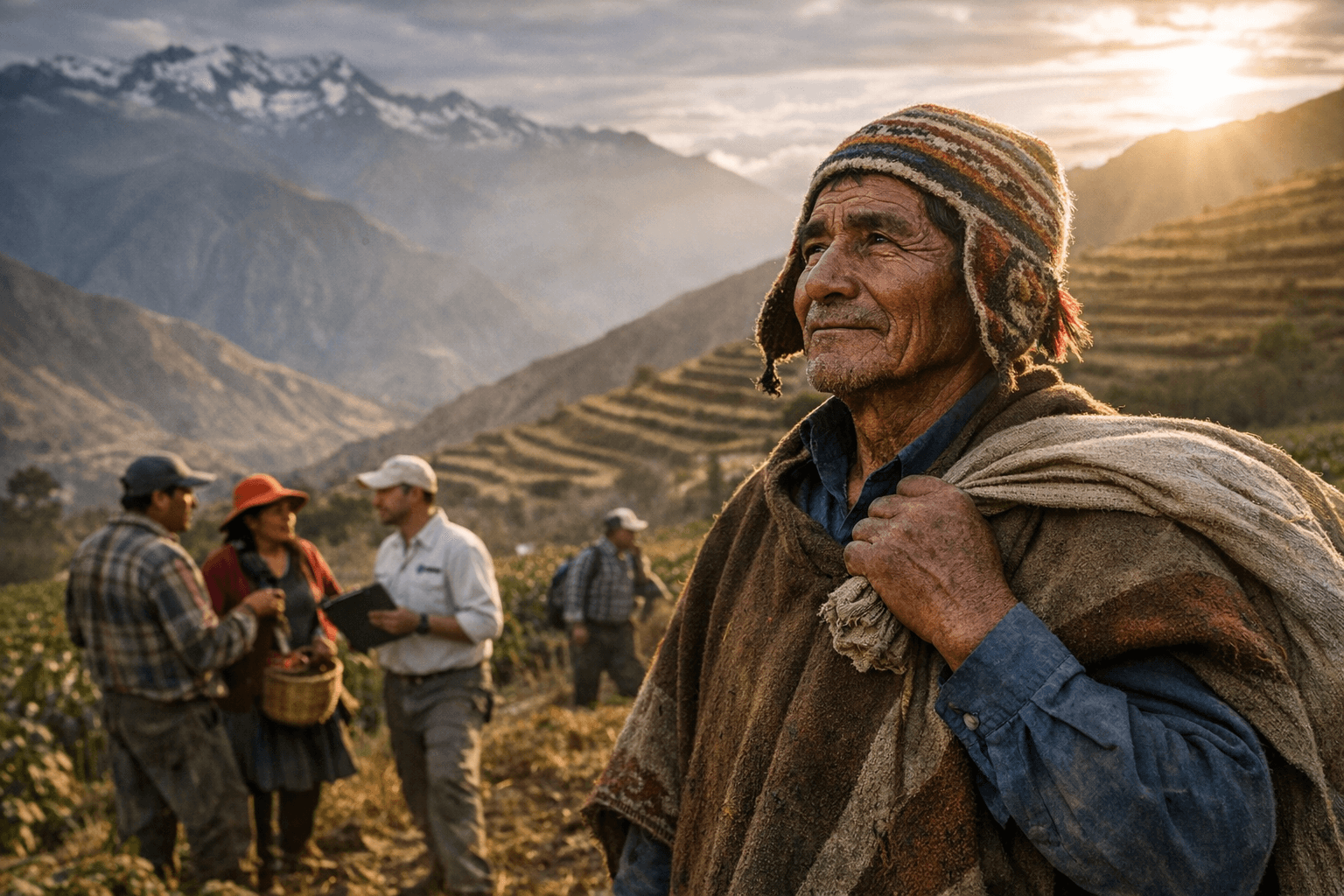
The paper notes that cocoa and coffee are strongly associated with persistent poverty, with estimates suggesting roughly 70-80% of cocoa and coffee farming families do not earn enough for a "decent living." Against that backdrop, a new comparative study of coffee and cocoa producers in Peru delivers a pointed verdict: social enterprises deliver measurably stronger farmer well-being than cooperatives or corporate sustainability programs, and the gap holds up even after accounting for demographic differences.
The survey focused on three regions: San Martín, Selva Central (Junín and Pasco), and the Quillabamba area in Cusco. Researchers combined a household survey with a statistical approach, then quantified outcomes using a standardized instrument. To measure farmer well-being, they used the Personal Well-Being Index, a self-reported measure spanning eight domains, including living standard, health, safety, community integration, and future security.
The headline finding cuts across all organized models first: farmers involved in any of the three sustainability arrangements — corporate programs run by green coffee traders or roasters, cooperatives emphasizing direct-trade relationships and fair prices, or social enterprises — reported higher well-being than those engaged with none. But the rankings inside that group matter considerably. After the researchers controlled for demographic and contextual variables, only social enterprises remained a statistically significant contributor to overall well-being. Farmers in social enterprises reported significantly higher satisfaction than independent farmers across living standards, personal relationships, community integration, future security, and spirituality. On future security specifically, social-enterprise participants scored higher than every other group in the study.
The researchers point to business model architecture as a central explanation. Cooperatives and corporate program participants largely operate as midstream actors, supplying large volumes of coffee and cocoa to manufacturers and roasters further up the chain. Social enterprises, by contrast, employ more sophisticated models that enable farmers to capture a greater share of the value created along the value chain. Those innovations include diversification of outputs with higher quality standards and differentiated company values like inclusion and community empowerment.
Geography and social targeting compound that advantage. The social enterprises examined intervene in highly contextualized ways, consciously working in areas around protected zones or communal forests and with specific farmer groups: former coca producers, indigenous communities, and women. They often originate from, or maintain a long-term personal presence in, the origin area where they operate — a depth of local embeddedness that corporate sustainability programs, by design, rarely replicate.
The findings land as a direct challenge to decades of industry convention. Coffee companies have long leaned on third-party certifications to measure their own corporate sustainability goals and discuss "impact." This study suggests that model, while better than nothing, leaves real well-being gains on the table. "Our findings challenge traditional productivity centered approaches and emphasize the importance of incorporating localized, socially tailored strategies to enhance the well-being of farmers within agri-food value chains," the authors wrote.
The study stops short of claiming causality — the researchers controlled for observable variables, but selection effects remain a standard concern in this kind of comparative work. Sample size, exact control variables, and full inferential statistics were not detailed in publicly available excerpts of the analysis. Still, the directional signal is consistent across domains and survives the controls applied, which is more than most certification-impact studies can claim.
For roasters and importers who have built sourcing narratives around Rainforest Alliance, organic, or Fairtrade seals, the study is worth sitting with. Certifications can coexist with social enterprise models, and the paper frames them as potentially complementary. But if the goal is durable farmer well-being rather than a box checked on a sustainability report, the data from Peru points toward a fundamentally different kind of partnership.
This article was produced by Prism’s automated news system from verified source data, official records, and press releases, then run through automated quality and moderation checks before publishing. The system is built and supervised by the people who set the standards it runs under. Read our full AI policy.
Did this article answer your question?