Heather’s Tunisian Crochet Arrowhead Stitch Joins Country Cottage Sampler
Heather’s Arrowhead Stitch adds lace, shaping, and a 12-inch payoff to the Country Cottage sampler, all in a two-row Tunisian repeat.
A sampler block that teaches more than one stitch
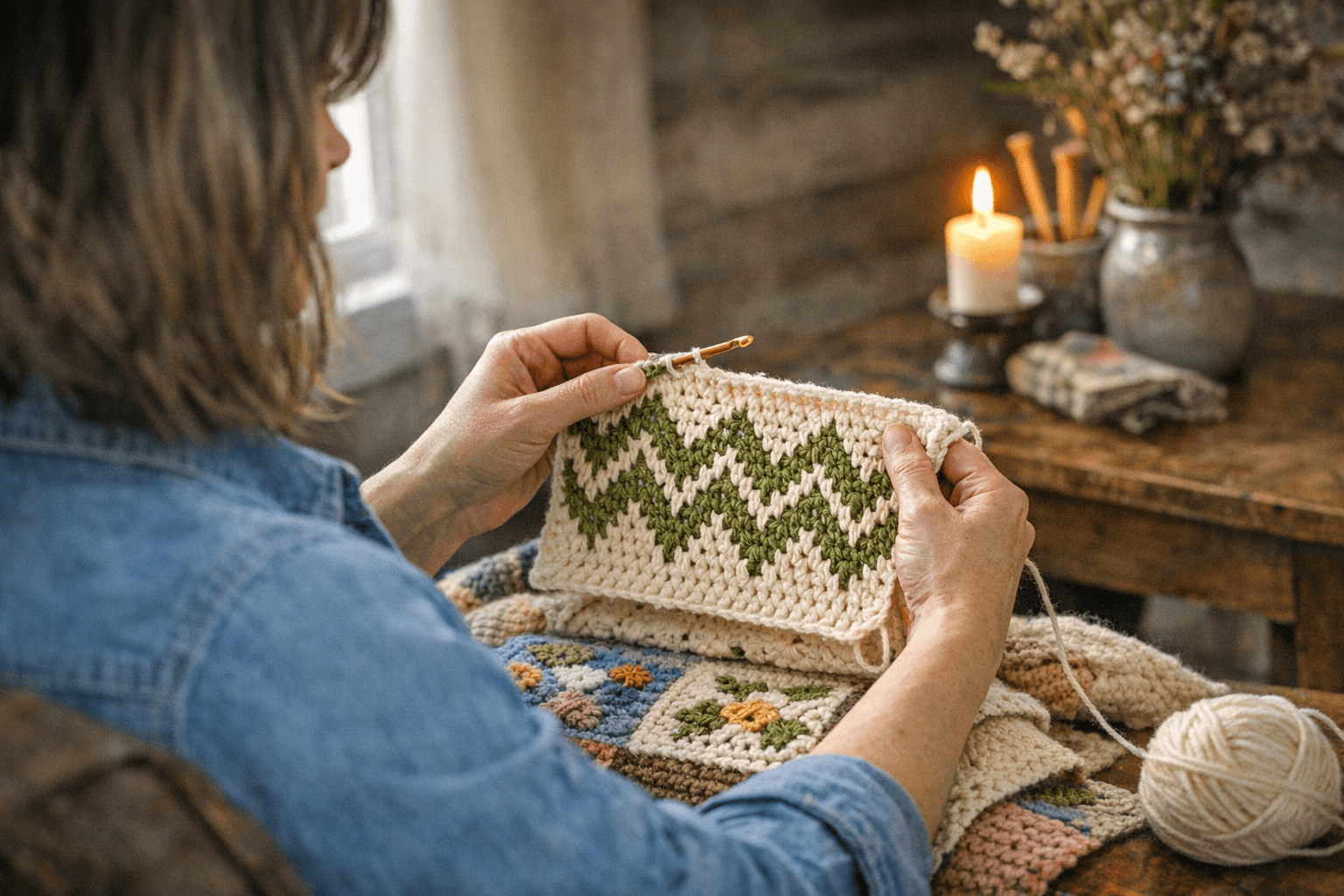
Heather J Anderson’s Arrowhead Stitch lands as the seventh block in the Country Cottage Tunisian Sampler, and it does exactly what a good learning square should do: it gives you a clear texture goal, a manageable repeat, and a reason to keep going. The stitch reads as lacy and textured, but it is not fussy. That balance is the point, because this sampler is built to help you learn Tunisian crochet from the basics upward while still ending with a blanket you will actually want to keep.
The bigger project behind it is a 20-square mystery blanket that runs all year, with a new square released every other Wednesday starting January 14, 2026. Heather brought the blanket-along back after taking a year off from her annual crochet-along project, and that return gives the whole series a practical rhythm: you are not being asked to master everything at once, just one square at a time. The plan is to finish by the end of October 2026, which makes the Arrowhead Stitch feel less like a stand-alone pattern and more like one step in a guided Tunisian course you can finish.
What makes the arrowhead stitch worth making
The first thing that sets this block apart from standard Tunisian texture is the fabric itself. A lot of beginner Tunisian pieces lean hard on solid, dense rows of Tunisian simple stitch. Arrowhead opens things up. It uses Tunisian simple stitch, decreases, yarnovers, and the full stitch, which gives you a more decorative surface without sending you into complicated territory.
The other useful detail is the two-row repeat. That sounds small, but in practice it is what keeps the block friendly. You are working enough variation to stay interested, yet the repeat is short enough that you do not spend the whole project checking your place. If you have ever liked the look of Tunisian lace but hated patterns that feel like they are constantly changing the rules, this is the sweet spot.
What you learn by making this block
This is the kind of square that teaches you how Tunisian fabric changes when you stop only stacking stitches and start shaping them. The decreases pull the fabric in. The yarnovers open it back up. The full stitch adds a different visual rhythm, so you are not just memorizing a stitch pattern, you are learning how several Tunisian building blocks behave together.
That matters beyond this one square. Once you have worked this block, you have practice with the exact moves that show up again and again in future Tunisian projects. You are building a toolkit, not just a blanket square. In a sampler that also promises cables, intarsia, corner-to-corner, bobbles, and cross stitching across the full year, Arrowhead fits neatly into the part of the curriculum where the stitches stop being purely basic and start teaching structure.
Materials, size, and the real project payoff
The materials list stays refreshingly modest. You need about 120 yards of worsted weight yarn, a 6.5 mm Tunisian hook, and a border hook. The finished square is listed at 12 inches by 12 inches after blocking, which gives you a concrete target before you cast on. That 12-inch size also tells you exactly how this block will behave inside the larger throw, instead of leaving you guessing whether your gauge is drifting.
The full sampler puts those numbers in perspective. Each square is designed to measure about 12 inches after blocking, and the finished blanket is expected to come out around 48 by 60 inches before edging. The yarn estimate is about 3,000 yards total, with roughly 120 yards per square and another 300 yards set aside for joining and border work. That is a useful shareable stat in its own right: one 12-inch Tunisian lesson becomes part of a full-size throw, not a pile of orphaned practice swatches.
Is this a good block for newer Tunisian crocheters?
Yes, but with one honest caveat. If you already know Tunisian simple stitch and you are comfortable keeping track of a short repeat, this block is a smart next step. The two-row structure keeps it approachable, and the stitch motifs are clear enough that you can learn while you work instead of decoding a maze.
If you are brand new to Tunisian crochet, this is not the first square I would hand you blind. The decreases and yarnovers ask for a little more confidence than a straight basic stitch row. That said, the sampler is built to teach from the ground up, and the broader project is meant to be joined at any time, so you can absolutely fold this into your learning path once the basics stop feeling awkward.
Why this sampler format works
Heather’s whole setup is stronger because it treats the sampler like a real teaching series, not just a parade of pretty blocks. The pattern is available as a free version on her website, and there is also a $10 PDF pre-order in the shop and on Ravelry that updates buyers with each new square as it is released. That means you can follow along without spending a cent, or pay for the convenience of getting each release delivered as the year moves on.
The support structure matters too. A video tutorial for the Arrowhead Stitch is coming soon, which is exactly the kind of backup that helps a textured Tunisian block land with more people. Heather also keeps Tunisian tutorials as a regular part of her content mix on her site and YouTube, so this does not feel like a one-off experiment. It feels like part of a teaching lane she knows how to run.
Arrowhead is part of a wider Tunisian conversation
This stitch has been around the crochet web long enough to have a paper trail. Fiber Spider posted a Tunisian Arrowhead Stitch video tutorial roughly a year earlier, complete with a row-by-row format that covered Row 1, Row 2, Row 3, repeat rows, and bind off. VAMI Creations also published a Tunisian Crochet Arrowhead Stitch tutorial in a prior series, and that work was tied back to Toni of TLYarn Crafts. So Heather is not inventing the stitch from scratch, she is packaging it inside a structured sampler where the learning path is the product.
That is why this block matters now. It gives you a stitch with actual shape, a repeat you can manage, and a clear place inside a 20-square Tunisian blanket that is still open for joiners. By the time the sampler wraps at the end of October, Arrowhead will have done what the best Tunisian blocks do: teach a new motion, sharpen your eye for texture, and earn its spot in a blanket that holds the whole year together.
This article was produced by Prism’s automated news system from verified source data, official records, and press releases, then run through automated quality and moderation checks before publishing. The system is built and supervised by the people who set the standards it runs under. Read our full AI policy.
Did this article answer your question?