How to Read a Crochet Pattern: A Beginner's Step-by-Step Guide
Crochet patterns look like code until you know the system; once you crack abbreviations and pattern structure, any project becomes readable.
Pick up almost any crochet pattern for the first time and it reads like a foreign language. "Sc in each st across, turn. Ch 3, dc in next 2 sts, 2 dc in next st..." What does that even mean? Here's the thing: it's not random. Every written crochet pattern follows a predictable structure, uses a standardized abbreviation system, and once you understand those conventions, the whole thing clicks into place. The Craft Yarn Council, which sets industry standards for yarn and fiber crafts, has built out a canonical guide to reading crochet patterns, and the framework they use is worth knowing inside and out.
Understanding the anatomy of a pattern
Before you even look at a single stitch instruction, a well-written pattern front-loads everything you need to know. You'll typically find a materials list, a gauge swatch specification, sizing information (if the project is wearable), and a list of special stitches or techniques used. Don't skip any of it. New crocheters almost always jump straight to the instructions, then hit a wall halfway through when they encounter an unfamiliar term that was defined in the notes section they ignored.
The materials list tells you exactly what hook size, yarn weight, and notions (stitch markers, tapestry needles, etc.) the designer used to achieve the result you're looking at. The gauge note, that little "14 sc = 4 inches" line that seems easy to skip, is the single most important spec in any sized project. It tells you how densely the designer was crocheting, and if your gauge doesn't match, your finished object will come out a different size than intended. Make the swatch. It takes 20 minutes and saves you from frogging an entire cardigan.
Decoding the abbreviation system
This is where beginners usually get tripped up, and honestly, it's also the fastest thing to learn. The Craft Yarn Council maintains standardized abbreviations for the U.S. crochet system, and most English-language patterns follow them. A few you'll encounter constantly:
- sc: single crochet
- dc: double crochet
- hdc: half double crochet
- tc or tr: treble (triple) crochet
- ch: chain
- sl st: slip stitch
- st(s): stitch(es)
- sp: space
- rep: repeat
- sk: skip
- yo: yarn over
The pattern will almost always include a key or legend, especially if it uses any non-standard or designer-specific stitches. Read that key before you start. Some designers have slightly different conventions, and a pattern from a UK designer will use terminology that maps differently onto the same physical stitches (a UK "double crochet" is the same stitch as a US "single crochet," which is a notorious point of confusion for beginners).
Reading stitch counts and repeat notation
Once you're past the abbreviations, the next hurdle is understanding how patterns communicate repetition and stitch counts. Two conventions matter most here.
Parentheses and brackets signal repeated sequences. When you see "(sc, ch 2, sc) in next st," that entire sequence happens inside one stitch. When you see "[dc in next 3 sts, 2 dc in next st] 4 times," you work that bracketed section four times total before moving on. This compact notation is why a complex lace round can fit on a single line of text.
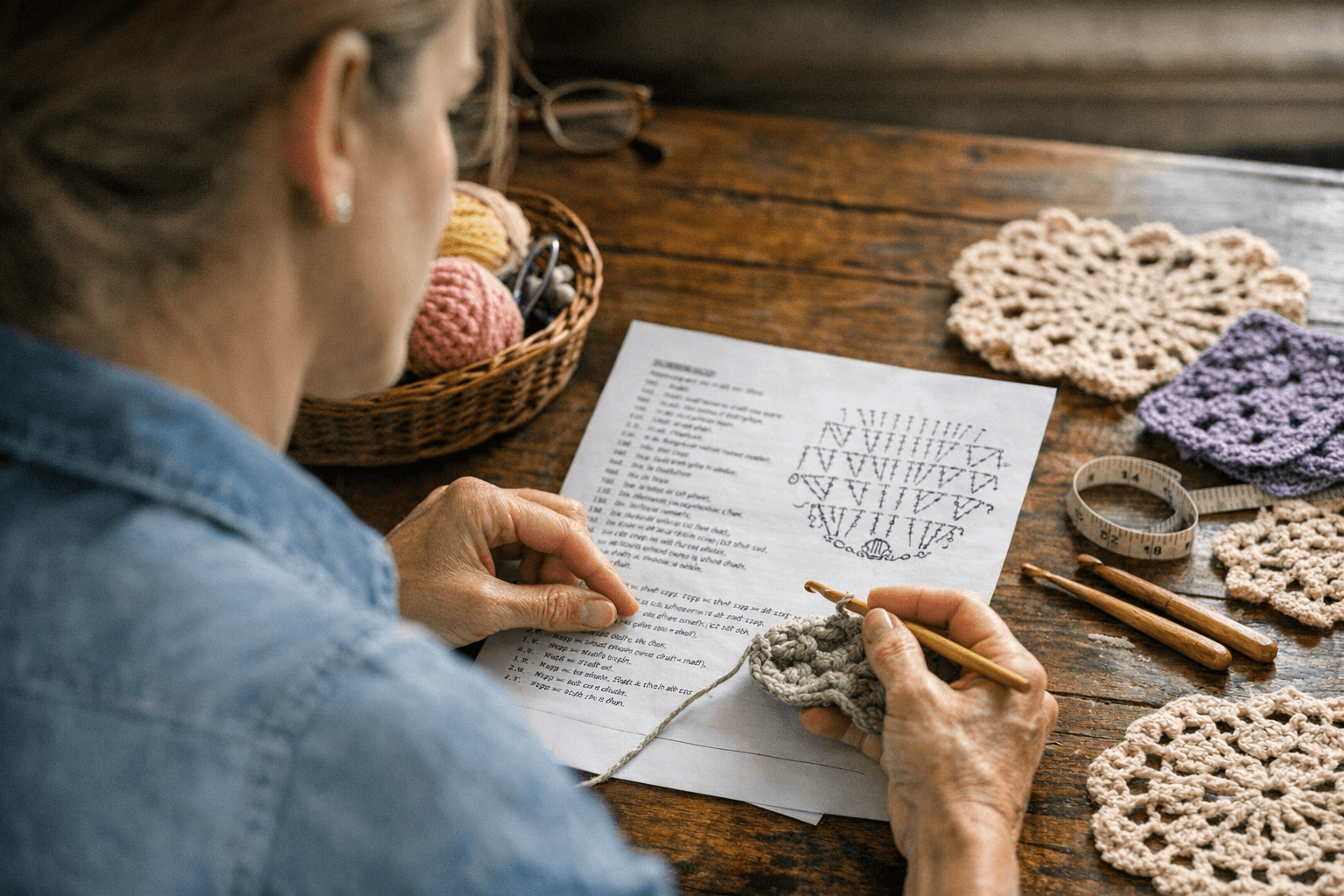
Stitch counts at the end of a row or round, usually written as a number in parentheses like "(24 sts)" or "24 sc," are your checkpoints. After completing each row or round, count your stitches. If the number matches, you're good. If it doesn't, you've either added or dropped a stitch somewhere in that section, and catching that now is infinitely better than catching it six rows later. Experienced crocheters use stitch markers at regular intervals (every 10 or 20 stitches in a long row) to make counting faster and catch errors earlier.
Working through a pattern step by step
Here's a practical method for approaching any new pattern, especially your first few:
1. Read the entire pattern once before picking up your hook. You're not trying to memorize it. You're scanning for anything unfamiliar so you can look it up before it stops you mid-project.
2. Check your gauge. Work a 6-inch swatch, wash and block it the same way you'd treat the finished piece, then measure. Adjust hook size up (for looser gauge) or down (for tighter gauge) and swatch again if needed.
3. Note any special stitches. If the pattern uses a stitch you haven't worked before, like a bobble, a shell, or a particular decrease method, practice it on your swatch yarn before you're working it into the actual project.
4. Work one section at a time. Many patterns are divided into sections (body, sleeves, border, etc.) or construction stages. Treat each as its own task rather than trying to hold the whole pattern in your head.
5. Count after every row or round. Cross-reference with the stitch count noted in the pattern. Mark where you are with a row counter or a simple pencil note on a printed copy.
A note on pattern sources and quality
Not all patterns are written with the same care. Patterns from established publishers, yarn companies, and designers who follow Craft Yarn Council conventions tend to be well-tested and clearly notated. Patterns from independent designers, free blog patterns, or older vintage patterns sometimes skip gauge information, use inconsistent abbreviations, or contain outright errors. This isn't a reason to avoid them. It's a reason to approach them with a bit more skepticism, check the comments section or Ravelry notes for reported errata, and trust your stitch counts over the written instructions when they conflict.
When the pattern still doesn't make sense
Even experienced crocheters occasionally hit a line that doesn't parse on first read. When that happens, try working it out physically with your hook and yarn rather than trying to decode it purely on paper. Sometimes "work across in established pattern" only makes sense once your hands are moving. Online crochet communities, stitch dictionaries, and video tutorials for specific techniques are all legitimate tools, not cheating. The Craft Yarn Council's own resources are a reliable first stop for checking standard terminology and technique definitions.
Reading a crochet pattern is genuinely a learnable skill, not an innate talent. The system is standardized enough that once you've worked through three or four patterns, the notation stops looking like code and starts looking like instructions. Get those first few projects under your belt, and you'll find yourself scanning a new pattern and knowing immediately what you're in for.
This article was produced by Prism’s automated news system from verified source data, official records, and press releases, then run through automated quality and moderation checks before publishing. The system is built and supervised by the people who set the standards it runs under. Read our full AI policy.
Did this article answer your question?


