Aid Flotilla Nuestra América Delivers 20 Tons of Supplies to Blacked-Out Cuba
The Granma 2.0 sailed into Havana harbor March 24 carrying 73 solar panels, bicycles, and medicine — the first of three ships in a 500-person flotilla defying Cuba's total oil blackout.
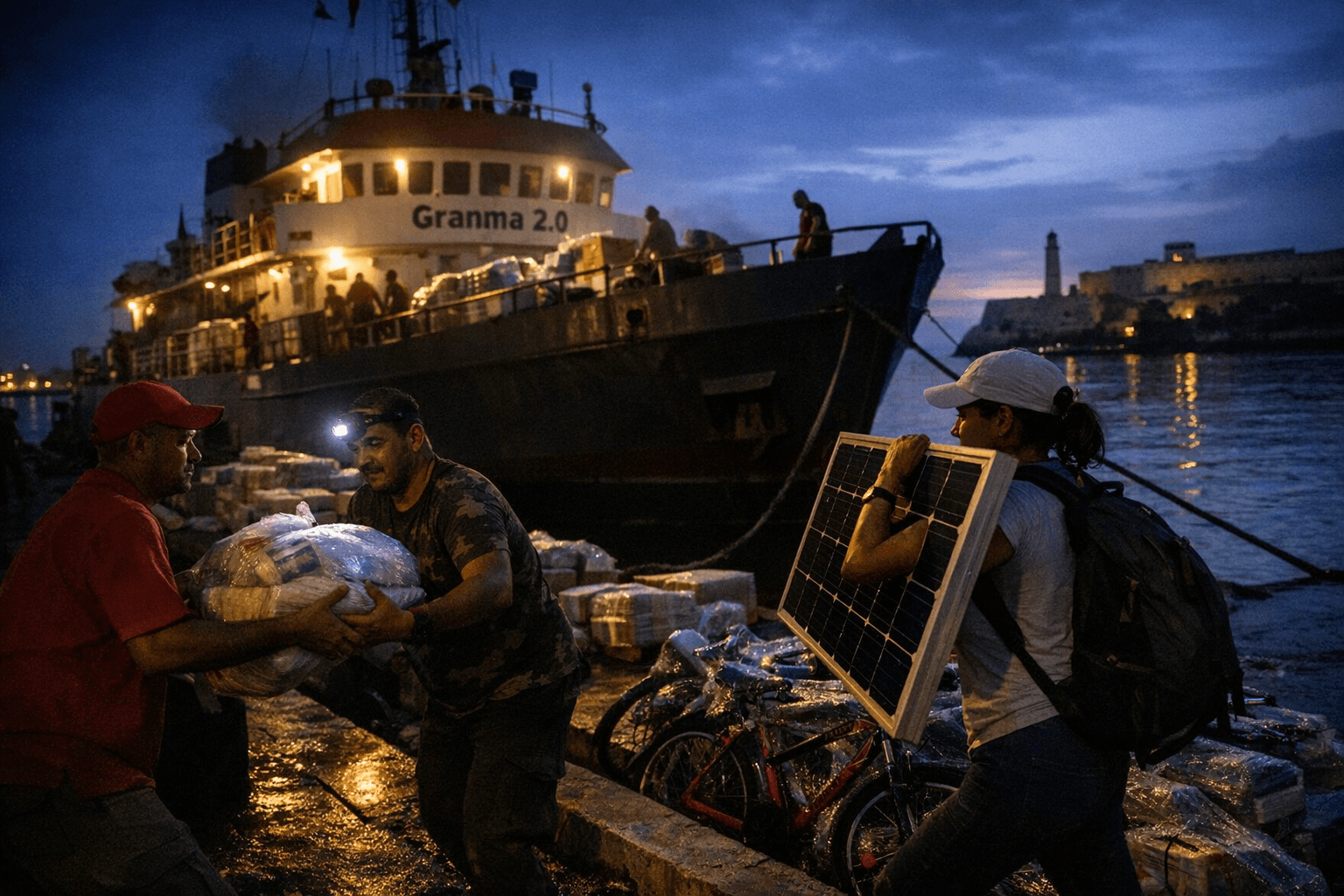
The first boat of a humanitarian aid flotilla reached Cuba on Tuesday, carrying food, medicine, solar panels, and bicycles as part of the "Nuestra América" convoy that set out from Mexico the week prior. Some 30 people were aboard the first of three ships expected to arrive as Cuba grapples with severe blackouts, a crumbling power grid, and a U.S. energy blockade.
The vessel, christened "Granma 2.0" in homage to the boat that ferried revolutionary leader Fidel Castro to the island in 1956, docked in Havana Bay on March 24. Activists waved Cuban and Palestinian flags from the deck as the ship arrived from Mexico. Before departure from the Mexican port of Progreso on March 20, dozens of volunteers had loaded boxes of medicine, water, rice, beans, formula, food cans, bicycles, and 73 solar panels onto the 75-foot fishing vessel.
The flotilla is part of the broader "Our America Convoy to Cuba," with more than 650 participants from 33 countries who arrived on the island last weekend with tons of aid and were received by President Miguel Díaz-Canel. Visitors included British parliamentarian Jeremy Corbyn, Colombian Sen. Clara López, Spanish politician Pablo Iglesias, and U.S. labor leader Chris Smalls, as well as the popular Irish hip-hop trio Kneecap. Convoy organizers estimated the total operation would deliver more than 20 tons of critical supplies, including food, medicine, solar panels, and bicycles.
The need is acute. President Miguel Díaz-Canel has confirmed the island has not received oil from foreign suppliers in three months, and Cuba produces barely 40% of the fuel it needs to power its economy. No oil has been imported to the island since January 9, hitting the power sector while also forcing airlines to curtail flights, a blow to the all-important tourism sector. Cuba's power grid collapsed Saturday, leaving the country without electricity for a third time in March, with the Cuban Electric Union attributing the latest total disconnection to an unexpected shutdown of a generation unit at the Nuevitas thermoelectric plant in Camaguey province. Cubans face daily blackouts of up to 15 hours in Havana; in the interior of the island of 9.6 million people, the outages are worse.
On January 29, President Donald Trump, through Executive Order 14380, imposed an oil blockade on Cuba, threatening sanctions against any country that directly or indirectly supplies oil to Cuba. Another blow came from the removal by the U.S. of Venezuela's former President Nicolás Maduro, which halted critical petroleum shipments from the nation that had been a steadfast ally to Havana.
A few dozen Cubans gathered at the port as the Granma 2.0 made its way into the harbor. Ernesto Sanchez, who was waiting dockside when the boat arrived, called it "the best thing to happen to us in these difficult times," adding that the U.S. blockade had been "unjustly imposed." He did not soften the reality on the ground: "Just by looking you can see the situation — with the fuel, the energy system, and everything else — has impacted us quite a lot." Lisandra Sánchez echoed the sentiment, saying: "We are grateful to all these brothers and sisters who are helping us with whatever aid they can provide us during this situation we are now facing in the country."
Not everyone on the docks shared that optimism. Havana resident Carlos said the aid is unlikely to make a material difference and would not resolve "the structural internal problems of the country." Critics have also pointed out that framing the crisis as purely a product of U.S. policy pushes into the background analyses that attribute Cuba's difficulties largely to its internal political and economic structure.
Brazilian participant Thiago Ávila, 39, put the convoy's purpose in plain terms as he disembarked: "This type of economic warfare shouldn't exist, this attitude of a pirate state that doesn't respect international law." Jeremy Corbyn, who traveled to Havana as part of the delegation, framed the mission in broader terms: "Cuba is not a threat to anybody except if you think free medical care, free education, and a culturally diverse population is a threat to the world."
Three vessels made up the sea component: the Granma 2.0 from Puerto Progreso, Yucatán, and two sailboats from Isla Mujeres, carrying additional tons of supplies. The solar panels aboard the convoy are earmarked for a specific purpose: organizers said the equipment will be primarily allocated to hospitals and clinics affected by prolonged power outages. Additional solar materials, valued at $500,000 and provided by U.S.-based organizations, supplemented the panels on board, with further panels contributed by groups in Colombia.
The Nuestra América Convoy arrived just days before Cuba is expected to receive its first shipment of Russian oil, which, if it materializes, would be the first significant fuel infusion the island has seen since January. Whether 20 tons of humanitarian cargo and a flotilla of solidarity can sustain 11 million people through rotating blackouts is a question no convoy organizer has been able to answer — but for the Cubans who watched the Granma 2.0 clear the harbor mouth on Tuesday morning, it was at minimum proof that the island has not been forgotten.
This article was produced by Prism’s automated news system from verified source data, official records, and press releases, then run through automated quality and moderation checks before publishing. The system is built and supervised by the people who set the standards it runs under. Read our full AI policy.
Did this article answer your question?