Cuban churches become lifelines as shortages deepen across the island
Dozens line up twice a week at a Havana church for free medicine as church aid fills gaps the state can no longer cover.
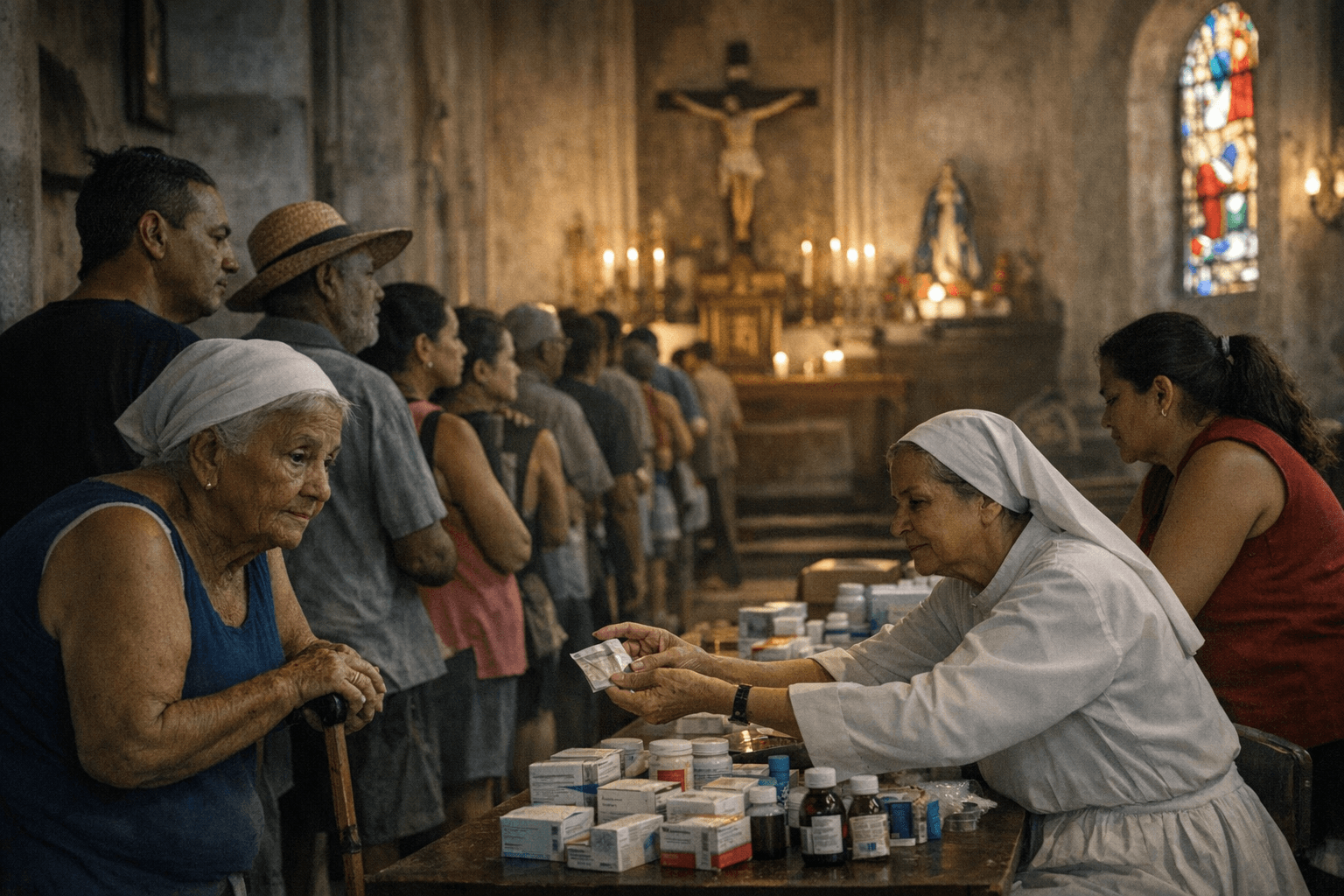
Outside Santa Cruz de Jerusalen Catholic church in Havana, the line now forms twice a week for free medicine the state pharmacy no longer has. What began in 2022 as a trickle of one or two people has swelled in recent months to as many as 300, a sharp measure of how quickly Cuba’s crisis has moved from inconvenience to basic survival.
Among those waiting is Juana Emilia Zamora, 71, a retiree with hypertension who lives on a monthly pension of 2,000 Cuban pesos, or less than four U.S. dollars. That is nowhere near enough to buy medicine on the black market, where prices have climbed beyond reach for many older Cubans. At Santa Cruz de Jerusalen, the aid comes without conditions, and the church has become a place where people still believe something will be handed over when they reach the front of the line.
The scene in Havana reflects a larger shift across the island. For decades after the 1959 revolution, the Catholic Church was sidelined as the state took control of education, healthcare, schools and many social programs. That changed gradually from the 1990s, when the end of state atheism and repeated economic shocks opened more space for religious institutions to take on social aid and even diplomatic mediation. Now, as shortages deepen, churches are not just filling gaps. They are functioning as an informal survival system.
Caritas Cuba has become one of the most important pieces of that network. Established on 25 February 1991 by decree of the Conference of Catholic Bishops of Cuba, it operates in all 11 dioceses, giving the church a nationwide reach that few other non-state institutions can match. That structure matters in a country where fuel shortages, transport breakdowns, food inflation and rolling blackouts have made official delivery systems unreliable, and where reliable electricity itself has become uncertain in daily life.
The wider humanitarian picture remains severe. The United Nations said in April that Cuba’s needs were still acute despite limited fuel arrivals, and that an updated plan aimed to support around two million people across eight provinces. The UN has also said earlier planning for Hurricane Melissa covered more than 2.2 million affected people, underscoring how the island’s present hardship now sits on top of storm damage from late 2025.
The church’s role has also drawn in outside actors. Washington has turned to the Catholic Church and Cáritas as a non-state partner in distributing $9 million in humanitarian aid for Hurricane Melissa victims, though that aid has been slow to reach remote villages. Cuban bishops warned in January of the risk of chaos and violence after the cut in oil supplies, and a Havana priest described the church in February as a sign of hope and comfort in a frankly difficult situation. In a country where the state once defined the social contract, the first responder is increasingly the parish.
This article was produced by Prism’s automated news system from verified source data, official records, and press releases, then run through automated quality and moderation checks before publishing. The system is built and supervised by the people who set the standards it runs under. Read our full AI policy.
Did this article answer your question?