Cuban Migrants Describe Harrowing Five-Day Sea Crossing to Grand Cayman
Five days at sea in a hull of pine boards and salvaged zinc, launched at dusk with the resin still wet: a Cuban migrant describes the crossing to Grand Cayman.
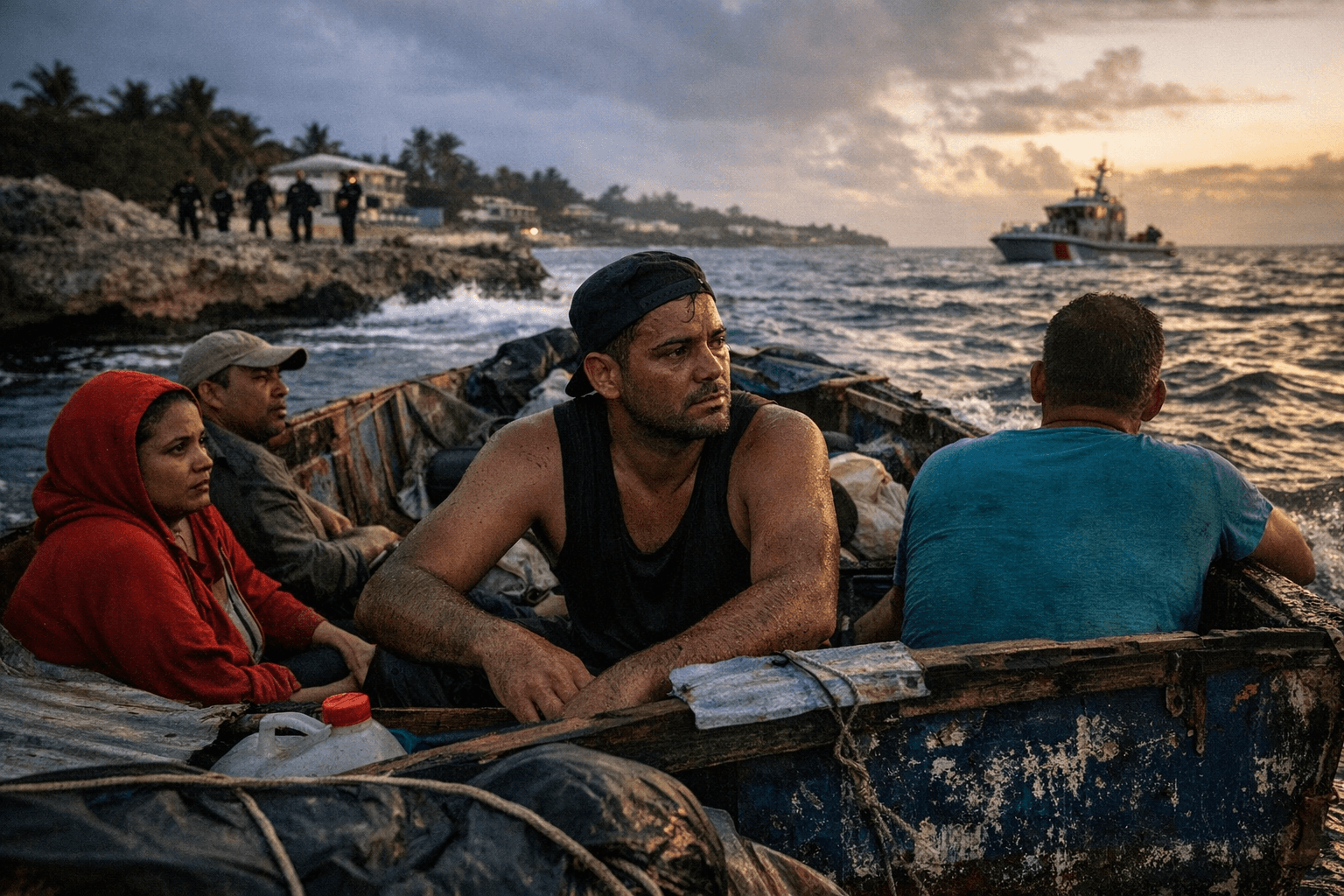
The hull was still tacky when they pushed off. Built inland from pine boards, salvaged zinc roofing sheets and fiberglass, fitted with a repurposed engine, the makeshift vessel that carried a group of Cuban migrants toward Grand Cayman departed at dusk under conditions that left no margin for error.
A detailed first-person account of that crossing, compiled from the direct testimony of one of the operation's organizers (name withheld for protection), describes not a sudden act of desperation but a planned, exhaustively financed operation that had already consumed tens of thousands of Cuban pesos across multiple failed attempts, money lost to aborted plans and to theft, before the group finally cleared Cuban waters.
Construction took place inland precisely to avoid detection. Once at sea, storms hit, the engine broke down, and navigational errors compounded the timeline. What the narrator expected to be a manageable crossing stretched to five days. Throughout, the psychological weight of interception fear ran constant, before and during departure, alongside the particular strain of leaving family behind with only partial disclosure of the plan.
The timing was deliberate. April and May are widely understood among those who make this calculation as the least dangerous window for a crossing to Cayman, a narrow stretch before Atlantic hurricane season renders the route catastrophic. Even so, the legal math at landfall is brutal: of the 24 Cuban migrants who arrived in the Cayman Islands through late March 2026, 20 had already been repatriated to Cuba. Cayman's Customs and Border Control processes arrivals under a 2015 memorandum of understanding with the Cuban government that establishes repatriation timescales. Home Affairs Minister Nickolas DaCosta has described the government's approach as resting on three principles: lawful border control, a humanitarian duty of care, and compliance with international refugee conventions.
Those not immediately sent back enter immigration detention at the Fairbanks facility in George Town. Asylum claims are processed under the International Convention on the Treatment of Refugees, and detainees receive a $150 monthly grocery voucher while cases are reviewed. Successful asylum grants are rare; the route to residency in Cayman is narrow and long.
The narrator knew the odds before setting out. Cuba's shortages of fuel, food, medicine and electricity, sharpening into 2026, alter the calculation for would-be migrants at every level, raising the perceived benefit of leaving even as the physical danger of the journey increases. Tight Cuban coastal surveillance limits mass departures, which is one reason 2026 numbers remain modest compared to the Balsero crisis of 1994, when nearly 1,200 migrants landed in Cayman within weeks.
What statistics cannot hold is the weight of a hull built in secret from whatever materials could be sourced, launched wet into open water, and kept moving for five days through storms and mechanical failure. The 2026 repatriation tallies record 20 people returned. They do not record what it cost to get there.
This article was produced by Prism’s automated news system from verified source data, official records, and press releases, then run through automated quality and moderation checks before publishing. The system is built and supervised by the people who set the standards it runs under. Read our full AI policy.
Did this article answer your question?