Cubans March Along Malecón Toward U.S. Embassy in Revolutionary Show
State media claimed over half a million marched Havana's Malecón on Dec. 20, as Díaz-Canel and Raúl Castro led a show of force months after Cuba's worst unrest in decades.
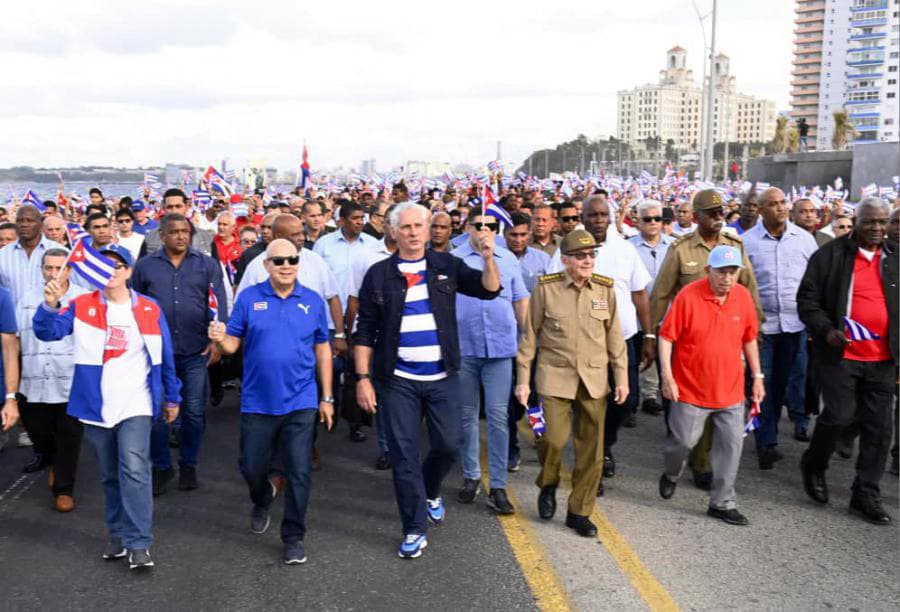
The same stretch of seafront boulevard that saw thousands of Cubans spontaneously erupt in anti-government protest in August 1994 was, on December 20, 2024, officially rebranded as a corridor of revolutionary loyalty. President Miguel Díaz-Canel Bermúdez and Army General Raúl Castro Ruz led what authorities called the Marcha del Pueblo Combatiente along Havana's Malecón toward the U.S. Embassy, with state-aligned outlets reporting over half a million participants drawn from every sector of Cuban society: students, doctors, construction workers, and artists marching under banners denouncing U.S. imperialism.
The half-million figure demands scrutiny. The Malecón runs roughly eight kilometers through Havana. Packing 500,000 bodies into that corridor at march density would require extraordinary logistics: coordinated transit, bloc assignments, and the full activation of Cuba's organizational infrastructure. The UJC, the Unión de Jóvenes Comunistas, alone brings over 300,000 members and more than 33,000 grassroots committees to bear. Founded April 4, 1962, with the motto "Estudio, Trabajo, Fusil" (Study, Work, Rifle), and currently led by First Secretary Aylín Álvarez García, the UJC is the backbone of exactly this kind of mobilization. Add the José Martí Pioneers Organization (OPJM, founded April 4, 1961) and the Federation of High School Students (FEEM, celebrating its 54th anniversary that same December), and you have the full scaffolding of Cuba's youth mobilization apparatus activated in a single afternoon. The numbers are unverifiable independently, but the organizational capacity to produce a genuinely massive turnout is real.
Youth were not just present; they were foregrounded. Díaz-Canel's speech invoked Cuba's 19th-century independence heroes before pivoting to "heroes of every color and age...our young people who are the soul of our country." The framing was deliberate: casting workers, nurses, scientists, and youth as active combatants in an ongoing ideological war rather than passive subjects of a struggling state. Cuba's official Communist Party newspaper Granma described the event as "a march against imperial ignominy," leaning into the government's standard framing of the 65-year-old U.S. trade embargo as economic warfare.
Raúl Castro's presence alongside Díaz-Canel added a layer the government clearly intended. His appearance served as a living endorsement connecting the current administration to the revolutionary generation, an especially significant signal given that the march was explicitly framed as a tribute to Fidel Castro, who died November 25, 2016. The juxtaposition of Cuba's two most recognizable living leaders at the head of the column carried messaging no speech could fully replicate.
The symbolism worked against a fraught backdrop. The Cuban Observatory of Conflicts registered 11,268 protests, complaints, and critical statements against the Díaz-Canel government during 2025 alone. Just nine months before the December march, on March 17, 2024, protests had erupted in Santiago de Cuba and across the country over acute food shortages and power outages, with crowds chanting "¡Comida y electricidad!" in what observers described as the worst Cuban living crisis since the early 1990s. Staging a state-organized march on the Malecón, the very site of the 1994 Maleconazo when thousands had spontaneously flooded that same seafront to protest economic hardship, was not incidental. It was a counter-programming decision designed to overwrite a geography that carries three decades of dissident memory.
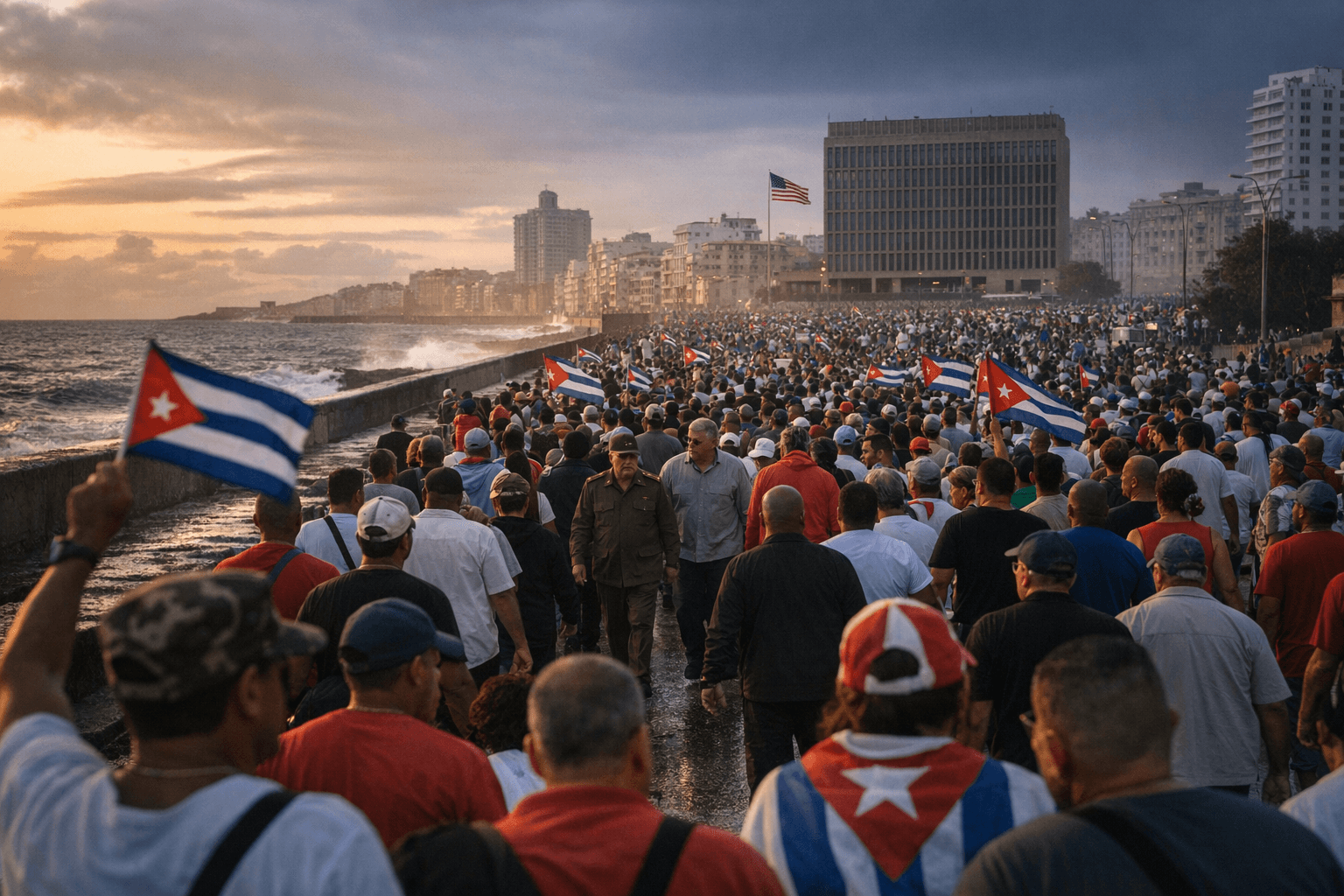
The U.S. Embassy issued a security warning to American citizens in Havana ahead of the march, given the route's proximity to the embassy compound. The José Martí Anti-Imperialist Tribune, the permanent rally platform facing the embassy, served as the event's symbolic endpoint.
Not everyone was moved. The dominant response on Cuban social media was mockery concentrated in the phrase "let Sandro go," targeting Sandro Castro, Fidel's grandson, whose publicly displayed luxury lifestyle cuts directly against the revolutionary austerity the march was meant to embody. The joke landed because it named a real contradiction that attendance figures cannot resolve.
What the December 20 march demonstrated was not simply street-level loyalty but the reach of Cuba's institutional mobilization infrastructure. The UJC, FEEM, OPJM, and parallel mass organizations remain capable of producing a large-scale, visually coherent public display on short order. Whether that capacity translates into genuine political resilience against the pressure building from below is the question the regime's next flashpoint will test.
This article was produced by Prism’s automated news system from verified source data, official records, and press releases, then run through automated quality and moderation checks before publishing. The system is built and supervised by the people who set the standards it runs under. Read our full AI policy.
Did this article answer your question?