Cuba's Deputy Foreign Minister Says Island Has Global Support Amid U.S. Pressure
165 nations backed the UN anti-embargo vote last October, yet Havana endured 15-hour daily blackouts in March. The gap between diplomatic sympathy and actual fuel is everything.
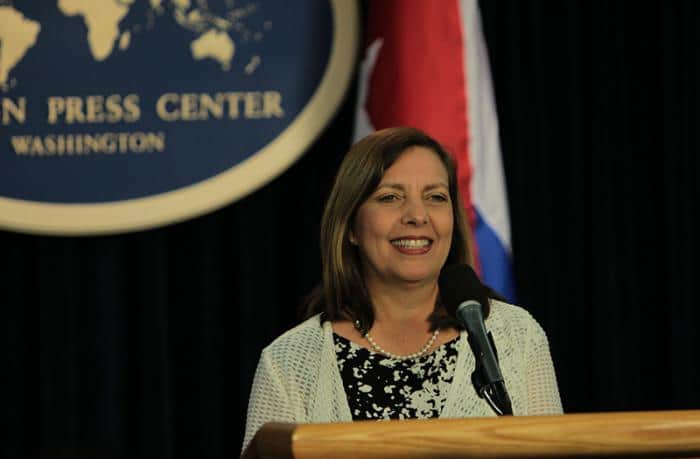
When Josefina Vidal Ferreiro, Cuba's deputy foreign minister, declared that "Cuba is not alone" in a March 29 interview as Washington's oil blockade deepened, she was pointing to something real: 165 countries voted at the United Nations in October 2025 to demand an end to the U.S. embargo, the 33rd consecutive year the resolution passed. The problem for ordinary Cubans watching from apartments with 15 hours of darkness per night is that UN votes do not pump fuel.
The gap between diplomatic sympathy and material relief defines Cuba's situation in early 2026. Vidal Ferreiro, in the interview, defended Cuba's position, rejected U.S. pressure, and warned of growing humanitarian consequences. She was also responding directly to remarks from U.S. President Donald Trump suggesting Cuba could be targeted next after Iran. Her statement served as both a defiant rebuttal directed at Washington and a reassurance aimed at Havana's domestic audience, where two island-wide blackouts hit Cuba on March 16 and 21, and residents of Havana faced up to 15 hours daily without electricity. First Secretary Miguel Díaz-Canel blamed the outages on difficulties in importing fuel due to "financial and energy persecution" by the United States.
U.S. Executive Order 14380, signed January 29, 2026, threatened tariffs against any country that directly or indirectly supplied Cuba with fuel. That order is the precise mechanism by which rhetorical solidarity fails to become gasoline. Mexico's President Claudia Sheinbaum warned of a potential humanitarian crisis, and two Mexican navy vessels departed Veracruz carrying 1,193 tons of supplies. But food aid, however welcome, does not restart power plants. Canada pledged approximately $6.7 million in assistance, routed through the World Food Programme and UNICEF, with Foreign Minister Anita Anand stating the aid would help address urgent needs. CARICOM organized a shipment of powdered milk, medical supplies, and water tanks, transported to Cuba for free aboard Mexican vessels. These are meaningful gestures; they are not crude oil.
The clearest test of the "not alone" claim came from Russia, Cuba's most strategically significant energy partner. Two Russian shadow fleet tankers were expected to deliver oil and diesel to Cuba in late March, enough for roughly two weeks of supply. But a Hong Kong-flagged vessel reportedly carrying 200,000 barrels of diesel from Russia docked in Venezuela instead of Havana, a redirection that illustrated how effectively Washington's tariff threat deterred even countries with strong political incentives to help. Putin condemned U.S. actions and pledged continued shipments; the vessel tracking data told a more complicated story.
China's support was the most concrete: Xi Jinping approved a package including $80 million in financial assistance and a donation of 60,000 tons of rice. Beijing's Foreign Ministry spokesperson Lin Jian stated that China "firmly supports Cuba in safeguarding its national sovereignty" and "will always provide support and help to the Cuban side to the best of our ability." That is real money and real grain, though not the sustained fuel supply Cuba's generating plants require.
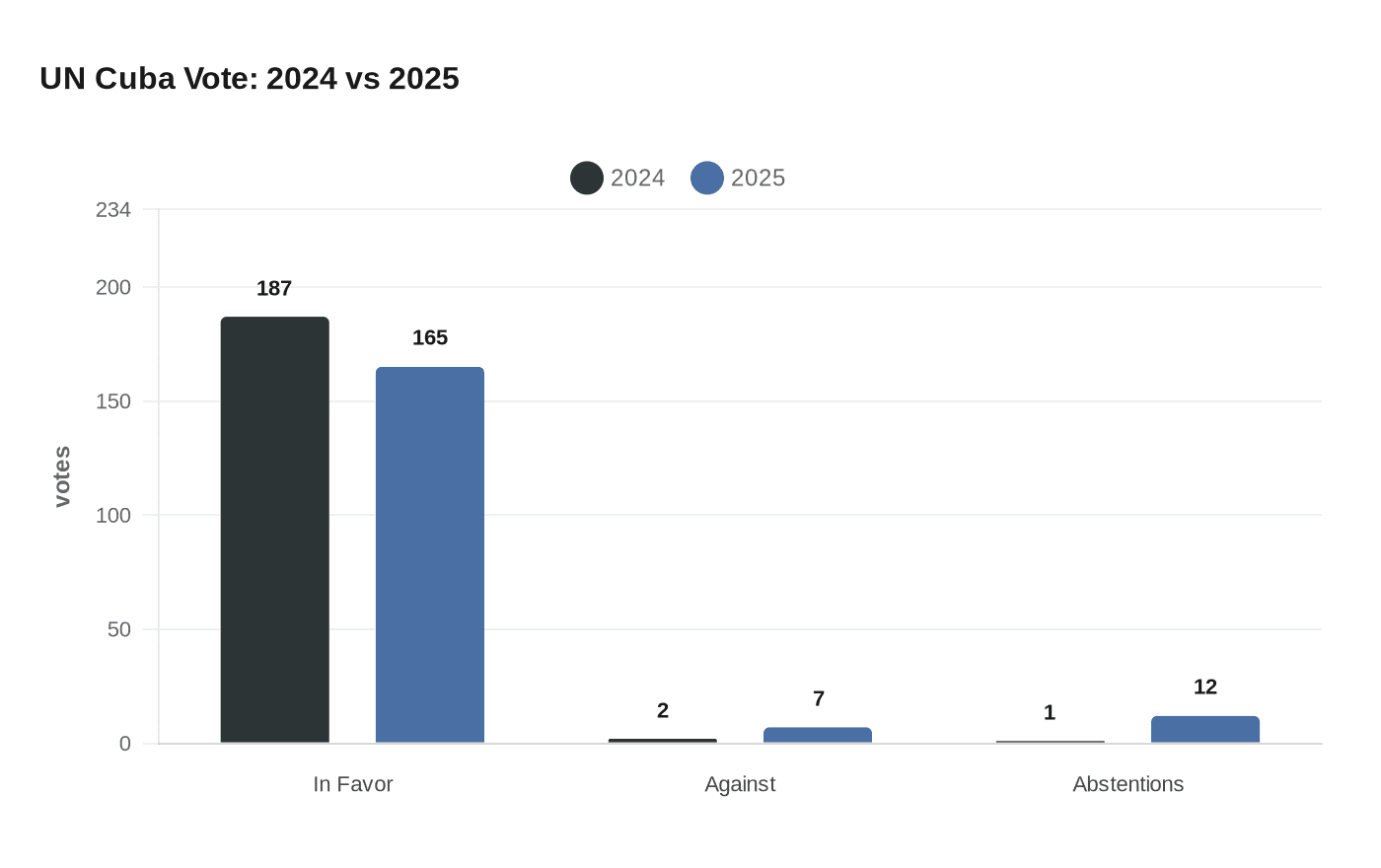
Then there is the UN vote itself, which deserves a closer read. The October 2025 tally of 165 in favor, 7 against, and 12 abstentions looks like overwhelming solidarity until compared to 2024, when 187 countries voted in favor and only the United States and Israel voted against, with one abstention. Countries including Argentina, Hungary, Israel, North Macedonia, Paraguay, and Ukraine voted against the resolution in 2025, several of them having previously supported or abstained. In one year, Cuba's margin at the General Assembly shrank considerably, a signal that U.S. diplomatic pressure is working in at least some capitals even as Havana describes deepening global solidarity.
None of this negates the strategic logic of Havana's approach. For a small state facing acute unilateral pressure, activating multilateral sympathy buys time, complicates the isolation narrative, and creates friction against further escalation. Vidal Ferreiro's interview framed Cuba's posture as resistance rather than capitulation, a message calibrated as much for domestic consumption as for foreign governments.
What her statement cannot do is bridge the distance between 165 hands raised in a New York voting chamber and a generator in a Havana neighborhood that has been dark since morning. The solidarity is genuine in many capitals. The question Cuba's government has not yet fully answered is whether that solidarity can outlast the financial deterrent embedded in Executive Order 14380 long enough to matter on the ground.
This article was produced by Prism’s automated news system from verified source data, official records, and press releases, then run through automated quality and moderation checks before publishing. The system is built and supervised by the people who set the standards it runs under. Read our full AI policy.
Did this article answer your question?