Díaz-Canel Vows No Resignation, Blames US Embargo for Cuba's Crisis
In Cuba's first U.S. TV interview since 1959, Díaz-Canel told Kristen Welker "resignation is not part of our vocabulary" as the island endures 22-hour blackouts.
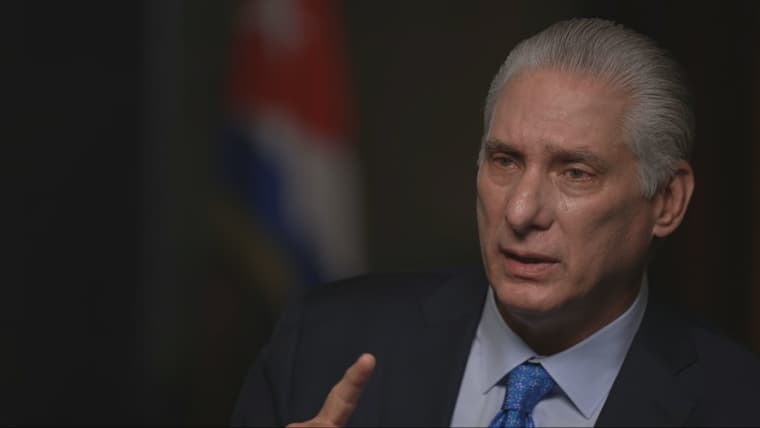
For the first time since Fidel Castro sat across from an American interviewer in 1959, a Cuban leader appeared on U.S. television. Miguel Díaz-Canel granted a sit-down with NBC News' "Meet the Press" moderator Kristen Welker in Havana on Thursday, and he came in swinging.
When Welker asked whether Díaz-Canel would be "willing to step down to save your country," the Cuban president bristled. "Resignation is not part of our vocabulary," he said, before turning the question back on her: "Do you ask that question to Trump?" He then suggested the query may have "originated from the United States Department of State." Welker did not back down, telling him she poses equally tough questions to President Trump.
The exchange came at a moment of acute collapse on the island. Cuba's economy has contracted by 23% since 2019, and the Economist Intelligence Unit projects a further 7.2% decline in 2026. Per capita GDP stood at just $1,082 in 2025, against a Latin American regional average of $10,212. Cuba and Haiti are the only two countries in the region still experiencing economic contraction. Rolling blackouts stretch up to 22 hours in some areas, and basic goods remain scarce.
Díaz-Canel pinned the crisis squarely on the more than 50-year-old U.S. embargo, accusing Washington of pursuing a "hostile policy" against the island and insisting the U.S. government has "no moral to demand anything from Cuba." He expressed openness to dialogue but drew a hard line against what he characterized as outside pressure.
Sovereignty formed the other pillar of his defense. "In Cuba, the people who are in leadership positions are not elected by the U.S. government, and they don't have a mandate from the U.S. government," he told Welker. "We have a free sovereign state. We have self-determination and independence, and we are not subjected to the designs of the United States."
Washington was quick to contest that framing. Secretary of State Marco Rubio said on March 27 that there "is no naval blockade around Cuba" and that Cuba lacks fuel because "it wants it for free."
Fuel is at the center of Cuba's current collapse. The island produces only 40% of the fuel it consumes, and oil shipments from Venezuela, a key lifeline, halted in January after U.S. intervention led to the arrest of Venezuela's then-leader. A single Russian tanker docked in Cuba recently for the first time in three months; Moscow says a second shipment is being prepared. Trump, for his part, said he had "no problem" with the Russian tanker's arrival, telling reporters he did not think it would prop up the Cuban government.
The unrest at home was conspicuously absent from Díaz-Canel's responses. Since March 6, at least 156 demonstrations have swept across multiple provinces, including road blockades, pot-banging protests, and an attack on the Communist Party's provincial offices in Morón, Ciego de Ávila, on March 14. When pressed on whether he would resign if Cubans themselves demanded it, he said he would step down only if the Cuban people deemed him unfit, a conditional that rings hollow to critics who note there is no free electoral mechanism on the island to measure exactly that.
The full interview is scheduled to air on "Meet the Press" this Sunday.
This article was produced by Prism’s automated news system from verified source data, official records, and press releases, then run through automated quality and moderation checks before publishing. The system is built and supervised by the people who set the standards it runs under. Read our full AI policy.
Did this article answer your question?