Miami Cuban Exiles Clash Over Who Will Lead a Post-Havana Transition
Rival exile coalitions have drafted a 51-member provisional council for Cuba while Marco Rubio's back-channel meetings with the Castro family sparked fury at rallies in Hialeah.
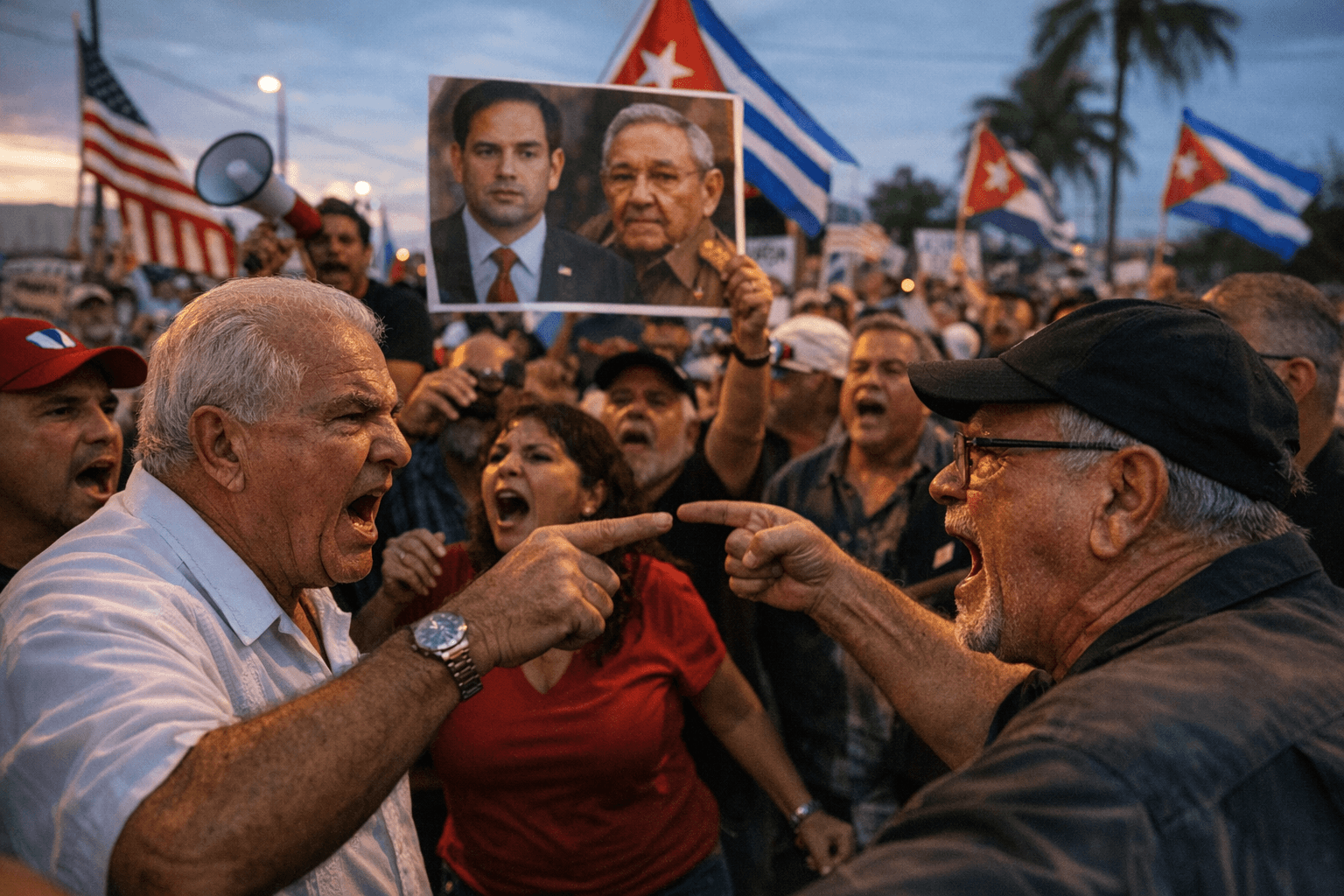
Two of Miami's most prominent exile coalitions put their names to a concrete post-regime blueprint last week, even as Secretary of State Marco Rubio's back-channel meetings with figures linked to the Castro family were generating the kind of fury that fills a hall in Hialeah.
The Asamblea de la Resistencia Cubana, led by Orlando Gutiérrez-Boronat, and Rosa María Payá's Pasos de Cambio coalition signed what they called a Liberation Agreement, proposing a 51-member provisional council to govern Cuba for up to two years. The document lays out three phases, moving from liberation through stabilization to democratization, with most council members drawn from inside the island rather than from Miami. It calls for the immediate release of more than 1,000 political prisoners and the restoration of basic freedoms, including press, association, and religion.
Payá was direct about what the plan is not. "There can be no stabilization under repression in Cuba," she said. "We don't have a wish list; we are driving a comprehensive transition plan addressing every necessary aspect during a provisional period."
The agreement landed against a backdrop that has made Miami exile politics more urgent than they have been in years. Nicolás Maduro's capture in January removed Havana's principal regional ally. Donald Trump told audiences from the Oval Office that he intended to "liberate" Cuba and that "something will happen soon." Those declarations reignited a question the exile community has never fully resolved: who speaks for Cubans when Havana shifts?
Rubio's conduct complicated the answer. His aides met Raúl Guillermo Rodríguez Castro, a grandson of Raúl Castro who holds no public office, in St. Kitts. Shortly afterward, Miguel Díaz-Canel confirmed on Cuban television that Havana and Washington were engaged in talks covering the embargo and security cooperation. For exile organizations that had long treated Rubio as their guarantor in Washington, the revelation was jarring. Exiles who reject any engagement with the regime showed up in Hialeah to say so.
Cuba scholar Ted Henken observed that Rubio appeared to be "preparing the Cuban American community for disappointment," adding: "It's possible the Cuban government resists again, or even if change comes, many promises won't be fulfilled, at least not immediately."
Ricardo Herrero of the Cuba Study Group, which favors transition through dialogue rather than collapse, was unsentimental about the underlying problem. "If you throw a rock in Miami you'll find several people who want to be president" of Cuba. His deeper concern was structural. "We can plant a ruler, but there will be a massive disconnect with the ordinary Cuban."
The Venezuelan precedent shadowed every calculation. Maduro's removal did not clean house. His inner circle survived largely intact, and proximity to Washington did not automatically translate into governing authority. A phrase circulating in Little Havana captured what that lesson means closer to home: after 67 years of waiting, no one wants to exchange a dictatorship for a protectorate.
If Washington backs the wrong coalition or bypasses exile organizations entirely in favor of a negotiated arrangement with Havana's existing power structure, the legitimacy of any transitional government will be contested before it takes office. That is the precise risk the Liberation Agreement was written to foreclose, and the precise risk that Rubio's meetings in St. Kitts have put back on the table.
This article was produced by Prism’s automated news system from verified source data, official records, and press releases, then run through automated quality and moderation checks before publishing. The system is built and supervised by the people who set the standards it runs under. Read our full AI policy.
Did this article answer your question?