Miami exhibition turns a salvaged raft into Cuba’s exile story
A salvaged raft at a Miami gallery turns Cuba’s crossing into something you can see, not just debate. Antonia Wright and Ruben Millares argue for compassion over exile hard lines.

The raft that refuses abstraction
A raft made from welded steel barrels sits at the center of Exile at Piero Atchugarry Gallery in Miami, and it does not behave like art that wants to be admired from a safe distance. Recovered from Key Biscayne in 2022, the vessel carries bullet holes, makeshift wiring, and a childlike boat drawing scratched into the metal. It looks like evidence because that is what it is: a remnant of a crossing, a scarred object from the 93-mile stretch of water that still pulls Cubans toward Florida when life on the island feels unbearable.
Antonia Wright and Ruben Millares build the show around that object for a reason. The raft gives shape to a crisis that is usually flattened into policy talk, boat-counting, or Miami talking points. Here, the journey is not an abstraction. It is metal, damage, fear, and memory made visible in the middle of the city where exile politics still define so much of Cuban American public life.
Why this story hits Miami differently
In Miami, Cuba is never only Cuba. It is family history, political inheritance, and a set of arguments that get passed down like heirlooms. Exile lands inside that debate by refusing the old habit of turning Cuban suffering into a slogan. Wright has said that the migrant experience cannot really be absorbed from a distance, and the exhibition takes that idea seriously by making viewers stand in front of an object that feels almost impossible to forget once seen.
That matters in a city where the harder-line exile narrative has long framed solidarity in narrow terms, often through punishment, pressure, and permanent confrontation. Wright and Millares answer with something more unsettling to old certainties: compassion. Their work does not ask viewers to abandon anger about repression on the island, or hope that the revolutionary government may one day fall. It asks whether those feelings can coexist with a more humane way of talking about the people still living through collapse.
For younger Cuban Americans especially, that shift carries weight. The exhibition suggests a generational turn away from pure slogan politics and toward a memory practice that can hold grief, ambivalence, and responsibility at the same time. In that sense, the raft is not only about departure. It is about who gets to define what solidarity with Cubans should look like now.
The crisis the raft records
The show gains force because the emergency on the island is not hypothetical. A State Department press statement on March 20, 2026 said Cuba was facing its 13th consecutive day of protests amid prolonged blackouts, fuel shortages, and a deepening economic crisis. That backdrop gives the exhibition its urgency: the raft is not a relic from a closed chapter but a mirror of a present tense disaster.
The official human-rights record is equally stark. The U.S. State Department’s 2024 report on Cuba says there were no significant changes in the human-rights situation during the year and lists arbitrary detention, torture or cruel treatment, censorship, and restrictions on freedom of expression among the major abuses. The 2025 Trafficking in Persons Report keeps Cuba at Tier 3, underscoring how serious the state of vulnerability remains. Together, those reports frame the island not as a place of ordinary hardship but as one where political control and humanitarian strain continue to deepen each other.
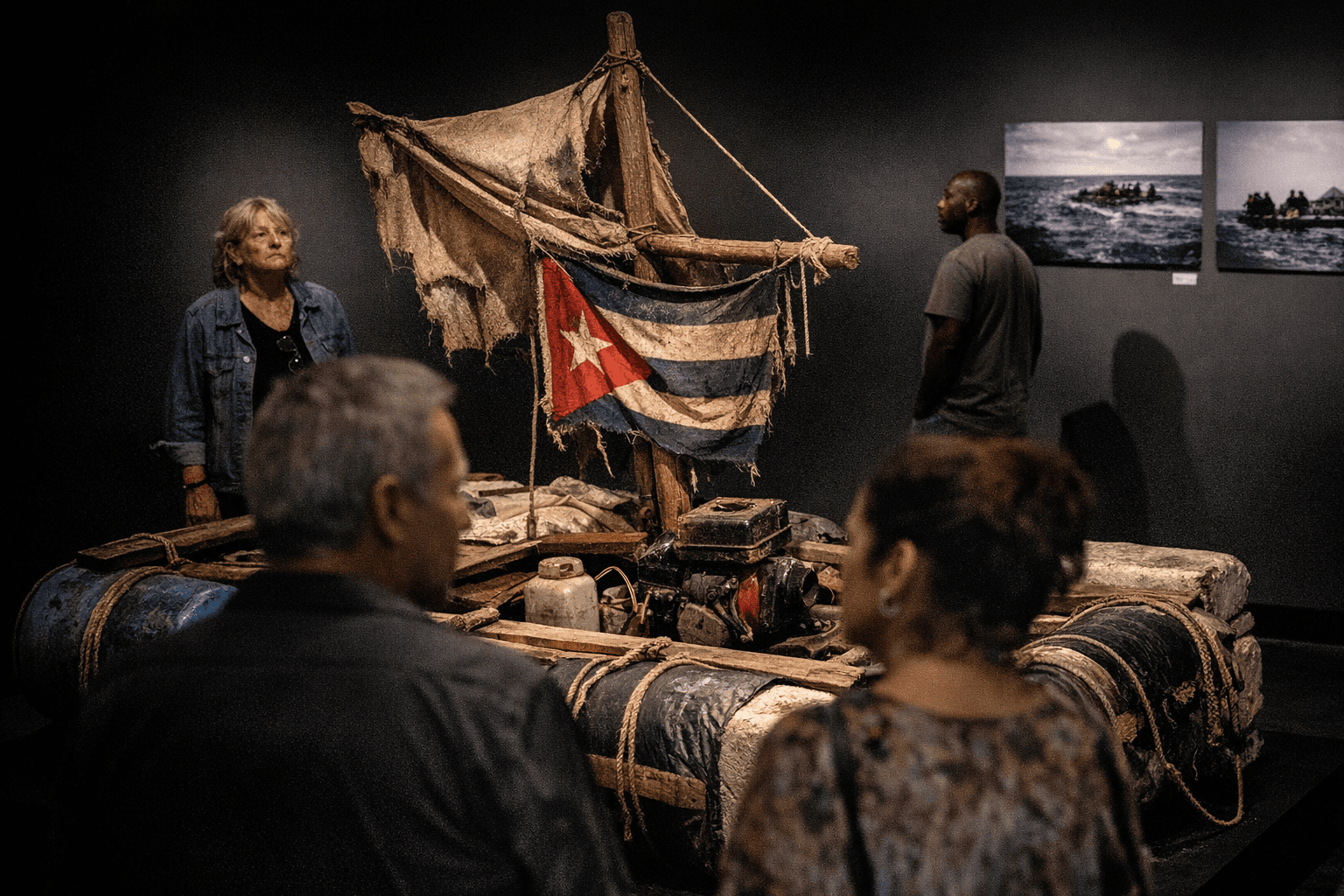
That is also why the image of a fragile boat matters so much. When people still risk the crossing in makeshift vessels, the journey becomes a verdict on daily life at home. The raft in Exile turns that danger into something Miami cannot neatly distance itself from, because so many families there know exactly what it means to wait for a relative who chose the sea over the status quo.
Art as a counter-message to exile politics
Coco Fusco’s view of the situation on the island as dire fits the exhibition’s larger argument: Cuba’s collapse is no longer something the diaspora can discuss only as an ideological battlefield. It is a humanitarian wound that continues to shape family life, migration decisions, and cultural memory. Exile responds by shifting the center of gravity from accusation to witness.
That shift is especially resonant against the background of U.S. policy language. The State Department says it supports “safe, orderly, and legal migration” from Cuba through the U.S.-Cuba Migration Accords, while also saying its broader Cuba policy is aimed at promoting human rights, religious freedom, democracy, telecommunications, internet access, and a growing private sector. The tension is obvious. Washington speaks in the language of order and reform, while the island remains in crisis and the sea remains part of the story.
Exile does not resolve that contradiction. It makes it harder to ignore. The exhibition suggests that the most honest response from the diaspora is not another round of performative certainty, but a willingness to see Cuban suffering as lived reality, not just a political instrument. That is where Wright and Millares land their argument, and it is why the show feels larger than a gallery installation.
What the exhibition leaves behind
The raft from Key Biscayne is a brutal kind of archive. Its bullet holes, wiring, and scratched drawing hold the trace of a journey, but they also preserve the moral pressure of the present. In a Miami where Cuba is often discussed through the language of victory, punishment, or leverage, Exile offers a different inheritance: one rooted in care, memory, and the refusal to reduce people to the politics made around them.
Running through May 2, 2026, the exhibition turns a salvaged vessel into a public reckoning. It asks whether the diaspora can keep faith with Cuba’s suffering without surrendering to the old scripts that made that suffering easier to weaponize. The answer, hanging in the gallery with the raft, is that compassion is not softness. In this story, it is the hardest argument in the room.
This article was produced by Prism’s automated news system from verified source data, official records, and press releases, then run through automated quality and moderation checks before publishing. The system is built and supervised by the people who set the standards it runs under. Read our full AI policy.
Know something we missed? Have a correction or additional information?
Submit a Tip