Raúl Castro still holds Cuba’s real power behind a broader facade
Díaz-Canel has the title, but Raúl Castro still sits at the center of Cuba’s real command structure, now hidden behind a more bureaucratic facade.
The real center of Cuban power has not moved far
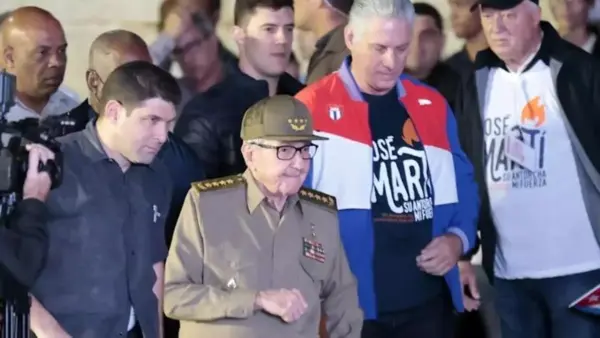
Miguel Díaz-Canel may occupy the presidency, but the command structure around Cuba still points back to Raúl Castro. The system has changed shape since the days of Fidel Castro, becoming more bureaucratic, more layered, and less visibly personal, yet the essential logic remains the same: a narrow circle still controls the strategic decisions while public institutions do much of the visible work.
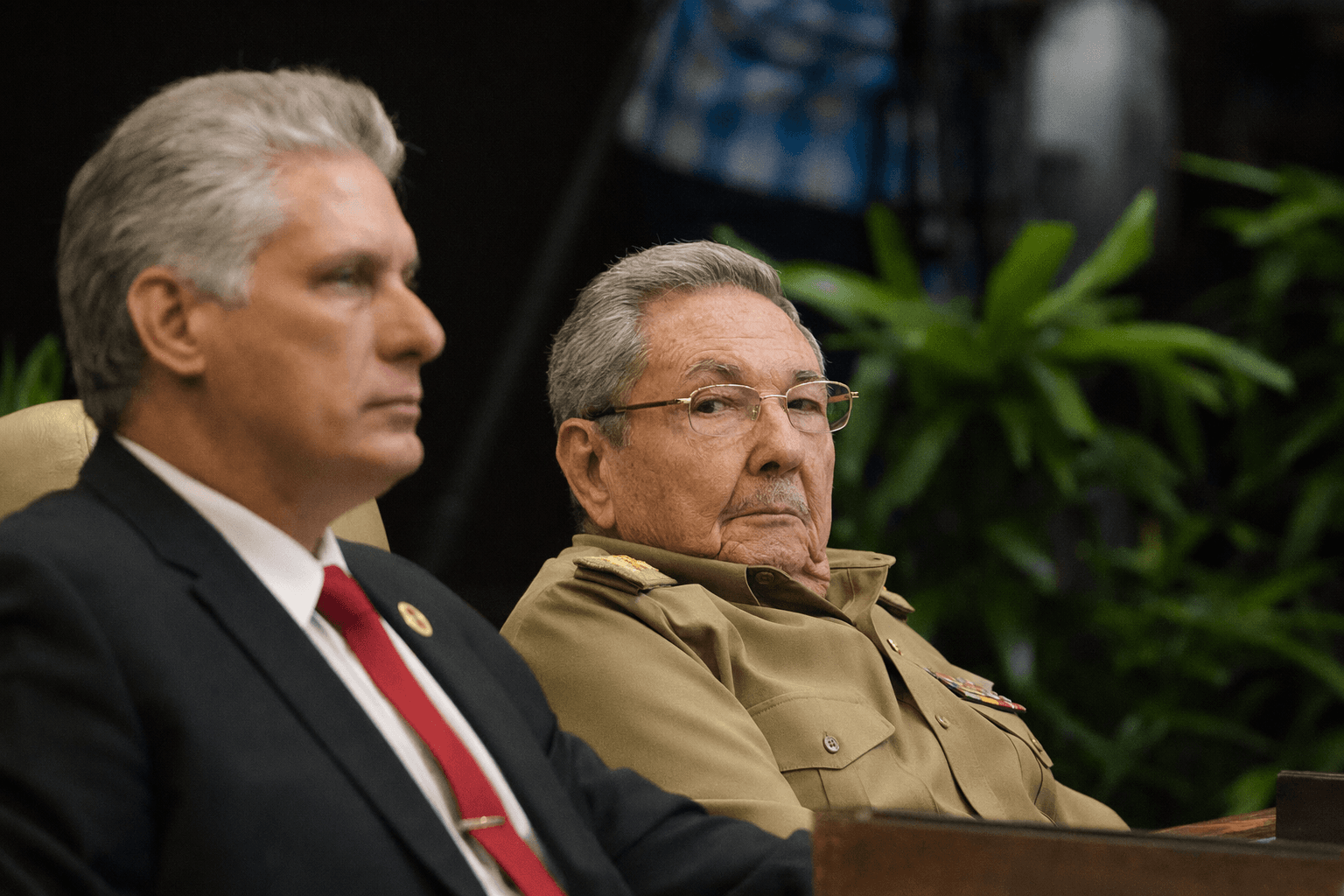
That is why the distinction matters. When policies fail, the people in front are not always the people who set the direction. In Cuba, the facade has grown broader, but the center of gravity still sits with Raúl Castro and the family and military network around him.
How the system hides power instead of sharing it
Under Fidel Castro, power was easier to identify because it was concentrated in a charismatic top-down model. Today, authority is spread across more intermediaries: technocrats, ideological officials, military-business managers, and sector heads who can make the state look more institutional without making it more accountable. The result is not a redistribution of authority, but a better shield for it.
That shield matters in a country living through deep strain. Cuba’s nationwide blackouts, its crumbling power grid, and shortages that touch daily life are not just technical failures. They are the visible signs of a system in which real power is concentrated high above the people who have to live with the consequences.
Who makes decisions, and who mainly fronts them
The clearest public face of government remains Díaz-Canel, but his role often reads as administrative rather than sovereign. He holds the presidency, yet the signals coming out of Havana repeatedly point to Raúl Castro as the deeper authority, especially on matters that touch state security, the military, and strategic negotiations.
A useful accountability map looks like this:
- Raúl Castro remains the central figure behind the curtain, even after leaving the presidency in 2018.
- Miguel Díaz-Canel is the public head of state, but his title does not erase the perception that he is not the final center of command.
- The Central Committee of the Communist Party of Cuba and the Council of Ministers of Cuba provide institutional cover, but they operate inside a hierarchy shaped by the old guard.
- GAESA, the military-controlled conglomerate, anchors economic power through tourism, financial investment, import-export, and remittances.
- Family insiders and trusted intermediaries help preserve continuity, which is why proximity often matters more than formal office.
That structure is what makes Cuba’s politics so hard to read from the outside. The people with the loudest titles are not always the ones with the last word.
Why the U.S. talks exposed the real hierarchy
One of the most revealing moments came on March 13, 2026, when Díaz-Canel publicly said Cuban officials had opened talks with the United States and described them as being led at the highest level, including Raúl Castro. That was not just a diplomatic detail. It was a sign that the former president still had to be named, and not as a ceremonial elder.
Associated Press reporting on March 25 and 26, 2026 went further, saying Raúl Castro was involved in early-stage talks with the United States. For a system that often prefers to present continuity through institutions rather than personalities, the need to acknowledge his role was telling. The message was simple: if Washington wanted to understand where decisions were really made, it had to look beyond the office of the president.
The talks also unfolded against worsening nationwide blackouts and a power grid in visible collapse. That matters because Cuba’s diplomatic posture cannot be separated from the domestic reality pressing on households, hospitals, shops, and transport. A government negotiating from a position of crisis tends to rely even more heavily on the inner circle that controls security, money, and access.
GAESA is the economic backbone behind the political one
If Raúl Castro represents the personal and family side of concentrated power, GAESA represents the institutional side. The U.S. Department of the Treasury has identified Grupo de Administración Empresarial S.A. as a Cuban military-controlled umbrella enterprise with interests in tourism, financial investment, import-export, and remittances. Later analysis has described it as one of the country’s most powerful institutions, and that is not exaggeration.
GAESA matters because it sits at the crossroads of money and control. When a military-linked conglomerate touches the sectors that bring in hard currency and shape everyday access to goods, economic weakness becomes a political asset for the center. The more the economy depends on opaque structures, the less ordinary Cubans can tell where responsibility begins and ends.
That is exactly why the distinction between public ministries and military-business structures matters so much. A policy failure may look like a market problem, a logistics problem, or a sanctions problem, but the real leverage often sits inside institutions designed to be hard to see.
Why Raúl Guillermo Rodríguez Castro is a signal, not just a name
Late-April 2026 reporting described Raúl Guillermo Rodríguez Castro, Raúl Castro’s grandson, as a key intermediary in backchannel contacts with U.S. officials. His role is important not because he carries formal power, but because he shows how political proximity still operates in Cuba. The nickname “Raulito” captured that dynamic well: access can flow through family lines even when titles stay thin.
He was also reported to have traveled to Saint Kitts to meet one of Marco Rubio’s top advisers. That detail reinforces the same point from another angle. In Cuban politics, trusted intermediaries can matter more than visible officeholders, especially when sensitive negotiations need deniability, discretion, or continuity with the old guard.
For readers trying to track who really matters, that is a crucial clue. If a relative can open a door that formal institutions cannot, then the public chain of command is only part of the story.
Why Díaz-Canel can look decorative without being irrelevant
Calling Díaz-Canel decorative does not mean he is meaningless. It means his power appears bounded by a structure that still answers upward. He is the face that can speak in public, absorb pressure, and present decisions as institutional, but he does not fully control the architecture behind those decisions.
That became obvious when he felt compelled to insist that U.S. talks were led by him, Raúl Castro, and other officials. The insistence itself carried anxiety. A leader confident in full authority does not need to underline it so carefully.
His role is best understood as the presidency inside a managed system, not the final seat of command. The difference explains why official statements in Havana often sound broader than they are. They can name many actors while leaving the deepest authority unchanged.
What this means for anyone watching Cuba now
The biggest mistake is to treat Cuba’s power structure as if dispersion automatically means reform. In practice, the opposite can be true. Power can become less visible, more networked, and harder to challenge while remaining fully centralized.
That is why readers should watch three things together:
- Who is named in negotiations, especially when the United States is involved.
- Who controls military-business channels, especially GAESA’s economic reach.
- Who family-linked intermediaries can reach, because backchannels often reveal the real hierarchy.
This is also where repression fits into the picture. Recent U.S. State Department reporting has cited repression, arrests, and pressure on independent journalists and protesters. In a state already under energy stress, that kind of control helps preserve order by narrowing who can speak, organize, and push back.
The result is a system of managed crisis. Cuba’s power no longer needs to appear everywhere to hold everything. It can stay hidden behind institutions, military enterprises, and inherited loyalty while still shaping the country’s direction. That is why Raúl Castro remains the figure to watch: not because he is the loudest voice, but because so much still leads back to him.
This article was produced by Prism’s automated news system from verified source data, official records, and press releases, then run through automated quality and moderation checks before publishing. The system is built and supervised by the people who set the standards it runs under. Read our full AI policy.
Did this article answer your question?