Starlink spreads quietly across Cuba as blackouts cripple internet access
Starlink is slipping onto Cuban rooftops as blackouts and ETECSA’s limits push users toward a risky workaround. The reward is reliable service, but the cost is secrecy, fines, and a challenge to the state telecom monopoly.
A signal people are hiding
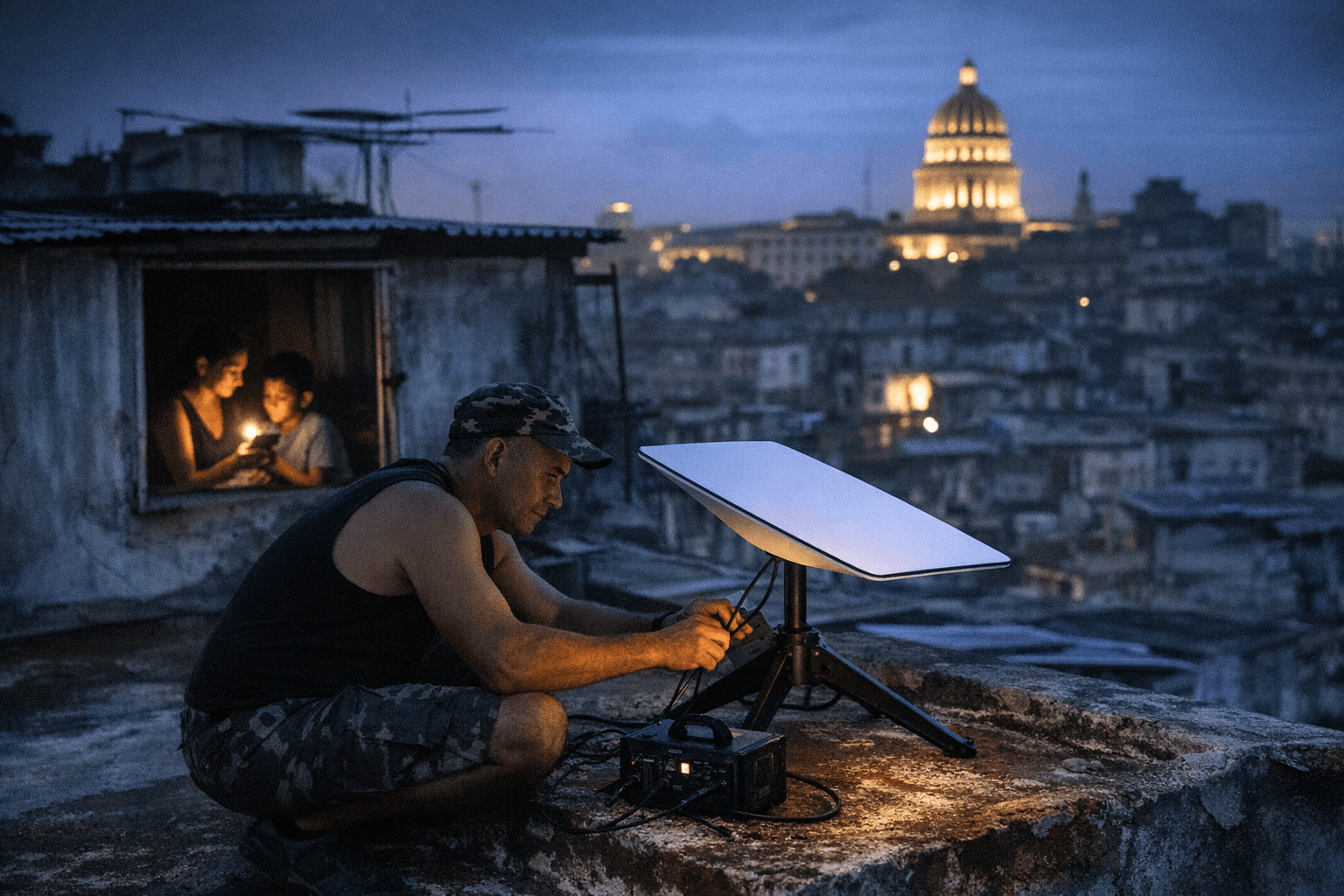
A rectangular Starlink dish on a rooftop has become a small act of defiance in Cuba. In Havana, Matanzas, and Santa Clara, the kit is showing up where people need it most, often kept out of sight from neighbors and authorities because the service is still illegal to market openly on the island.
That secrecy tells the whole story. Cubans are not chasing a luxury gadget; they are chasing a connection that keeps working when the power cuts out and the state network bogs down. In a country where internet access can be expensive, unstable, and limited by blackouts, the draw of Starlink is less about ideology than survival.
How the hardware gets across the line
Getting a Starlink kit into Cuba is often as improvised as using it. The equipment may be broken into pieces and hidden inside televisions, computer towers, cables, or other electronic scrap, a tactic meant to blend in with ordinary luggage and avoid attention at customs.
Once inside, the challenge becomes keeping the dish alive and unnoticed. Users need a place with a clear view of the sky, but they also need the installation to stay discreet. That is why many setups are paired with backup batteries, UPS systems, or small solar arrays, so the connection can survive the country’s constant outages instead of dying with the grid.
The risk is not theoretical. Cuban customs said in April 2025 that it blocked the illegal entry of 20 Starlink devices at Havana airport, and state-linked reporting said the same operation also involved 85 routers. That crackdown makes clear that satellite internet gear is no side issue for the authorities, it is already treated as a target.
Why people are willing to pay anyway
The strongest argument for Starlink in Cuba is practical, not political. One programmer in Matanzas said he needs a more stable connection to do work for foreign clients, and that ETECSA could not reliably deliver it. His family in Miami helps pay the subscription, a detail that captures the new divide in Cuban connectivity: those with outside support can buy themselves a better line.
That cost still matters, but for some households it is worth it because daily life now runs through the internet. Work, school, communication with relatives abroad, medical coordination, and digital payments all depend on a connection that does not vanish every time the lights go out. For a small but wealthy slice of the population, the dish is becoming a private escape hatch from a public failure.
The broader context is the June 2025 backlash over ETECSA’s mobile-data price hikes. Students protested after subsidized plans were capped at 6 GB, and Reuters reported that an extra 3 GB would cost 3,360 pesos, well above the monthly minimum wage of 2,100 pesos. That gap explains why an illegal satellite option can look rational even before you factor in the outages.
Musk’s post turned a rumor into a fact
The turning point came when Elon Musk wrote on X on March 16, 2026: “Works in Cuba, just can’t be sold there.” That one line did not legalize anything, but it did confirm what many Cubans were already seeing on rooftops and in underground networks: the signal reaches the island even if the company cannot sell the service there openly.
A report the next day reinforced the point, saying Starlink’s signal reaches Cuban territory while the service remains unmarketed on the island and exposed to possible fines, confiscation, and other penalties. In other words, the technical door is open, but the legal door is still shut. That tension is exactly what is making the service so attractive to people who can obtain it quietly.
For Cuban users, that distinction matters. A service that works but cannot be sold becomes a shadow market, and a shadow market thrives wherever official systems fail to meet demand. The more the state insists on control, the more valuable the workaround becomes.
What the crackdown says about ETECSA’s grip
The fight over Starlink is really a fight over the limits of the state telecom model. ETECSA remains the dominant provider, yet its pricing, outages, and data caps are pushing users toward alternatives that the government cannot easily regulate once they are hidden inside homes and apartments.
That is why the rooftop dish matters far beyond one subscriber. It shows that Cubans are willing to smuggle, pay extra, and risk punishment to get around a monopoly that no longer feels dependable. It also shows how quickly a banned technology can turn into a symbol of everyday resistance when the official network cannot keep up.
The state has already signaled that it understands the threat. Customs seizures, router crackdowns, and the broader pressure on unauthorized equipment all point to a government trying to hold the line as demand leaks outside its control. But every hidden dish says the same thing: when people can no longer count on the official connection, they will build a private one, even if it has to come through the black market and survive the blackout.
This article was produced by Prism’s automated news system from verified source data, official records, and press releases, then run through automated quality and moderation checks before publishing. The system is built and supervised by the people who set the standards it runs under. Read our full AI policy.
Did this article answer your question?