US Navy drone patrols off Cuba amid rising tensions with Havana
A 12-hour MQ-4C Triton flight traced Havana and Guantanamo Bay as Washington hardened its Cuba policy and widened its watch over migration, security, and maritime incidents.
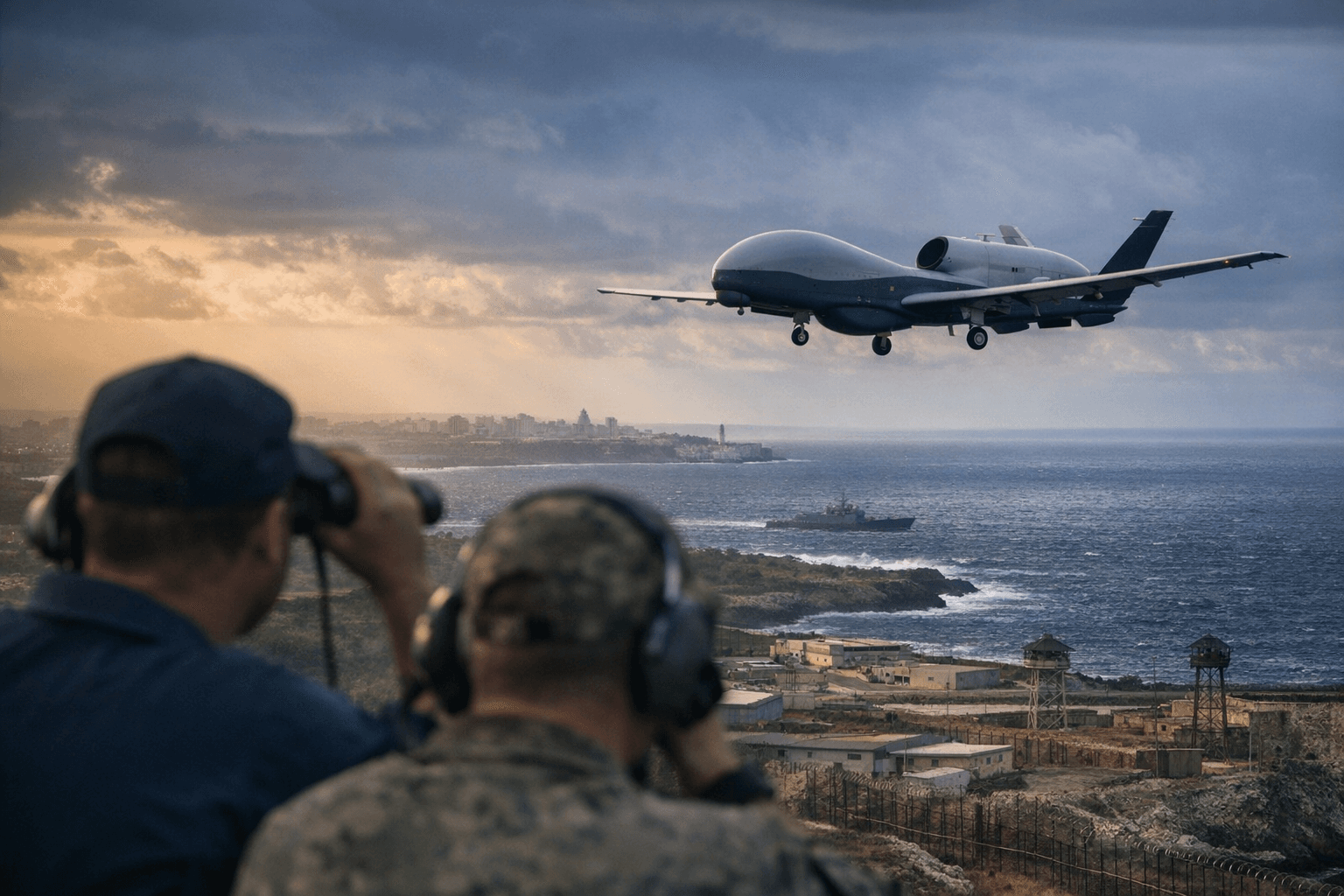
A U.S. Navy MQ-4C Triton spent 12 hours circling off Cuba’s coasts, tracing the Gulf of Mexico and the North Caribbean with Havana and Guantanamo Bay in view. The flight was not just another patrol. It landed in the middle of a sharper U.S. calculation about Cuba: a country Washington now describes as an unusual and extraordinary threat, and a place where maritime surveillance has become part of a broader pressure campaign.
The timing matters because the policy backdrop has changed fast. In June 2025, the Trump administration said it had signed a National Security Presidential Memorandum to strengthen U.S. policy toward Cuba. By January 2026, The White House said Cuba constituted an unusual and extraordinary threat to U.S. national security and foreign policy, while also saying Havana aligned itself with Russia, China, Iran, Hamas, and Hezbollah. That language turns a drone patrol into something larger than a routine maritime scan. It signals that Washington is watching Cuba not only as a nearby island, but as a node in a wider adversarial network.
The other pressure point is movement, not just missiles. In January 2026, the White House said Cuba had failed to cooperate sufficiently on law-enforcement information, had refused to accept removable nationals, and had posted a high visa overstay rate. Those issues make surveillance off the Cuban coast part of a bigger set of concerns that includes migration enforcement and security coordination. When a country is seen as uncooperative on removals and information sharing, the watch list grows, and so does the political value of keeping eyes on the water.
Guantanamo Bay adds another layer of sensitivity. Any sustained military flight near that base, and near Havana, is loaded in a way few other patrols in the region are. The MQ-4C Triton is built for exactly this kind of mission. Naval Air Systems Command says it can fly above 50,000 feet for more than 24 hours and cover 7,400 nautical miles, which makes it a natural platform for long-range, persistent maritime intelligence, surveillance, and reconnaissance. The aircraft can stay above the weather, above most threats, and keep watch long enough to map patterns, not just snapshots.
That same week, Washington was still dealing with another Cuba-related file: Secretary of State Marco Rubio said the U.S. was tracking an off-coast Cuban maritime incident with the Department of Homeland Security, the U.S. Coast Guard, and the embassy in Havana involved. At the same time, the State Department said it was providing $3 million in disaster assistance to the Cuban people after Hurricane Melissa. The result is a familiar but increasingly tense mix: aid on one hand, pressure and surveillance on the other, with the old embargo from February 1962 still framing every move.
This article was produced by Prism’s automated news system from verified source data, official records, and press releases, then run through automated quality and moderation checks before publishing. The system is built and supervised by the people who set the standards it runs under. Read our full AI policy.
Did this article answer your question?