Adonis Rose Celebrates New Orleans Drumming Lineage and Legacy
Adonis Rose turns New Orleans drumming into a living practice, connecting family lineage, NOJO stewardship, and the city’s next generation of players.

Why Adonis Rose matters in the New Orleans drum story
You cannot talk about New Orleans without talking about great drummers and drumming, and Adonis Rose sits right in the center of that conversation. He is a New Orleans native, a Grammy Award-winning drummer, producer, composer, educator, and cultural diplomat, which tells you immediately that this is not just a player profile. This is about stewardship, about how a city’s rhythm survives because someone protects it, interprets it, and hands it forward with intent.
That matters now because Rose is part of a broader effort to keep New Orleans drumming documented as a living tradition, not a museum piece. Modern Drummer has recently highlighted Johnny Vidacovich, Joe Dyson, Herlin Riley, and Teddy “Tif” Lamson, and Rose’s interview fits into that same current. The message is clear: the city’s drumming heritage is still being played, argued over, taught, and remade in real time.
A lineage that starts at home
Rose’s story carries family weight, and in New Orleans that is never a small detail. He came from a musical family, with bassist Chris Severin as his uncle, and sources identify Vernon Severin as his father and Wilfred “Crip” Severin Jr. as his grandfather, both influential drummers in the city. He also took to the drums early, influenced by his father and the legendary James Black, which helps explain why his playing is rooted in more than chops. It is rooted in inheritance.
That kind of background changes how you hear a drummer. The groove is not just a personal voice, it is a family language and a neighborhood accent. In New Orleans, that usually means the kit is only part of the story, because the deeper lesson is how the drummer carries second-line feel, street processional energy, church precision, and club-band flexibility without turning any of it into a caricature.
What the lineage actually looks like
The interview’s power comes from the names it surrounds Rose with. The city’s drumming line stretches through Dee Dee Chandler, Earl Palmer, Eugene “Bones” Jones, Cornelius “Tenoo” Coleman, Idris Muhammad, John Boudreaux, Ricky Sebastian, Walter Lastie, Louis Barbarin, Herman Ernest, Stanton Moore, Russell Batiste, Terrence Higgins, Gerald French, Brian Richburg, Alvin Ford, and Joey Peebles. That is not a decorative list. It is a map of how New Orleans drumming has been preserved through players who understood feel, community, and continuity.
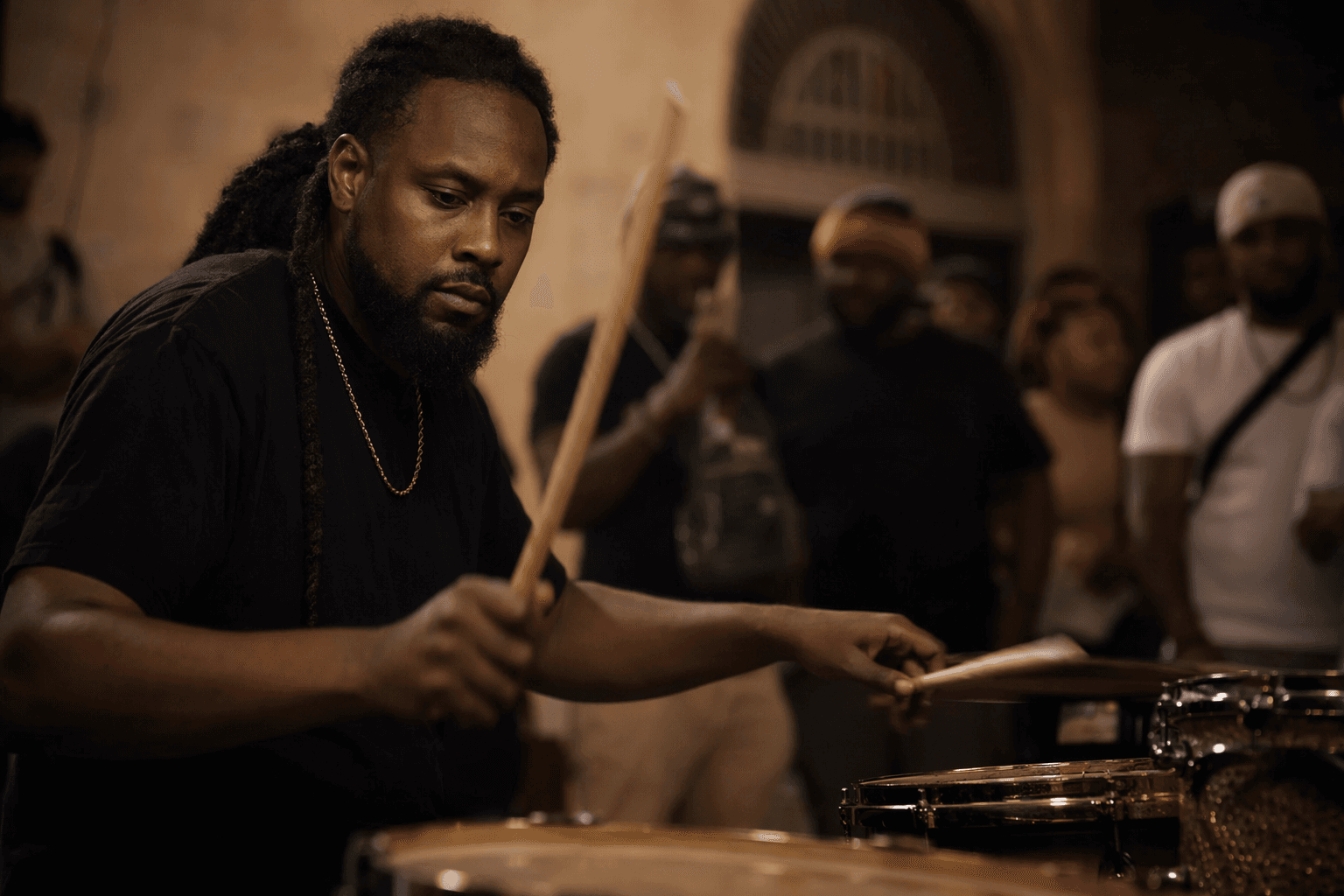
For drummers, the lesson is practical. New Orleans is not a single pattern or a stock groove you pull off the shelf. It is a community and a pedagogy, where older players shape the phrasing, the time, and the social function of the music that younger players inherit. Rose stands inside that chain, and his importance comes from being both a beneficiary of the tradition and a custodian of it.
NOJO as an institution, not just a band
Rose’s stewardship becomes even clearer through the New Orleans Jazz Orchestra. NOJO was formed in 2002 as an 18-piece big band created to celebrate and strengthen the American jazz portfolio, and Rose was named artistic director in January 2017. He then led NOJO into its first concert season in October 2017, which is the sort of detail that matters because it shows leadership, not just prestige.
His résumé backs that up. Rose won a Grammy Award with NOJO in 2010 for Best Large Ensemble, and he has more than 50 recordings to his credit, including five as a leader. That is the profile of someone who has already done the hard work of turning heritage into a functioning institution. In a city where jazz and brass-band vocabulary can be treated like branding, Rose’s role at NOJO shows what real preservation looks like: rehearsals, repertoire, public performance, and the discipline to keep the music legible to the next player in line.
The hard part of stewardship
Stewardship also means navigating the damage done to institutions. In December 2017, Irvin Mayfield and Ronald Markham were indicted on federal charges including conspiracy, wire fraud, mail fraud, money laundering, and obstruction of justice. That scandal cast a long shadow over the New Orleans jazz ecosystem, and it made leadership around NOJO even more consequential.
Rose’s job in that environment was bigger than playing well or booking gigs. He had to help restore credibility while keeping the repertory alive. That kind of work is invisible when it is done well, but it is exactly what keeps a scene from collapsing into nostalgia. New Orleans music only stays meaningful when someone is willing to do the administrative, educational, and public-facing labor that supports the art.
How Rose keeps the tradition moving
One of the clearest signs that Rose sees New Orleans drumming as a living export is the way he keeps presenting it in different formats. In April 2023, he assembled the Crescent City All-DruStars for a set at the Exit Zero Jazz Festival in Cape May, New Jersey. That move says a lot. It places New Orleans drumming in front of an outside audience without sanding off the local specificity that makes it matter.
Even more telling is NOJO7, the seven-person offshoot drawn from the full orchestra. It is designed to work in Brass Band style and move across traditional New Orleans music, funk, R&B, and originals. That flexibility is the whole point. If you want to understand the city’s drum legacy, you have to hear how its players can move from a procession feel to a straight-ahead pocket, from ensemble writing to street-band propulsion, without losing identity.
What drummers can take from Rose’s example
The practical value here is bigger than biography. Rose shows what it looks like to honor lineage without freezing it. He is not treating New Orleans drumming like a set of relics to be displayed behind glass. He is treating it like a working vocabulary that can survive only if it is used, taught, adapted, and booked.
A few takeaways stand out:
- Learn the names behind the sound. New Orleans drumming is built on figures like Earl Palmer, Idris Muhammad, Walter Lastie, and Stanton Moore, not just on anonymous style markers.
- Treat feel as culture, not ornament. In this city, groove carries memory, social function, and community history.
- Build institutions as seriously as you build technique. NOJO shows that a scene needs organization, leadership, and repertoire.
- Be able to translate the tradition. NOJO7 matters because it can move from Brass Band style to funk, R&B, and originals without losing the New Orleans core.
- Accept that preservation includes accountability. The post-2017 context around NOJO makes clear that stewardship is also about rebuilding trust.
Rose’s story lands because it connects all those pieces. He is a drummer, but also a teacher, a cultural carrier, and an organizer of other people’s music. That combination is what keeps New Orleans drumming alive, and it is why his place in the lineage feels less like a tribute and more like a responsibility still being carried onstage.
This article was produced by Prism’s automated news system from verified source data, official records, and press releases, then run through automated quality and moderation checks before publishing. The system is built and supervised by the people who set the standards it runs under. Read our full AI policy.
Did this article answer your question?