China Post honors traditional percussion instruments with new stamp set
China Post’s new five-stamp percussion set is more than a collectible: it’s a compact lesson in Chinese ritual sound, from bronze bells to hand-clappers.
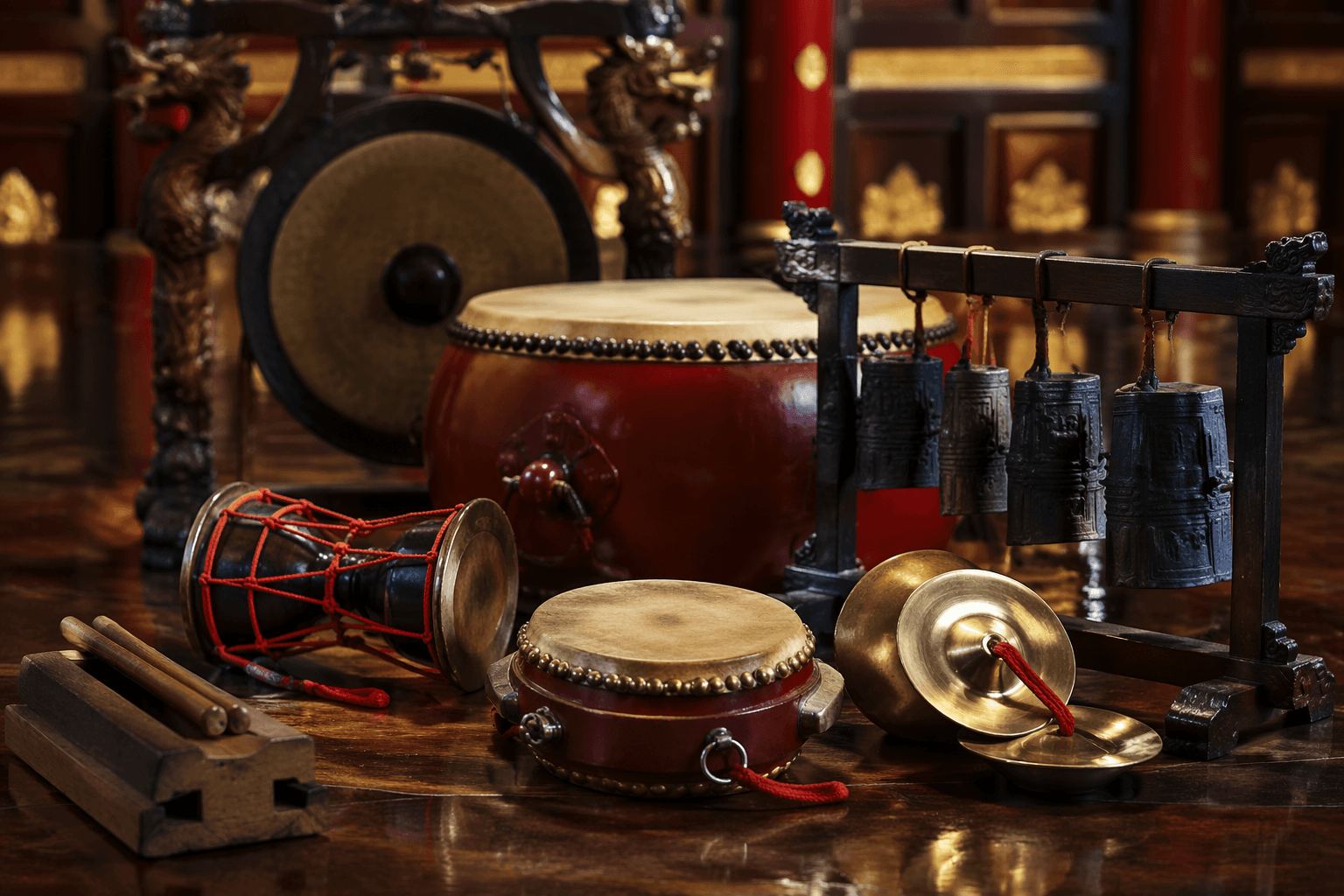
China Post has turned five traditional percussion instruments into a compact masterclass in musical heritage. The new set, issued as Traditional Chinese Musical Instruments - Percussion Instruments, uses stamp design, engraving, and AR audio to show why these instruments still matter to drummers, collectors, and anyone who cares about how culture gets preserved in public.
A percussion set with real musical weight
This is not a novelty issue dressed up as a music story. China Post has been issuing the Traditional Chinese Musical Instruments series since 1983, starting with the 1983 T.81 set for plucked instruments and adding bowed instruments in 2002. The percussion issue is the third group, and that matters because it places drums, bells, chimes, gongs, and clappers inside a long-running archive rather than a one-off commemorative release.
The five stamps were issued on June 13, 2026, the same day as the year’s Cultural and Natural Heritage Day. The set has a total face value of 5.20 yuan, an issuance quantity of 3.92 million sets, and a sale period of six months through designated post offices plus China Post’s online and mobile retail channels. Each stamp measures 30 by 40 mm, and the sheet format is 20 stamps per sheet, or four complete sets per sheet.
Why these five instruments, and why these five images
The set features bianzhong, bianqing, a large tanggu drum, a large gong, and paiban. That selection gives the issue a broad percussion vocabulary: bronze bells and stone chimes for courtly and ceremonial sound, frame-based drum and gong imagery for impact, and paiban for the sharp, timekeeping click that sits at the opposite end of a giant bell’s resonance.
For drummers, the important thing here is scale. These instruments range from the monumental to the hand-sized, and China Post’s designers had to make them coexist on one small format without flattening their character. Shen Jiahong and Shang Ying handled that by bringing the largest instruments forward while still keeping their full forms visible in the background, which is exactly the right instinct when you’re trying to fit a culture’s whole percussion identity onto a stamp face.
That design problem is familiar to anyone who has ever tried to photograph a full kit, a rack of gongs, or a temple percussion setup in a way that still reads as a single ensemble. If one instrument dominates, the series loses coherence. If everything is reduced to the same size, the music loses hierarchy. The set works because it preserves both.
The historical center of the issue is bianzhong
The strongest historical anchor is the bianzhong, the bronze bell set that has become one of the most recognizable symbols of ancient Chinese music. China Post says the bells originated in China and rose to prominence in the Zhou dynasty, especially during the Spring and Autumn and Warring States periods. The background image on the stamp is based on the Marquis Yi of Zeng bianzhong, unearthed in 1978 in Suizhou, Hubei Province, and dated to 433 B.C.
That detail gives the issue real depth. Bianzhong are not just decorative museum pieces, they are evidence of how percussion functioned as power, ritual, and acoustic architecture. The stone chimes, or bianqing, push the same idea into a different material register, which is part of why this set feels so smart: it doesn’t just show “things that make noise.” It shows how materials, pitch, and ceremony shaped a civilization’s sound world.
China Post also notes that percussion, as a broader family, includes instruments that create sound not only by striking, but also by shaking, rubbing, or scraping. That definition is a useful reminder for any drummer or percussionist who tends to think too narrowly about the section. It is not just about sticks and heads. It is about all the ways a controlled impact, friction, or motion can organize time and color.
How the stamps were made
The production side is unusually rich for a stamp issue. China Post says the set uses offset plus engraving printing, with security paper, security ink, irregular perforations, and fluorescent overprinting as anti-counterfeiting measures. The engravers listed are Yang Zhiying, Li Hao, Yin Xiaofei, and Xu Zhe.
That matters because the tactile quality of engraving still gives a stamp a physical presence that flat offset alone cannot match. You can see it in the line weight and the depth of the forms, and you can feel it when a stamp moves under your fingers. For a subject like percussion, where texture and attack are everything, that choice fits the theme perfectly. The result is both secure and musical in the way it handles detail.
A stamp that plays back its own subject
The cleverest part of the issue may be its AR function. Viewers can scan the stamps with a smartphone and hear corresponding sounds, turning the set into a multisensory introduction to percussion rather than a static image spread. China Post also says additional digital content will be released through the China Philatelic Stamp Encyclopedia mini-program.
That pushes the stamp beyond illustration and into guided listening. A collector can look at the bianzhong and then hear what the idea of bell-based ritual music might actually sound like. A drummer can do the same with the gong or tanggu and think about how each attack occupies space differently. It is the kind of digital layer that makes sense when the physical object is already doing serious historical work.
Why the date and the setting matter
The release was timed to 2026 Cultural and Natural Heritage Day, whose national theme is “Cultural Relics Belong to the People and Serve the People.” The main city events were held in Wuhan, Hubei Province, with host city activity jointly organized there by the National Cultural Heritage Administration and the Hubei provincial government.
That timing is not decoration. It frames the stamp set as part of a broader public argument about what gets preserved, taught, and symbolically elevated. When a state postal system gives five percussion instruments this kind of presentation, it is saying these sounds belong in the national memory, not just in archives or museums.
That is the real value here for anyone serious about drumming. The set widens the vocabulary. It links the strike of a gong, the sustain of a bell, the snap of a paiban, and the ceremonial authority of ritual percussion into one visual lesson. The stamps may be small, but they hit like a well-orchestrated ensemble, and that is exactly why they land.
This article was produced by Prism’s automated news system from verified source data, official records, and press releases, then run through automated quality and moderation checks before publishing. The system is built and supervised by the people who set the standards it runs under. Read our full AI policy.
Did this article answer your question?