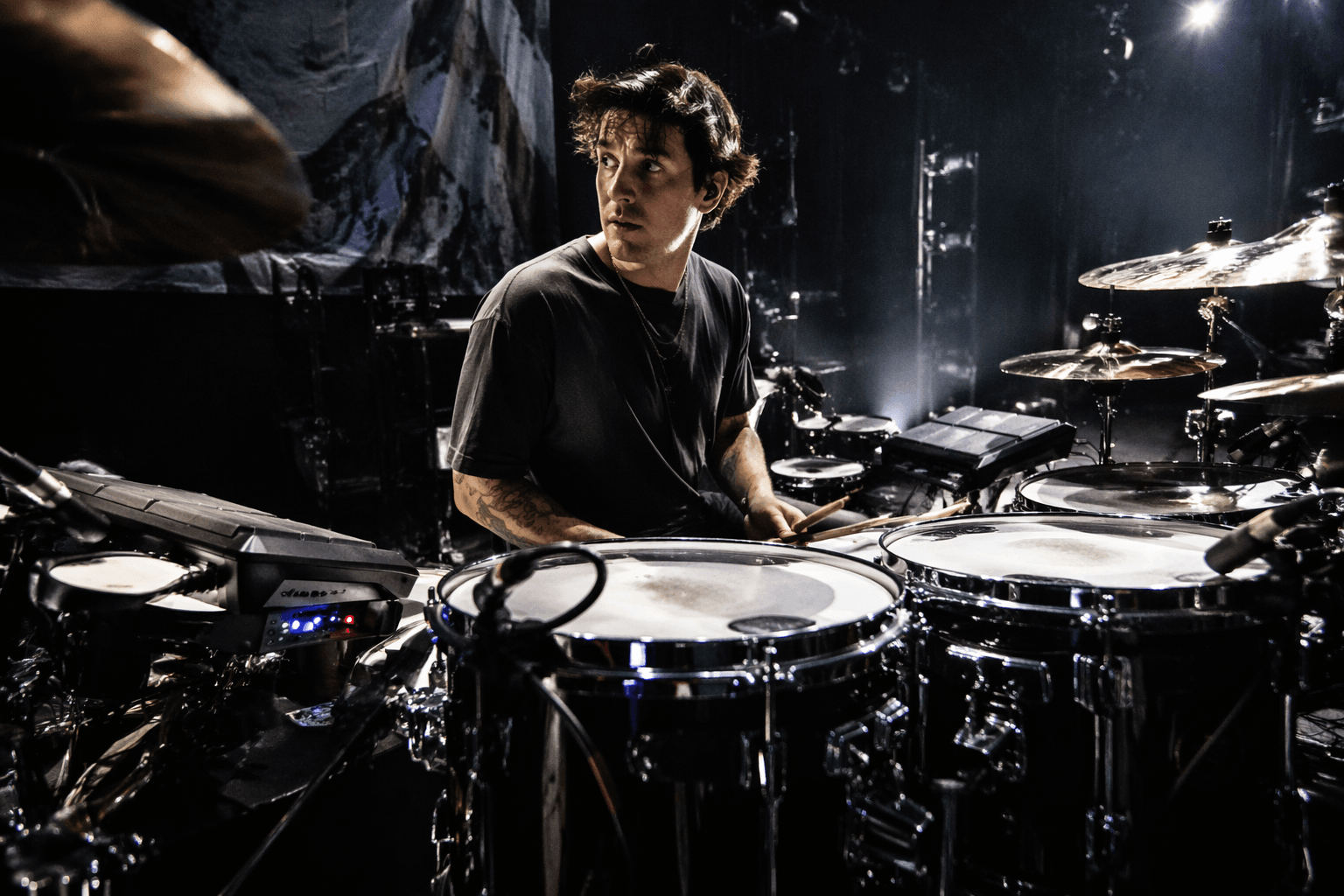
Danny Carey’s hybrid kit maps pads and pedals to Battery 4
Carey’s hybrid rig works because every pad, pedal, and hi-hat position has a defined job, and Battery 4 turns that into a playable map.

Danny Carey’s hybrid kit is a lesson in organization, not gadget overload
Danny Carey’s Mandala V3 setup works because it treats the electronic side of the kit like part of the instrument, not a pile of triggers. Seven Mandala pads and two electronic pedals are routed on dedicated MIDI channels into Battery 4, with each pad, zone, and pedal position assigned a specific function. That is the real takeaway for drummers: the rig sounds convincing because the mapping is disciplined.
Carey has been thinking this way for a long time. In a 2012 recap, he said electronic drums changed how he performed live and in the studio, especially in how he could anticipate chord changes and shape the nuances of a song. The current rig is simply the mature version of that idea, built into a touring system that is precise enough to survive Tool-scale arrangements.
What the Mandala V3 brings to the table
The Mandala V3 is not just a pad with a fancy name. Synesthesia describes it as a high-definition, zero-latency MIDI drum controller with 4 surface triggers, 9 rim triggers, and 128 strike detection rings, plus support for strike position, pressure, and slide output. The company also says MIDI begins within 0.55 milliseconds, which is the kind of responsiveness you need if the electronic part is going to feel like an extension of your hands instead of a delay between intention and sound.
That expressive design comes out of the instrument’s history. Synesthesia says the Mandala grew from a creative partnership between Vince De Franco and Danny Carey, with the original Mandala arriving in 2006 and later refinements leading to V3. That matters because Carey is not just endorsing a controller, he has helped shape the logic of the controller itself.
How the signal flow stays readable
Carey’s Battery 4 rig runs in standalone mode on a MacBook, which keeps the setup focused and direct. Battery 4 can also be used as a plug-in inside a DAW, but Carey’s current workflow is built around the standalone approach, and that makes sense for a live environment where speed and stability matter more than a sprawling session template.
The software side is built around Battery 4’s cell matrix, which can be up to 16 columns by 8 rows. In practice, the columns map to devices and the rows map to trigger zones, so the whole grid becomes a visual translation of the physical kit. Once you understand that structure, the rig stops looking like a mystery and starts looking like a spreadsheet you can actually perform from.
The key point is that this is not random triggering. Each Mandala pad sends a defined MIDI message, each pedal sends its own data, and Battery 4 turns those inputs into specific samples. That makes the system modular, which is exactly why it can be scaled up for Tool’s music and still remain legible under pressure.
Why the hi-hat is the hardest part to fake
Most of the pads in Carey’s setup are configured as three-zone instruments, but one pad acts as a hi-hat controller with specialized assignments. That detail is where a lot of hybrid rigs fall apart, because pads can sound impressive even when they are poorly mapped, while the hi-hat exposes everything instantly.
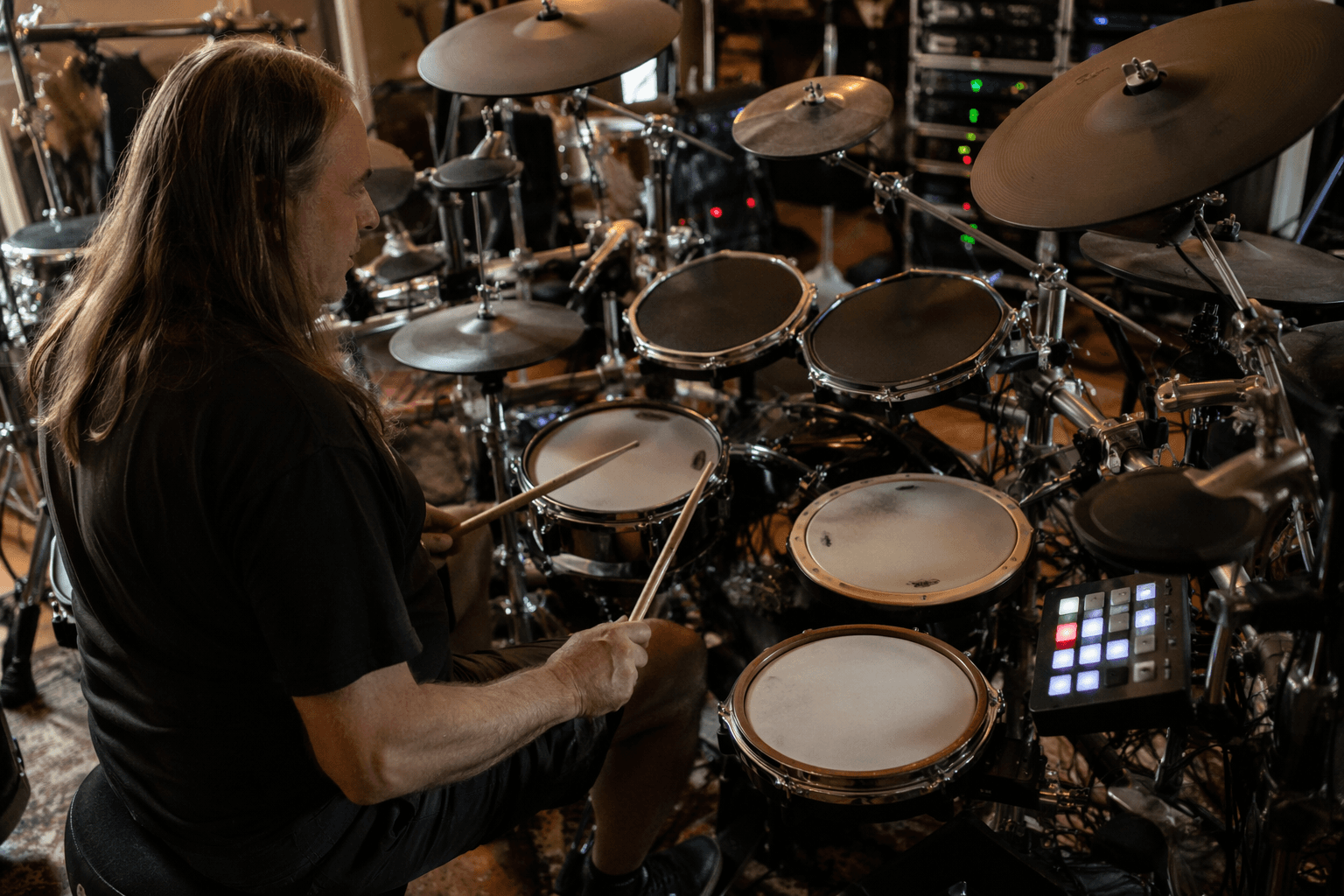
In Carey’s system, pedal-position data determines whether Battery 4 plays open, closed, or intermediate articulations. That is the small technical detail with the biggest musical payoff, because hi-hat realism is usually what separates a convincing hybrid kit from one that sounds mechanical. If the foot controller is stiff, vague, or poorly assigned, the whole electronic layer starts sounding like a demo instead of a drum part.
Tool’s “The Grudge” is a useful example here because it shows how the mappings behave in a real song. MIDI notes and channels trigger specific samples, which means the parts are not just assigned to pads for convenience, they are placed to serve the arrangement. The result is a rig that can handle complex material without making the drummer fight the software.
The history behind the current touring version
The Mandala story did not jump straight from prototype to polished touring hardware. Mandala materials say Carey had been using seven prototype Mandala pads in Tool’s hybrid setup since 2017, then upgraded to seven production-model Mandala V3 pads in 2025 during rehearsals in New Zealand before Tool’s Pacific Rim tour. That timeline shows a long testing period, which is exactly what you want to see before trusting a hybrid system on a major run.
That production upgrade also explains why this setup matters beyond celebrity gear watching. Carey is known for intricate, cinematic performances, so his rig has to preserve feel, not just fire samples. The move from prototypes to production-model V3 pads tells you the system has been stress-tested in real rehearsals, not imagined from a spec sheet.
What a smaller hybrid kit can steal from this rig
You do not need seven Mandala pads and two pedals to borrow the useful part of this setup. The lesson is to think in zones, assign each control a clear job, and keep the software layout easy to read under stage conditions. Battery 4’s grid helps because it gives you a clean way to separate devices and articulations, even if your own kit is just one pad, one kick trigger, and a hi-hat controller.
A practical starter version of Carey’s logic would look like this:
- Give each pad a single musical role first, then add extra zones only if you can play them cleanly.
- Use dedicated MIDI channels when you want the software to stay organized and predictable.
- Treat the hi-hat as the realism test, because the pedal should change articulation, not just volume.
- Build your sample layout so the screen mirrors the kit, not the other way around.
- Keep the rig playable at tempo before you add more sounds.
That is why Carey’s Mandala V3 and Battery 4 combination matters to drummers who are not filling arenas. It shows how expressive hardware, disciplined MIDI mapping, and sampler software can work together as one instrument. The gear is impressive, but the real trick is the architecture, and that is the part worth copying.
This article was produced by Prism’s automated news system from verified source data, official records, and press releases, then run through automated quality and moderation checks before publishing. The system is built and supervised by the people who set the standards it runs under. Read our full AI policy.
Did this article answer your question?