Dwarf Fortress Adventure Mode guide makes roguelike starts easier
Adventure Mode’s quick start turns Dwarf Fortress’s open-world side into a clean first run: build a character, leave fast, eat, rest, and survive long enough to explore.
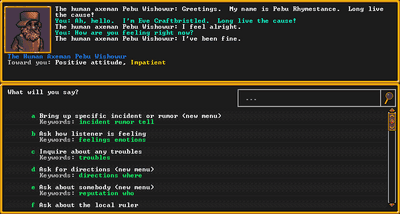
Key symbols, menu prompts, and shortcut notation come before anything else in the Dwarf Fortress Adventure Mode quick start. It is built for players who have never tried Adventure Mode before, and it opens with the basics that matter most: how the wiki shows keys, how menu instructions read, and how to move through the interface without fighting the notation.
Start with the interface, not the drama
The fastest way to a good first session is to learn those controls before anything else. Adventure Mode asks you to make decisions quickly, often while the world keeps moving around you. That matters more here than in fortress play, where you can pause, stockpile, and build systems before anything happens.
The quick start is marked for v53.15. v53.15 was released on June 25, 2026.
Build a character who can actually leave town
The first real fork in the road comes during character creation, and it breaks into manageable stages. You choose race, status, and civilization first, then move into background, skills, attributes, appearance, personality, equipment, mounts, pets, and party members.
For a first run, the important thing is not perfection but coherence. A character with the right basics, enough capability to travel, and a setup that matches the route you want to try is far easier to enjoy than one overloaded with obscure choices you do not yet understand. That structure keeps the process from turning into a wall of menus.
Your first hour, step by step
1. Finish world and character setup without chasing edge cases.
The game is a single-player fantasy simulation with a randomly generated, persistent world, so every Adventure Mode start is plugged into a bigger living place. You do not need to master every variable before leaving character creation. You do need to get to the point where your adventurer has a plausible identity, a workable loadout, and the ability to move.
2. Set off instead of lingering in menus.
Move straight from character creation into the play loop. Adventure Mode rewards momentum: leave, begin moving, and let the world become legible through action rather than through another round of setup.
3. Use fast travel early.
Fast travel gets you into the world’s geography without forcing a slow crawl across empty space. If fortress play is about planning a place, Adventure Mode is about entering one, and fast travel is the quickest way to feel that shift.
4. Secure the basics before you chase anything dangerous.
Food, drink, and rest are the survival triad. If you wander too far before you have those covered, the world stops feeling adventurous and starts feeling like an inventory problem. The quickest satisfying session is usually the one where you eat, drink, sleep, and keep going.
5. Find help before you pick a fight.
Find allies or muscle before you pick a fight. Adventure Mode combat is much easier to enjoy when you are not treating every encounter like a solo test of nerve. A first run goes better when you have support, especially before you fully understand what your build can do.
6. Pick a target, fight well, then loot and move on.
Once you have enough stability to press forward, the classic Adventure Mode loop is simple: find a target, fight effectively, loot, and keep the journey alive. That sequence also teaches one of the mode’s biggest differences from fortress play: your decisions are about movement, risk, and immediate survival, not long-term production chains.
What usually goes wrong on a first run
Most early failures are practical, not dramatic. Players push too far without supplies, ignore rest, or take fights before they have support. Others get trapped by route planning, which matters more the longer the journey gets, because Adventure Mode asks you to think ahead about where extra supplies will come from before you head deeper into the world.
Trading, visiting towns and sites, and completing quests all fit into that same survival logic. These are not side errands so much as the scaffolding that keeps a run from collapsing when the road gets long. If you can move through a town, replenish what you need, and choose your next destination with some margin left, you are already playing the mode well.
Why Adventure Mode feels unlike fortress play
Fortress mode gives you systems to manage from above. Adventure Mode puts you inside the generated world as one person. That is why so much of the quick start focuses on identity, capability, travel, and survival.
That same difference explains why the mode has remained a major focus for Bay 12 Games and Steam over the last two years. Steam opened the Adventure Mode beta on April 17, 2024, and anyone who owned Dwarf Fortress on Steam could access it. Steam later announced a full launch on January 23, 2025, after the extended beta period, while Bay 12 continued actively working on the mode, with menu work and other features still being completed.
Where the mode is headed next
Bay 12 has Adventure Mode site building planned as the first major post-launch Adventure Mode feature. Site building existed in older Dwarf Fortress, but it did not make it into the graphical version at launch, so its return sits right at the center of the mode’s ongoing restoration and expansion.
This article was produced by Prism’s automated news system from verified source data, official records, and press releases, then run through automated quality and moderation checks before publishing. The system is built and supervised by the people who set the standards it runs under. Read our full AI policy.
Did this article answer your question?