Dwarf Fortress wiki quickstart guide helps new players survive the embark
The Quickstart guide turns Dwarf Fortress’s harsh first hours into a survivable sequence, from embark choices to first food, water, and bedrooms.
After world generation comes embark: choosing a site, assigning starting skills to the initial seven dwarves, selecting supplies and equipment, and arriving with a wagonful of provisions. The first real obstacle in Dwarf Fortress is getting past the game’s own intimidation factor, and the wiki’s Quickstart guide is written for people who have never played before and want to “jump in head-first” without drowning in menus, jargon, or bad first decisions. In a game where collapse is part of the lesson, that structure gets a fort through year one instead of leaving a new player staring at the fortress mode screen.
Embark is where the real game starts
The real game starts before the first tile is mined. A new player is not simply placing a settlement marker. They are making the decisions that determine whether the first season becomes a working machine or a pile of corpses and abandoned tools.
That is why the quickstart does not treat the embark screen as a formality. It treats site choice, dwarf skills, and starting cargo as the core of the opening run. If you want miners who can actually dig, or a starting pantry that can survive a slow first harvest, those choices happen here.
A path through the opening fog
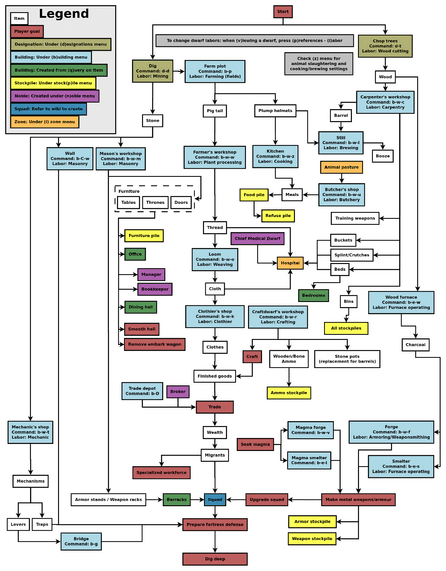
The Tutorials page points newcomers toward a flowchart called “From Caravan to Happy Dwarves,” a typical sequence of actions for starting a new fort. That is the right kind of help for Dwarf Fortress, because the game does not reward a single fixed script. It rewards understanding the order in which things usually happen: arrive, stabilize, dig, feed, drink, and only then start turning a stockpile of stone into something that looks like a settlement.
The quickstart’s big strength is that it gives an order of operations without pretending the order is law. It reduces the friction between embark and survival by breaking the first fort into small, solvable jobs. First comes choosing the site and loading the wagon. Then comes labor assignment. Then comes the first safe rooms, the first stockpiles, and the first effort to make the fortress self-sustaining. That progression is especially useful for players coming in after the Steam release, when the interface still presents a lot of information even though the game is more approachable than it used to be.
What the first fort actually needs
The early-game checklist in the quickstart is brutally practical. It walks through basic labor management, getting miners and other dwarves doing useful work, digging safe lodgings, setting up stockpiles, producing food, securing drinking water, and learning when to build workshops or begin trading.
That sequence reflects the reality of Dwarf Fortress mode. A new player does not need to master everything at once. The first priority is safe housing. The second is reliable food. The third is water and the infrastructure that keeps dwarves from wandering off into avoidable disaster. Once those basics are in place, workshops and trade come next.
Failure is still the teacher, but the lesson is cleaner
The guide leans on the community maxim “losing is fun,” but it uses it as a practical mindset rather than a joke. In Dwarf Fortress, a lost fort is not proof that you played wrong. It is proof that the simulation is deep enough to keep teaching you new systems each time you fail. The quickstart does not try to remove that philosophy. It makes failure less random by giving you a better first map through the game’s complexity.
That approach fits the culture around the game. Dwarf Fortress has always been built around discovery through disaster, and the game itself has no conventional end screen or real goal.
A newer front door for an older fortress
The guide’s usefulness is tied to the game’s longer history of becoming more accessible without losing its identity. Dwarf Fortress began development in October 2002, released its first alpha on August 8, 2006, and later reached version 50.01 as the official Steam and itch.io release with an official graphical set. Bay 12 Games has had the project in development on-and-off since 2002 and consistently since 2006, with Tarn and Zach Adams at the center of that work.
The December 6, 2022 Steam and itch.io launch widened the audience again. Kitfox Games publishes the Steam version, and Polygon highlighted the tutorial during that release.
This article was produced by Prism’s automated news system from verified source data, official records, and press releases, then run through automated quality and moderation checks before publishing. The system is built and supervised by the people who set the standards it runs under. Read our full AI policy.
Did this article answer your question?