Foil Drive Fusion Challenges Traditional eFoils With Lighter, More Versatile Design
Fusion is winning over eFoil buyers by shedding 30 to 35 pounds, riding more like a surf foil, and letting one setup evolve with the rider.

Weight and portability are the first real shock
Foil Drive Fusion is pulling riders away from traditional eFoils for one simple reason: it makes the whole system easier to live with. REAL Watersports says a complete eFoil built around Fusion can save about 30 to 35 pounds versus a traditional eFoil, and that is not a small trim. That kind of weight drop changes everything from loading the truck to carrying the board across a parking lot to dragging it back up the beach after a session.
Foil Drive’s own numbers explain why the package feels so different. The company places Fusion in a Gen2.5 category and describes it as a hybrid electric-foil system that blends eFoil power and runtime with assist-style lightness and adaptability. The main unit weighs 8.35 kg, or 18.4 pounds, and the Fusion battery comes in at 4.9 kg, or 10.8 pounds. It runs on a 43V architecture with an 864 Wh Fusion 860 battery, which is a serious setup, but still far easier to handle than a fully integrated traditional eFoil. If you have ever wrestled a heavy rig through soft sand, that difference is not theoretical.
The ride feels closer to foiling, not just motorized cruising
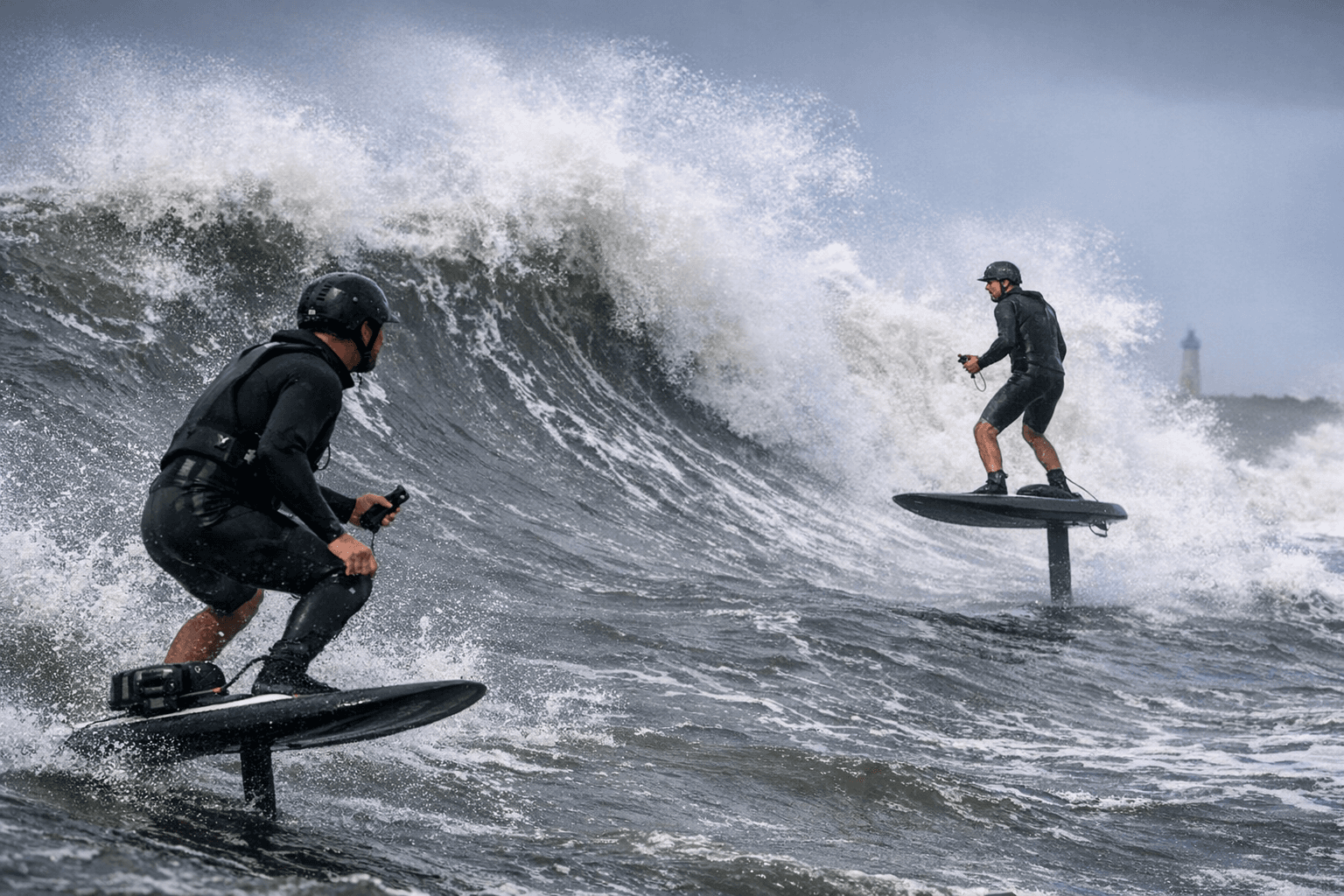
The other big reason Fusion is turning heads is how it changes the feel on the water. REAL Watersports’ take is that the lower weight gives the board a better feel and makes the setup more performance-oriented as the rider gets better, especially when turning or linking swells. That matters because a lot of traditional eFoils feel like you are managing the machine first and riding the water second. Fusion is being pitched as the opposite, with enough power to get you going but less bulk once you are up and foiling.
Foil Drive backs up that positioning by calling Fusion ideal for long rides, learners, and performance riders. That is the sweet spot that makes the product interesting. A new rider can use the assist to get more time on foil, but a stronger rider can lean into the surf feel without hauling around a board that behaves like a motorized appliance. The key move is that Fusion is not locked into one mode either. Foil Drive says you can switch from eFoil mode to Foil Assist mode by changing to a shorter cable length, which is exactly the kind of practical flexibility that matters when you want one setup to do more than one job.
Modularity is the real upgrade if you want one board to grow with you
This is where Fusion starts looking less like a single product and more like a different way of thinking about electric foiling. Foil Drive says it is built for “any mast, any foil, for any discipline,” and that is a huge shift from the integrated, closed-platform feel of many traditional eFoils. If you already have a board and foil you like, or if you want to experiment with different mast and wing combinations as your riding changes, Fusion lets you build around your preferences instead of buying into one fixed system.
REAL Watersports’ product page adds a concrete example of that flexibility with compatibility around an Armstrong Integrated Mast setup, while also pointing to broader kit configurations. That matters because the upgrade decision is not just about raw power. It is about whether you want to keep replacing whole boards and systems, or whether you want one electric platform that can follow you from learning to cruising to surf sessions. Foil Drive’s February 25 comparison piece, “Foil Drive Fusion vs. Assist Max: Is the Upgrade Worth It?”, also shows how active this conversation has become. The question is no longer whether electric assist works. It is which architecture gives you the best mix of power, runtime, and adaptability without boxing you in.
Reliability, setup, and the new buying ladder are what make Fusion feel like a real alternative
REAL Watersports goes further than most shops by saying Fusion is the most reliable eFoil product on the market, and Foil Drive’s feature set gives that claim some structure. The system has IP68-rated dust and water resistance, the controller can display live speed, top speed, and total distance covered, and an optional Intelligent Tilt Sensor can be factory-set at 30 degrees to shut the motor off if the board tips past that angle. Those are the kinds of details that matter when you are buying gear you actually plan to use hard, not just admire in a garage.
The retail picture is equally telling. REAL Watersports is offering a Fusion base kit, premium eFoil, and performance eFoil packages, which gives riders a ladder of entry points depending on budget and ambition. That approach makes sense because Fusion is not just one price point trying to do everything. It is being positioned as a bridge between assist tech and a more traditional full-power setup, and the hands-on credibility matters too. Matt Nuzzo assembles and tests the new Fusion at REAL Watersports in Cape Hatteras, North Carolina, where the conversation is clearly moving from spec sheet hype to actual board-time judgment. Foil Drive’s YouTube channel calling Fusion the “third and final system” in its Gen2 lineup alongside Assist Max and Assist Slim says the same thing in a different way: this is not a side project. It is a platform move.
For riders deciding whether to stay with a full eFoil or switch, Fusion makes the strongest case when portability, surf feel, and gear flexibility matter more than having the most self-contained system on the market. If you want less weight, easier handling, better progression, and one setup that can evolve with your riding, Fusion is the kind of upgrade that starts to make traditional eFoils look oversized and overcommitted.
Know something we missed? Have a correction or additional information?
Submit a Tip