Moloka'i to O'ahu Race Adds Dedicated Foiling Division for July 2026
The Moloka'i to O'ahu foil race runs July 20, 2026, pitting SUP foil and wing foil athletes against 40 miles of open Kaiwi Channel. Registration closes April 5.
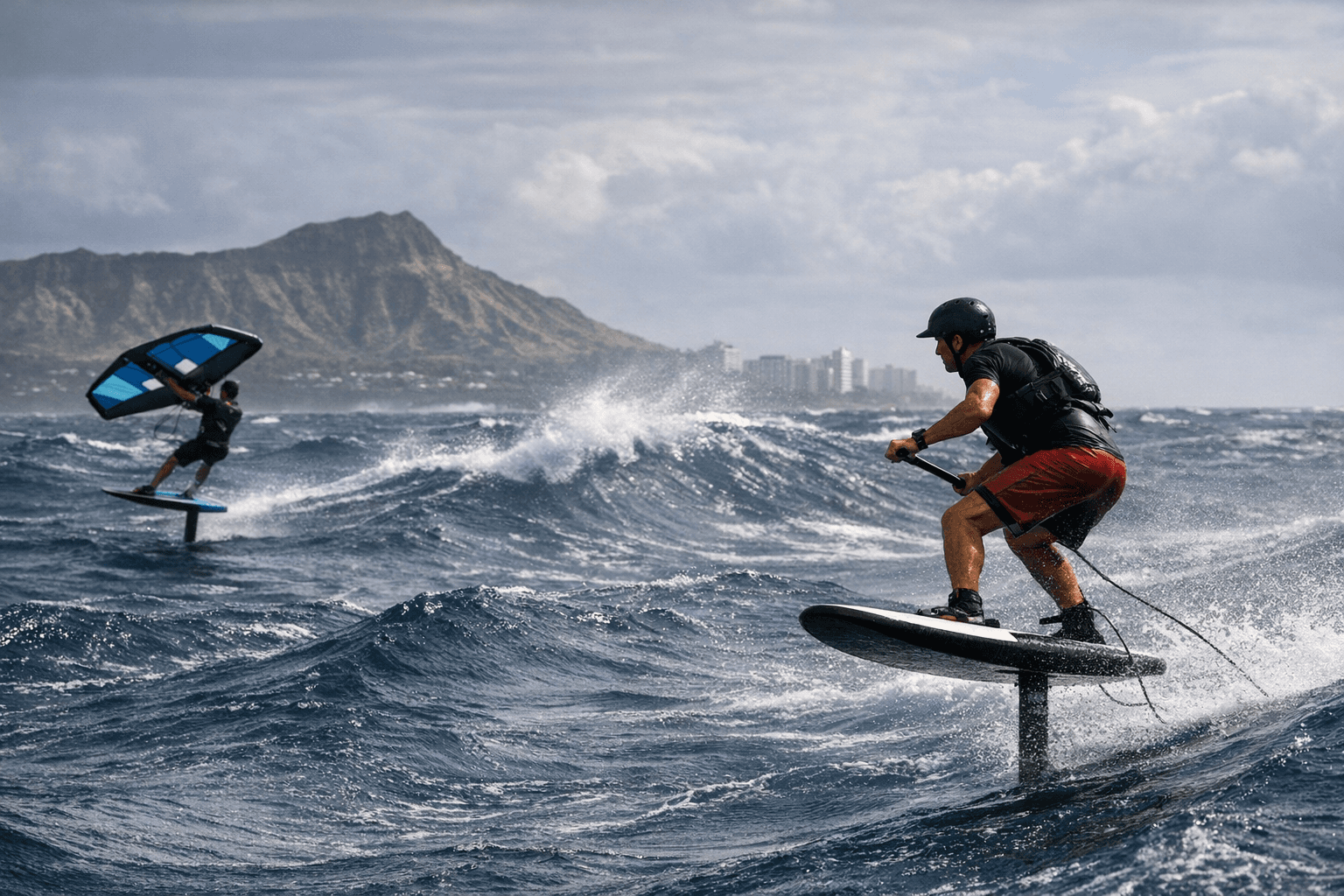
The Moloka'i 2 O'ahu Paddleboard World Championships has locked in Monday, July 20, 2026 for its M2O Foil Edition, a dedicated racing day for both SUP foil and wing foil athletes making the full 40-mile Kaiwi Channel crossing from Illio Point, Moloka'i to Maunalua Bay, O'ahu. Registration opened March 14 at 7 a.m. HST and closes April 5, giving teams a tight window to commit and nail down their equipment decisions before the summer build.
The foil date sits six days ahead of the main 27th-edition M2O on Sunday, July 26, which runs the same Kaiwi crossing for prone and SUP paddlers. The calendar split is deliberate: foil athletes get a recovery buffer, and the foil race serves as the final leg of the Koa Kai Triple Crown, a cumulative three-race series connecting Maui, Moloka'i, and O'ahu. Triple Crown scoring weights M2O finishing times most heavily, so July 20 is where overall titles are decided.
Last year's foil race put a sharp point on how competitive this field has become. Italy's Edoardo Tanas, 22, defended his SUP foil title in 1 hour, 56 minutes and 55 seconds, pulling away from Kane de Wilde of Maui in the final miles. De Wilde recovered to claim the 2025 Koa Kai Triple Crown overall on cumulative time. In wing foil, 16-year-old Anderson Gallagher of Lahaina finished in 1:47:44, with fellow teen Cash Berzolla of Kula pushing him to a 57-second margin at the line. Those times matter as a benchmark: a sub-two-hour crossing of the Kaiwi on a SUP foil, in trade wind swells and open-ocean current, signals that modern race foil setups have graduated well past novelty.
The channel presents conditions that punish conservative gear choices. Variable trades, long-period south and northwest swell windows in July, and a course that tracks along O'ahu's exposed southeastern coast mean athletes need a downwind board that can hold a connection through bump transitions at speed. The race protocol itself adds complexity: escort boats are required for team entries and must maintain communication on channels 71 and 72, with strict reef-protection zones in effect around Moloka'i's Kepuhi Beach. SUP foil escort boats are staged separately from wing foil escorts at the Illio Point start to prevent a congested channel launch.
For anyone still finalizing their July setup, the Koa Kai field from 2025 leaned hard on high-aspect downwind foils and dedicated race boards in the 7-to-8-foot range. With Tanas defending and de Wilde, Kai Thompson of Australia, and a crop of Maui-based teenagers all on form from recent events, the 2026 foil race is shaping up as the most competitive edition yet.
Know something we missed? Have a correction or additional information?
Submit a Tip