Arches National Park defines low-impact climbing for fragile sandstone
Arches makes the call clear: climb free or clean, leave no fixed gear behind, and back off when sandstone is wet and vulnerable.
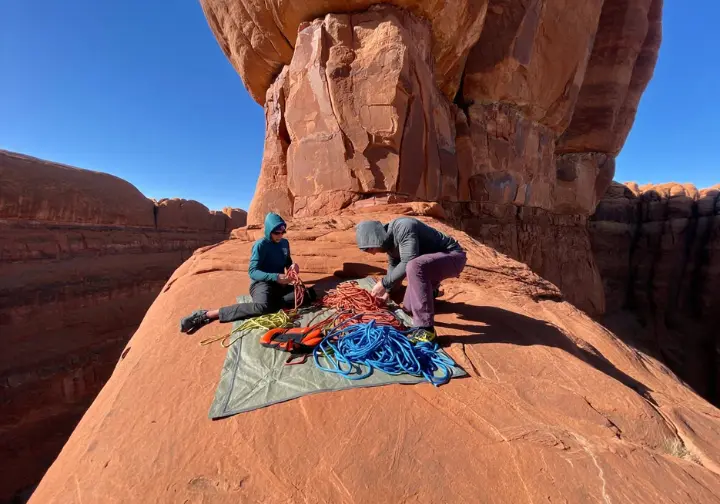
Treat Arches National Park like a quick roadside stop and you miss the whole point of climbing there. The park’s own guidance says canyoneering and rock climbing must be done as free climbing or clean aid climbing, and it defines fixed gear as man-made material left behind after the party is done. On fragile sandstone, that means every sling, bolt, cam, and anchor choice carries a preservation cost.
Free climbing is the default, not the exception
At Arches, the first decision is not which pitch to link, but whether your style fits the rock. Free climbing and clean aid climbing are the accepted modes, and that line immediately rules out the lazy habit of treating desert stone like an open-ended hardware dump. REI and Utah.com both summarize the park the same way: most routes demand advanced technical skills, and the climbing standard is built around free climbing or clean aid climbing.
In practical terms, that changes how you move. You plan for removable protection, think twice before relying on anything permanent, and assume the route is being managed as part of the landscape rather than as a blank canvas. Clean climbing here is not a niche ethic for purists. It is the operating rule that lets climbing continue without turning the sandstone into a ledger of scars.
What counts as fixed gear
The park’s definition is blunt and useful well beyond Arches. Fixed gear is any man-made article, including hardware or software such as webbing, rope, or cord, used to aid ascent or descent or as protection and left on the route when you are done. That means the question is not just whether the piece works, but whether it stays there and changes the climb for everyone who comes after.
That definition matters because it draws a hard line between temporary protection and route alteration. In a fragile desert setting, leaving material behind is not neutral, even if it seems small in the moment. If your system depends on something staying in place after you leave, Arches treats that as an impact, not just equipment.
How the park manages anchors and access
Arches did not arrive at this policy overnight. In April 2007, Climbing magazine reported that the park had a climbing management plan open for public comment. The National Park Service then announced a finalized Climbing and Canyoneering Management Plan in January 2014, and the park’s management materials say it was developed to protect natural resources and visitor experience while still allowing climbing and canyoneering.
The December 2013 plan, as summarized by the Canyonlands Natural History Association, added group size limits, climber registration, an improved climber education program, safety standards, and climbing access routes. That is the shape of real-world access at Arches: not a free-for-all, but a permit-minded system built around route-by-route control. A management-plan appendix adds one important nuance, too: replacing existing fixed anchors or fixed gear on an existing climb deemed unsafe does not require prior authorization, while any new installation of fixed gear requires a permit.
Why Delicate Arch changed the conversation
The tighter posture makes sense once you look at the park’s history. In 2006, after Dean Potter climbed Delicate Arch, the National Park Service tightened climbing rules to prevent a repeat. That incident turned an iconic feature into a policy flashpoint, and it helped make the park’s limits feel less like abstract bureaucracy and more like a direct response to visible impact.
A 1993 Climbing retrospective already noted that the rules and regulations for climbing in Arches had evolved since the 1990s. That long arc is the important part for anyone heading into the park now: the current clean-climbing standard grew out of years of debate over access, hardware, and what should be allowed on public sandstone.
Wet sandstone changes the risk calculus fast
The other part of the Arches equation is weather. Wet sandstone softens, and one climbing write-up on the subject notes it can lose up to 75 percent of its strength when wet. That means a route that feels fine to the eye can still be too fragile to trust under hand and foot, especially after rain or runoff.
For a Four Corners climber, the practical takeaway is simple: wet sandstone is not a gray area. If the rock is damp, the safest move is to wait, because the failure mode is not just a slippery foothold, it is damage to the stone itself. In a place like Arches, the right decision is often to walk away before the rock tells you no the hard way.
The lesson reaches far beyond Arches
Arches sits inside a wider regional argument about fixed anchors and climbing access. In March 2023, The Colorado Sun reported that federal proposals to restrict fixed anchors sparked a climbing outcry. In January 2024, the Coalition to Protect America’s National Parks published comments on fixed anchors and fixed equipment in National Park Service wilderness areas, and in December 2024 the Access Fund said the National Park Service withdrew a proposal that threatened climbing access and sustainable wilderness climbing.
There is also a cultural layer to the hardware question. In April 2021, The Colorado Sun reported on climbing bolts found on 1,000-year-old petroglyphs in Utah, a reminder that permanent gear can collide with archaeological resources as easily as it can with wilderness character. That is why Arches reads like a field manual for the whole Four Corners: climb with removable gear, keep routes clean, respect permit systems, and treat wet sandstone as off-limits until it is truly ready.
That is the real takeaway from Arches. If you arrive thinking of it as a quick stop with good scenery, the park hands you a sharper lesson: the best ascent is the one that leaves the sandstone looking exactly like it did when you arrived.
This article was produced by Prism’s automated news system from verified source data, official records, and press releases, then run through automated quality and moderation checks before publishing. The system is built and supervised by the people who set the standards it runs under. Read our full AI policy.
Did this article answer your question?