Why biological soil crusts matter on the Four Corners desert floor
That dark, bumpy desert skin is living groundcover, and one careless shortcut can scar it for decades. Learn where to step, drive, and camp in Four Corners country.
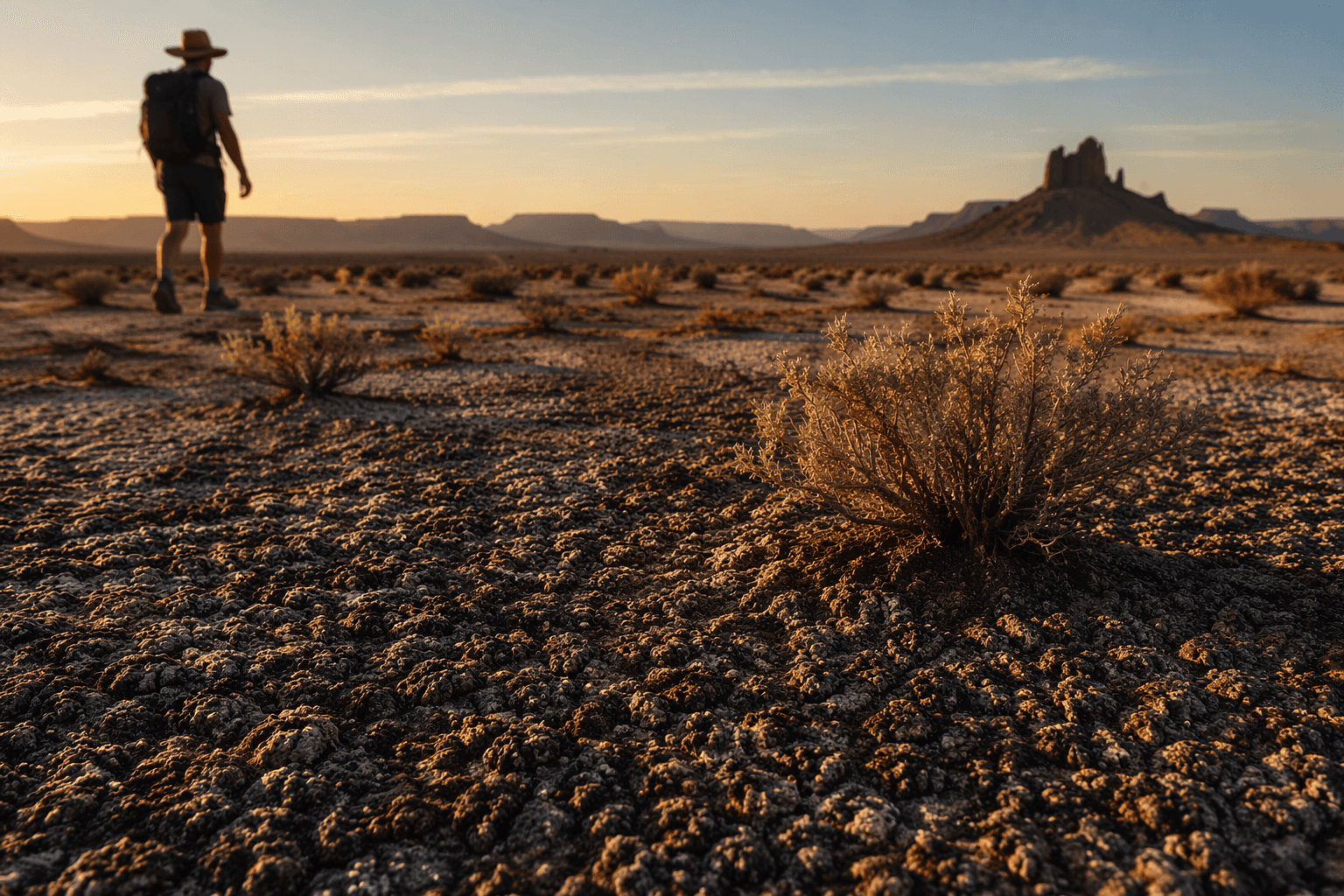
On the Four Corners desert floor, the trickiest thing under your boots is often the patch that looks like plain dirt. Biological soil crusts, also called cryptobiotic soils, are a living skin made of micro-fungi, soil lichens, mosses, green algae, bacteria, and cyanobacteria. Miss that distinction once, and a footprint, tire track, or campsite can leave a mark that outlasts a season by a long shot.
What that desert skin looks like
If you want to recognize biological soil crust on the ground, start with texture before color. In canyon country, the crust often shows up as a dark, knobby, slightly raised surface rather than loose sand, though young crust can be nearly indistinguishable from dirt. That is exactly why so many hikers and drivers flatten it without realizing what they have stepped on.
The best mental model is not “dust on top of the ground” but “living groundcover.” On the high deserts of the Colorado Plateau, which stretch across Utah, Arizona, Colorado, and New Mexico, Natural Bridges National Monument puts these crusts at 70 to 80 percent of the living ground cover. They are the foundation of high desert plant life throughout canyon country, and that is the right way to think about them if you are picking a line across open country.
Why one footprint lasts so long
They help retain soil moisture, slow evaporation, enhance seedling establishment, and reduce erosion by wind and water. They also shape nutrient cycling, soil hydrology, plant community development, and soil erosion.
Cyanobacteria are a big part of that story. When they are wet, they move through the soil and leave behind a sticky web that binds loose particles together, which is why intact crust resists wind and runoff much better than bare ground. That same structure is why a single careless crossing can open a weak point that keeps unraveling long after the boots or tires are gone.
The recovery timeline is the part most visitors underestimate. At Capitol Reef National Park, vehicles can scar biological soil crust for decades, and even under the best conditions a thin veneer may take five to seven years to return. If the soil nutrients are lost, the repair can take up to 50 years of cyanobacterial growth, and lichens and mosses take even longer.
Where to step, and where not to
The simplest rule is still the one that works best: stay on established trails. If you absolutely have to move off-trail, use wash bottoms or slickrock, because those are the durable surfaces. In dispersed camping country, set up on slickrock or in previously disturbed areas instead of spreading into untouched flats.
A shortcut around a muddy patch becomes a new path. A second set of tire tracks beside the first widens the disturbed strip. A camp that creeps a few feet into untouched ground starts crushing crust where the next storm can turn the damage into erosion.
For overlanders, the same principle applies to vehicles and pull-offs: use existing travel lines and avoid making fresh ones just because the route looks easier from the driver’s seat. For hikers and bikers, the hazard is more subtle, because the crust can look like ordinary soil until you are already standing on it. The safest habit is to treat any dark, knobby surface as living ground, not empty space.
Why land managers keep sounding the alarm
Official pages for Glen Canyon National Recreation Area, Grand Canyon National Park, Arches National Park, Canyonlands National Park, Capitol Reef National Park, Hovenweep National Monument, and Natural Bridges all treat biological soil crust as a fragile feature across canyon country.
A USGS release on 24 years of continuous biological soil crust survey data in Canyonlands National Park found signs of increasingly inhospitable growing conditions for native organisms. Climate and land-use change can push later-successional crusts toward earlier-successional forms with lower carbon and nitrogen fixation rates.
USGS data document a physical disturbance study with annual human trampling from 1996 to 2018 at Arches and Canyonlands, plus a climate manipulation experiment from 2005 to 2018 in Castle Valley.
The practical takeaway for a Four Corners trip
The cleanest way to move through this country is to read the surface before you commit your weight, your tires, or your tent. Step on trail tread, slickrock, or wash bottoms when you need a durable line. Avoid the dark, knobby crust, even when it looks thin.
This article was produced by Prism’s automated news system from verified source data, official records, and press releases, then run through automated quality and moderation checks before publishing. The system is built and supervised by the people who set the standards it runs under. Read our full AI policy.
Did this article answer your question?