12 Clean Line-Art Thigh Tattoos That Celebrate Geometric Minimalism
The thigh gives line art room to breathe, so geometry reads cleaner and smarter there. These 12 placements help you choose a composition that stays elegant in motion.
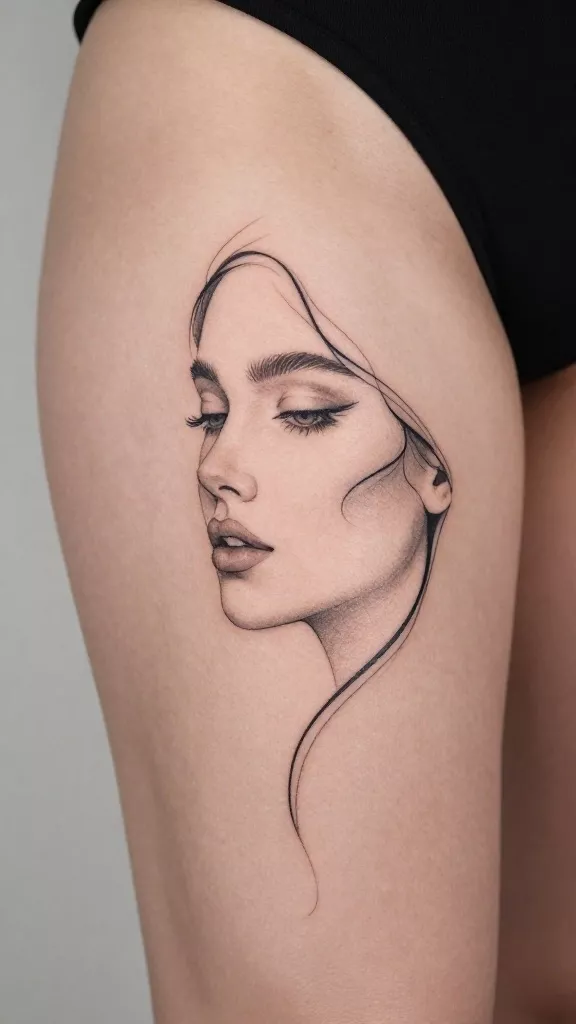
InspirationDe’s April 23, 2026 curation lands at exactly the right moment for geometric minimalists: the appetite is still there for refined tattooing, but the mood has shifted toward fine lines, negative space, and placements that let the body do part of the drawing. The thigh is where that shift becomes obvious. A good geometric piece on the thigh does not just sit there, it stretches, relaxes, and changes with the leg.
A body-aware canvas, not a flat page
The first thing to understand about thigh line art is that the placement changes the design language. Tattooing 101 is blunt about it: placement can make or break a design because a tattoo has to flow with the body. On the thigh, that means a clean outline can feel elegant and intentional, while the same motif dropped on the wrong curve can start to look compressed or awkward.
Why the outer thigh reads so well
The outer thigh is the broadest, flattest part of the area, which is why it suits geometric patterns so naturally. Loony Tattoony notes that this zone can handle complex artwork, including geometric work, without forcing the composition to fold in on itself. If you want straight lines, repeated angles, or a frame-like structure, the outer thigh gives those shapes enough surface to stay crisp.
When the upper thigh gives a design room to stretch
Tattooing 101 classifies the upper thigh as a large canvas, and that scale matters more than people expect. Vertical or elongated compositions can breathe here, which keeps the negative space between lines from looking crowded. For minimalist geometric pieces, that extra length can make a single motif feel deliberate instead of like it was squeezed to fit.
Why the inner thigh calls for restraint
The inner thigh is listed as a medium canvas, so it rewards tighter, more controlled compositions. This is the placement for a smaller line-art figure, a narrow geometric stack, or a piece that depends on closeness rather than sprawl. If the design needs too much open skin to work, the inner thigh can make it feel compressed; if it is scaled correctly, it reads quietly and cleanly.
Open skin is part of the composition
Minimalist geometric tattoos do not succeed only because the lines are thin. They succeed because the empty space around them is being used as a design element, and the thigh is one of the few placements that gives that space real room to matter. On a crowded body area, symmetry can start to feel cramped; on the thigh, the gaps between shapes can stay legible and refined.
Why fine line and thigh placement work together
Tattoodo defines fine line by execution and needle gauge, often using round liner needles or a single needle to create that thin, hair-like look. That approach pairs well with the thigh because a lighter touch can follow a longer contour without overpowering the area. Tattoodo also notes that fine line tattoos place less stress on the skin than bolder work and tend to heal faster, which makes the placement feel practical as well as aesthetic.
What stays elegant when the leg moves
The most successful thigh geometry is usually the kind that keeps its shape when the wearer walks, sits, or bends. Long vertical lines, clean arcs, and open compositions stay elegant because they move with the leg instead of fighting it. That is where thigh placement becomes more than a backdrop: the body becomes part of the animation.
What starts to distort with too much complexity
Dense ornament, tiny stacked details, and overworked symmetry can lose clarity when they are forced onto a thigh layout that does not support them. The risk is not only visual clutter, but distortion as the skin shifts and the muscles change shape. A minimal geometric tattoo avoids that trap by keeping the structure simple enough that movement does not break the read.
Why minimalist geometry is still leading the mood
Tattooing 101 says fine line tattoos remained a staple trend in 2025 and are expected to keep growing, with minimalist, geometric, and floral forms at the center of that demand. That is part of why line-art thigh tattoos feel current rather than nostalgic. They satisfy the same visual appetite as larger geometric work, but with less weight and more air.
Conceal or reveal, depending on the day
Loony Tattoony points out that thigh tattoos are popular partly because they are easy to conceal or show depending on clothing. That flexibility gives the placement a real-life edge: it can disappear under workwear, then come forward with a shorter hemline or swimwear. For a clean line-art piece, that means the tattoo can feel private without being hidden forever.
What to ask before you choose the placement
Before settling on a thigh geometric piece, ask a few practical questions: does the design need a broad flat field, or will it collapse if it has to bend; does it need the upper thigh’s longer canvas, the inner thigh’s tighter scale, or the outer thigh’s broader surface; and will the open skin around it still look intentional once you are moving through daily life. Those questions matter because the best minimalist thigh tattoos are not just precise, they are placed with the body in mind. That is why the cleanest line-art designs on the thigh often feel the most enduring: they do not fight the leg, they complete it.
This article was produced by Prism’s automated news system from verified source data, official records, and press releases, then run through automated quality and moderation checks before publishing. The system is built and supervised by the people who set the standards it runs under. Read our full AI policy.
Did this article answer your question?