Würzburg Tattooer Ney Showcases Dotwork’s Rise in Geometric Design
Ney’s Würzburg work shows why dotwork is changing geometric tattoos: it reshapes contrast, readability, and how a pattern survives on skin.

What dotwork changes before you choose a geometric tattoo
Dotwork is winning attention in geometric tattooing because it makes structure the subject, not just the decoration. In Würzburg, tattooer and model Ney, who appears online as ney.riven, is part of that conversation, showing how careful point placement can turn a restrained design into something that still feels precise and modern.
That matters if you are deciding between fineline and dotwork for a geometric piece. Both styles live close to the ornamental and geometric space because both depend on control, spacing, and visual restraint, but they behave differently once the ink is on skin. Fineline leans on crisp contours; dotwork builds its image through repeated black points, so the rhythm of the pattern becomes just as important as the subject itself.
How dotwork actually builds a geometric image
The clearest technical difference is the way shading works. In dotwork, there is no smooth gradient in the traditional black-and-gray sense. Instead, shadow appears through dot density, with tightly packed points creating darker zones and wider spacing opening the design back up to skin.
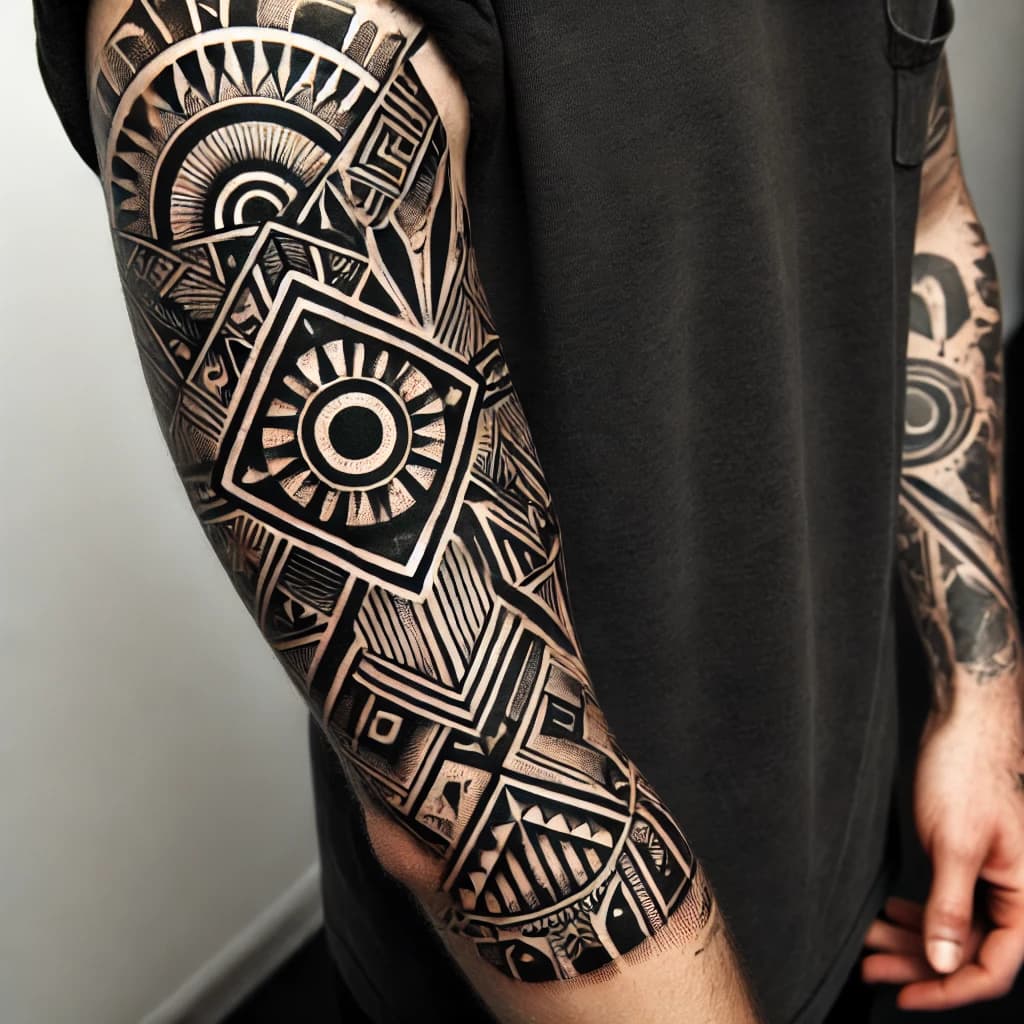
That is why the style is often compared to pointillism. The comparison is useful because it frames dotwork as a disciplined visual system rather than a gimmick. For geometric tattoos, that discipline changes everything: circles, borders, mirrored panels, and sacred shapes can feel sharper because the eye has to read the spacing, not just the outline.
Why geometric readers keep circling back to dotwork
Geometric tattoos already ask a lot from the viewer. They depend on symmetry, balance, and repeated structure, so the way a tattoo is shaded can either support that architecture or blur it. Dotwork tends to reinforce the structure because it preserves negative space and keeps the design looking airy even when it gets visually dense.
That makes it a strong fit for mandala work, sacred geometry, and ornamental patterning. If a design is built from repeating motifs, dotwork can make the repetition feel intentional rather than heavy. For anyone choosing a first geometric piece, that often means the tattoo reads as design before it reads as illustration.

Fineline versus dotwork: the choice is about the look you want
Fineline and dotwork are often discussed together because they share a restrained, contemporary feel, but they give you different results. Fineline is the better choice when the goal is a crisp, minimal drawing with clearly defined edges. Dotwork is better when the goal is texture, depth, and a pattern that seems to breathe with the skin.
That difference affects readability. A fineline geometric tattoo can look beautifully precise, but it depends heavily on line clarity. A dotwork piece can hold onto its pattern language even as it softens, because the image is already built from small units rather than a single hard contour. If you want a design that feels quiet but deliberate, dotwork usually gives more visual room to work with.
Aging, contrast, and why spacing matters so much
A geometric tattoo does not age as an abstract idea. It ages as line thickness, dot spacing, and contrast. Delicate linework and carefully spaced points can lose sharpness over time if they are not protected well, which is why aftercare and sun protection matter so much for this category.
The Cleveland Clinic notes that tattoos are controlled forms of trauma to the skin and that improper aftercare can lead to infection, rashes, scars, or smudging. It also says a tattoo can take a few months to fully heal, depending on size and placement, and sunscreen belongs in standard aftercare. For geometric work, that advice is especially practical: if the contrast softens too quickly, the whole pattern can lose its symmetry.
Why this style feels bigger than a trend
Part of dotwork’s appeal is that it fits the current taste for tattoos that look precise, modern, and refined without relying on heavy color or visual clutter. That is one reason the style keeps showing up in trend discussions, from local studios to social feeds. Ney’s Würzburg perspective makes that visible at street level: this is not just a global Instagram look, but a regional tattoo language being translated by real artists for real clients.

The broader market helps explain the demand. Pew Research Center reported in August 2023 that 32% of U.S. adults have at least one tattoo, and 22% have more than one. Among tattooed adults, 69% said they got tattooed to honor or remember someone or something, 47% to make a statement about their beliefs, and 32% to improve their personal appearance. Those numbers point to a big shift: tattoos are now mainstream enough that subtle geometric ornament can function as personal identity, not just decoration.
The deeper history behind the modern look
Dotwork may feel current, but the visual logic behind it is old. Smithsonian Magazine notes that humans have marked their skin for thousands of years across cultures for protection, status, religious belief, adornment, and punishment. One of the earliest known examples is Ötzi the Iceman, found in 1991 and dated to around 5,200 years ago, whose body carries dots and small crosses on areas such as the lower spine, knee, and ankle joints. The placement suggests a therapeutic purpose, which gives dotwork a surprisingly deep precedent.
Geometric tattooing also reaches back through older traditions. CO:CREATE Ink traces modern geometric work to ancient civilizations such as Egypt and to Indigenous traditions including Māori moko, which can convey rank, status, and lineage. That historical context matters because it shows why geometric tattoos carry weight even when they are minimal: the style has always been about order, meaning, and the body as a mapped surface.
What to ask for if you want the right geometric result
Before you commit, the real question is not whether dotwork is prettier than fineline. It is whether you want your design to read as line, texture, or both.
- Choose fineline if you want a cleaner outline and a lighter drawing feel.
- Choose dotwork if you want pattern, soft depth, and a more textured geometric surface.
- Choose stronger spacing when symmetry and breathability matter most.
- Choose denser dot fields when you want contrast without heavy fill.
Ney’s work shows why dotwork keeps rising in geometric design: it turns restraint into structure. For a tattoo built on symmetry, that can be the difference between a design that simply looks delicate and one that still reads clearly after years of living on skin.
This article was produced by Prism’s automated news system from verified source data, official records, and press releases, then run through automated quality and moderation checks before publishing. The system is built and supervised by the people who set the standards it runs under. Read our full AI policy.
Did this article answer your question?