Flower of Life Tattoos: Meanings, Designs, Placements, and Pain Management Tips
The Flower of Life packs 19 overlapping circles into one of sacred geometry's most loaded symbols — here's how to wear it right.
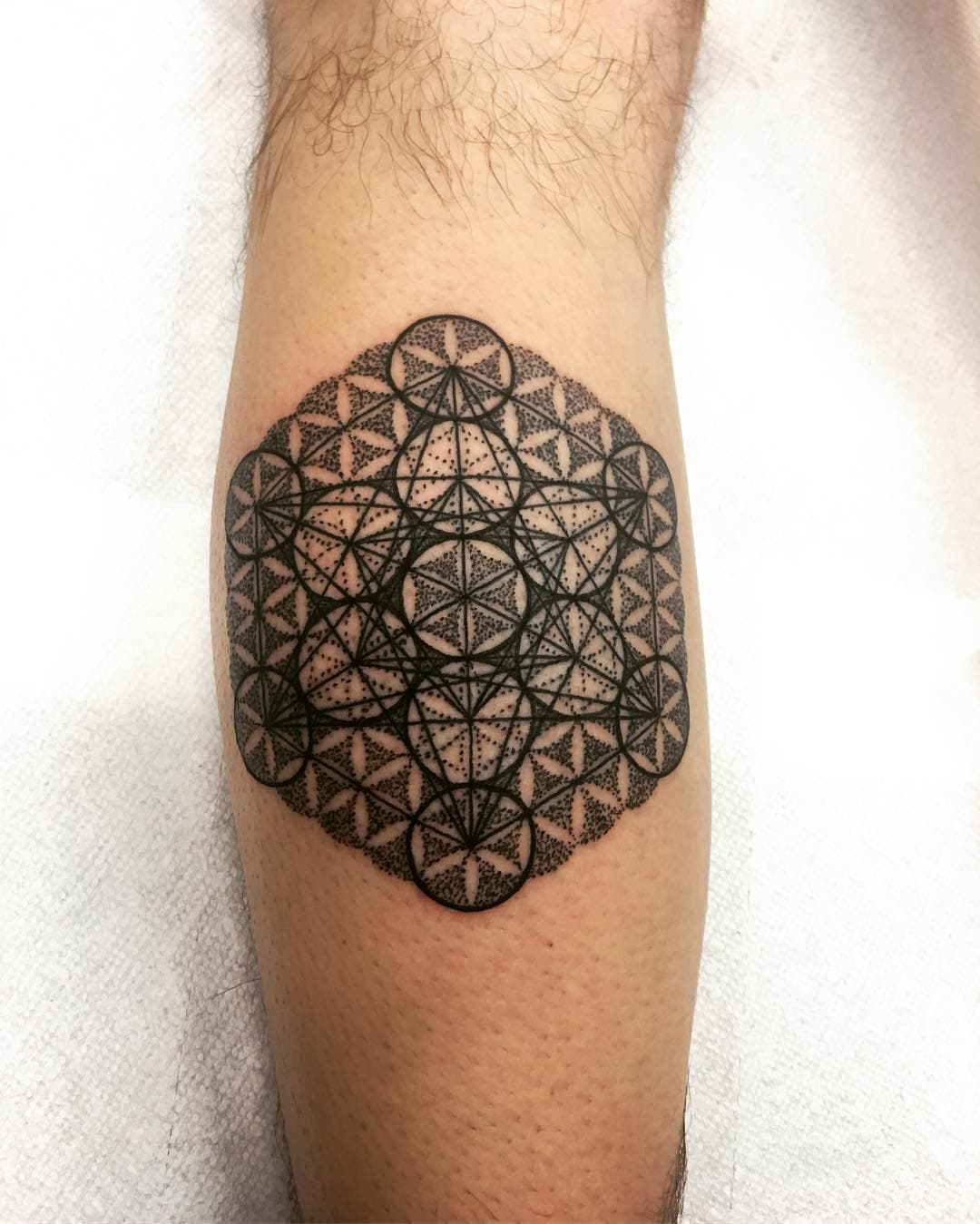
Few tattoo designs carry as much geometric density and symbolic weight as the Flower of Life. Nineteen overlapping circles arranged in a precise hexagonal grid, the pattern shows up in ancient Egyptian temples, Leonardo da Vinci's notebooks, and now, increasingly, on the skin of people who want something that means more than decoration. If you're considering getting one, there's a lot to think through before you book that appointment.
What the Flower of Life actually means
At its core, the Flower of Life is a sacred geometry symbol representing the interconnectedness of all living things. The overlapping circles are read as a map of creation itself, each ring intersecting with six others to form a structure that repeats infinitely outward. Different traditions load it with different interpretations: in New Age spirituality it's associated with unity and the Akashic records; in more esoteric readings, the inner pattern contains the Fruit of Life, which in turn encodes Metatron's Cube and all five Platonic solids. That's a lot of metaphysics packed into what is, geometrically speaking, a remarkably elegant construction.
For tattoo purposes, what matters is that this isn't a symbol with one fixed meaning. People get it as a meditation anchor, a reminder of impermanence, a nod to sacred mathematics, or simply because the pattern is visually arresting. Know your own reason before you sit down with an artist, because it will shape every design decision that follows.
Design variations worth knowing
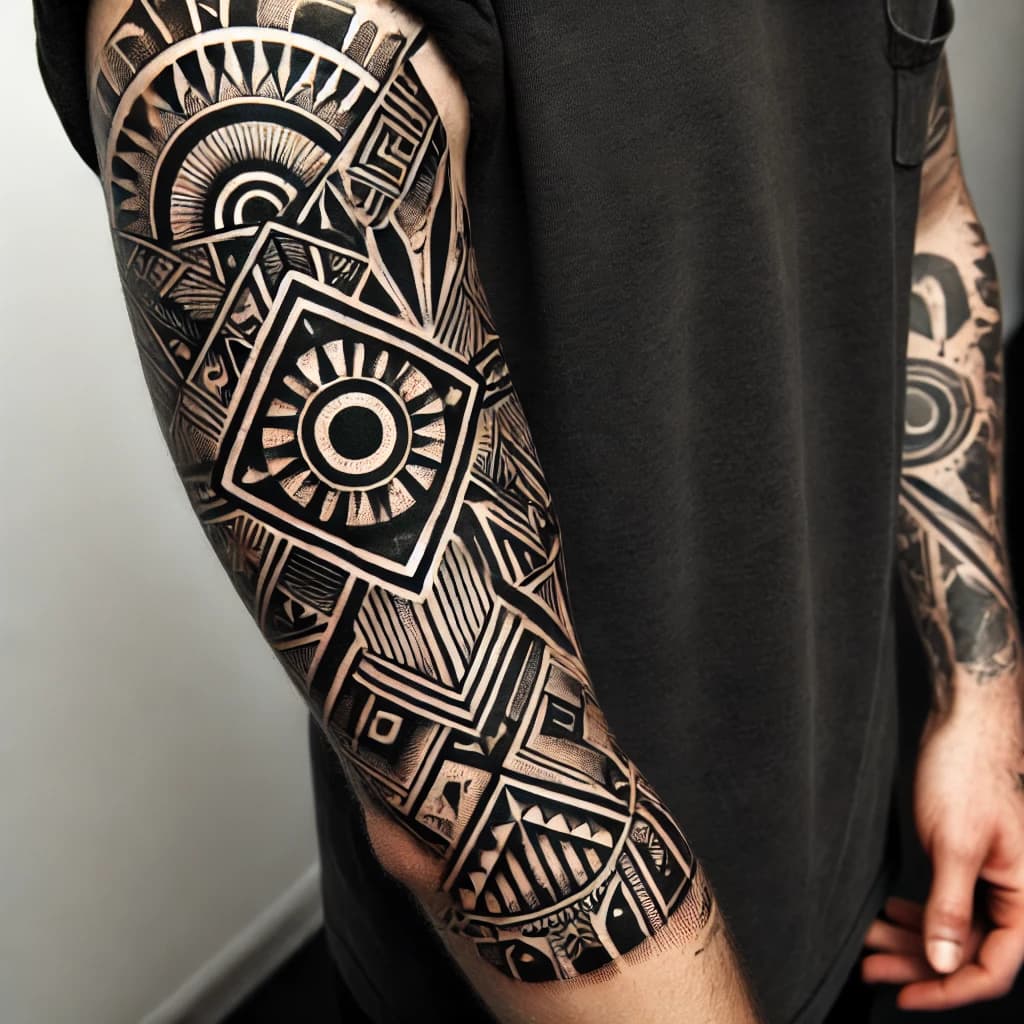
The base pattern is fixed, but what artists do with it varies enormously. The most straightforward approach is a clean linework rendering, black ink only, with consistent line weights throughout. This version ages well and stays legible at smaller sizes. More elaborate versions incorporate mandala elements radiating outward from the central circle, or nest the Flower of Life inside a larger geometric framework like a Sri Yantra or Metatron's Cube overlay.
Some artists work in dotwork, building the circles from thousands of individual dots rather than continuous lines. The effect is softer, almost luminous, and it handles shading and gradient transitions particularly well. Blackwork fills, where alternating sections of the grid are blocked in solid black, create a high-contrast optical effect that photographs dramatically but requires a skilled hand to keep the geometry precise. If you're leaning toward color, sacred geometry work tends to favor jewel tones and watercolor washes rather than flat fills, with blues, purples, and golds appearing most frequently in portfolio work.
One design decision that catches people off guard: scale. The Flower of Life's geometry depends on consistent proportions. Too small and the intersections blur together, especially as the tattoo ages and ink spreads. Most experienced geometric tattoo artists will tell you the absolute minimum workable diameter is around 3 inches for a clean linework version, and larger if you want interior detail to remain readable in ten years.
Placement considerations
Placement for a circular, symmetrical design like this is both more and less flexible than you'd expect. The geometry works well on flat or gently curved surfaces where the circles won't distort. Prime real estate includes the sternum, upper back between the shoulder blades, the outer thigh, and the forearm. These spots offer enough surface area for the design to breathe and enough flatness that the circular grid reads correctly.
Curved or highly muscular areas introduce distortion. The shoulder cap, for instance, wraps the design around a complex three-dimensional surface, which can work artistically but requires an artist who understands how to compensate for the curve during application. The ribcage is popular for sacred geometry work but compresses and expands with every breath during the session, which adds difficulty for both artist and client.
Visibility is personal. Some people want the Flower of Life somewhere they can see it daily, which points toward the inner wrist or forearm. Others treat it as a private symbol and place it on the chest or upper back. Neither approach is wrong, but think about how the placement interacts with your professional life and how the design will look as your body changes over time.
Session preparation
Geometric tattoos are unforgiving of variables. Unlike organic designs where slight inconsistencies can read as style, geometric work lives or dies by precision, and that precision starts before the needle touches your skin.
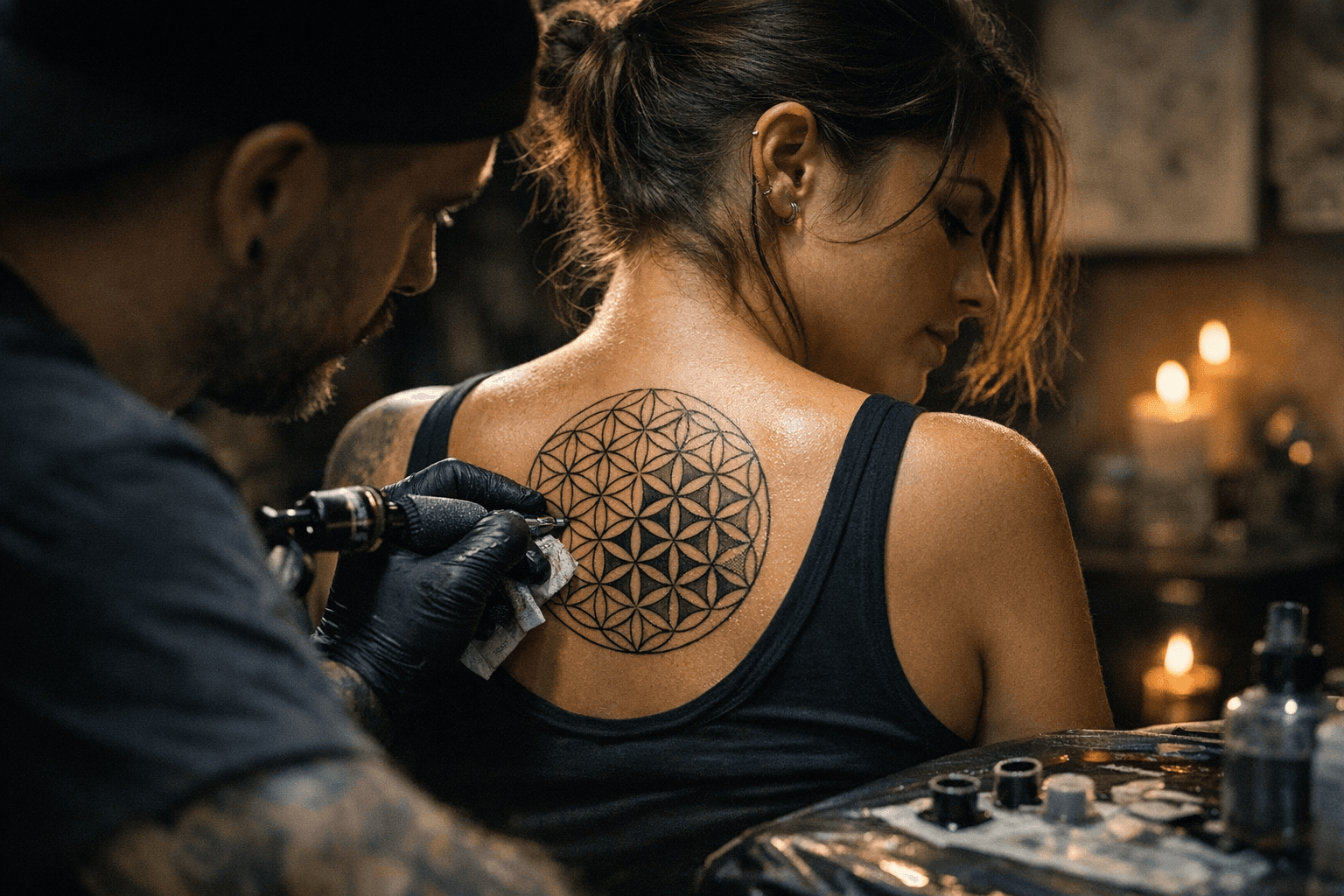
In the days before your appointment:
- Stay well-hydrated. Hydrated skin holds ink more evenly and is easier for the artist to work with.
- Avoid alcohol for at least 24 hours prior. It thins the blood and increases bleeding, which muddies the ink and makes fine lines harder to execute cleanly.
- Eat a solid meal within two hours of your session. Blood sugar crashes mid-session are real and they make everything worse.
- Moisturize the placement area consistently in the week leading up, but skip lotion on the day of the appointment.
- Get a full night's sleep. Your pain tolerance is measurably lower when you're tired.
Wear or bring clothing that gives the artist easy, unobstructed access to the placement area. If you're getting sternum work, a button-front shirt you can open is more practical than anything you pull over your head.
Managing pain during the session
The Flower of Life is a detail-heavy design, which means longer sessions than a comparably sized simpler tattoo. That extended time in the chair is where pain management strategy actually matters.
Topical numbing creams, primarily lidocaine-based products, are widely available and genuinely effective for the first hour or two of a session. Apply them according to the product instructions, typically under plastic wrap for 45 to 90 minutes before your appointment. Be aware that some artists find heavily numbed skin behaves differently under the needle, so discuss this with your artist beforehand.
During the session itself, controlled breathing is your most reliable tool. Slow exhales during the most intense passes help regulate your nervous system response. Some people find that talking with their artist keeps them distracted effectively; others prefer silence and focus. Know which type you are before the session starts so you're not figuring it out under pressure.
Taking short breaks is not only acceptable, it's smart. Sitting rigid and tense for hours increases overall soreness and can cause muscle fatigue that makes staying still harder. A five-minute break every 45 to 60 minutes, where you stand, move around, and eat a small snack, makes the back half of a long session significantly more manageable.
Avoid taking ibuprofen or aspirin before your appointment for pain pre-treatment. Both are blood thinners. Acetaminophen is the safer pre-session option if you feel you need something.
After the needle: what to expect
Geometric tattoos, with their dense linework and repeated passes over the same areas, tend to produce more initial inflammation than simpler designs. Expect the area to be red, raised, and tender for the first 48 hours. Follow your artist's aftercare protocol exactly, and resist the urge to assess the final result until the tattoo has fully healed, typically four to six weeks out. Fine lines can look slightly blown out during healing and then settle back into crispness once the skin regenerates.
The Flower of Life is one of those designs that rewards patience: in the research phase, in the artist selection process, and in the healing period after. Get the geometry right, place it thoughtfully, and it holds up as one of the most structurally satisfying patterns in the entire sacred geometry canon.
This article was produced by Prism’s automated news system from verified source data, official records, and press releases, then run through automated quality and moderation checks before publishing. The system is built and supervised by the people who set the standards it runs under. Read our full AI policy.
Did this article answer your question?