Geometric Neck Tattoos Demand Precision on a Curved, Visible Canvas
Geometry on the neck can look immaculate or unravel fast. The curve, motion, and visibility make placement the real design test.
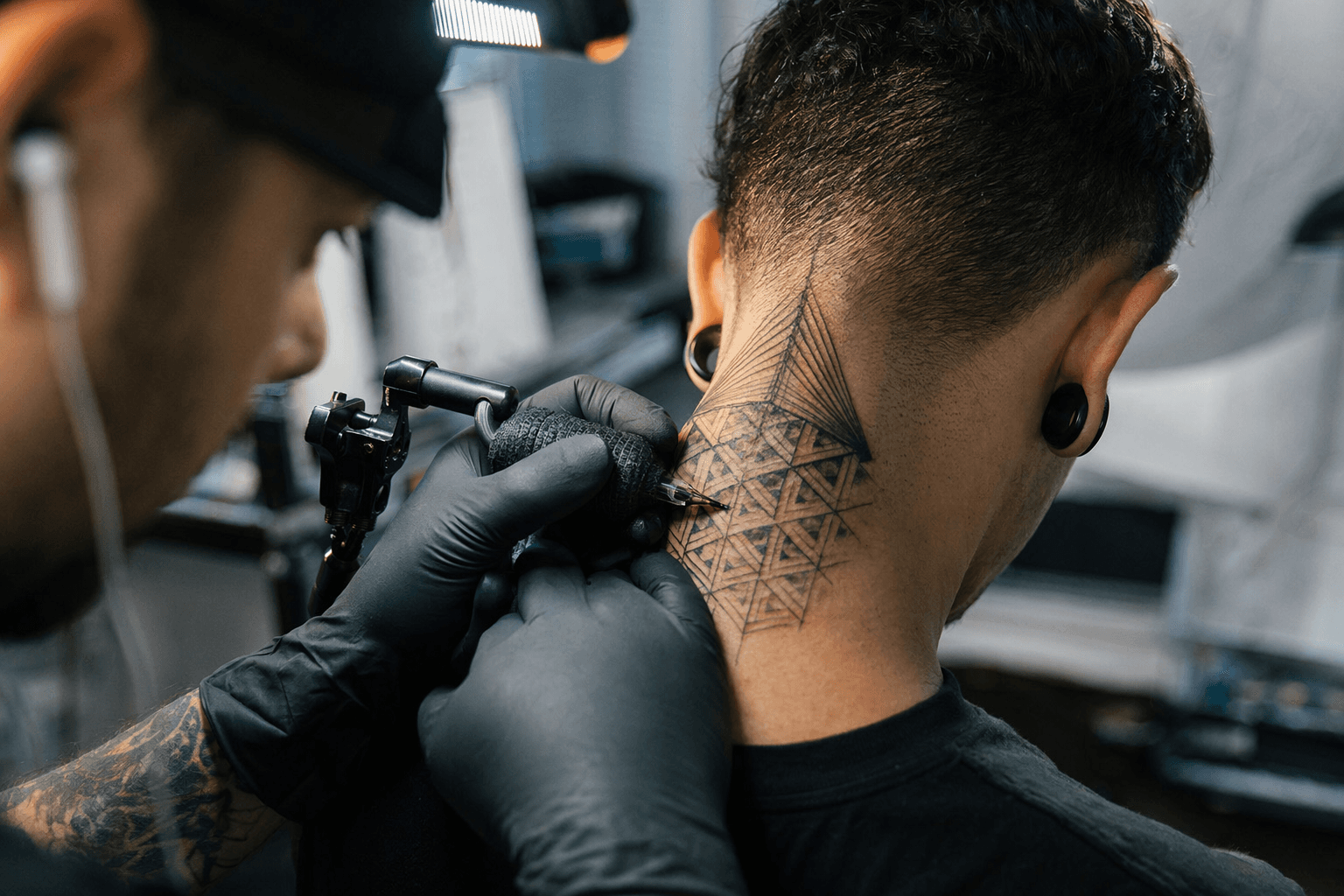
The neck rewards confidence, but it punishes sloppy geometry
A neck tattoo can turn into a clean architectural statement or a warped distraction depending on how well it respects the body beneath it. That matters even more for geometric work, where symmetry, line precision, and repeating pattern logic have to survive a surface that moves every time you swallow, speak, or turn your head.
The stakes are not just visual. Tattoo-associated infections have been documented by the CDC, including 22 cases across four states, and a dermatology study of 700 tattoo aftercare instructions found that many still left out basic hygiene guidance and clear advice on when to seek medical care. On a placement as exposed and mobile as the neck, design discipline and aftercare discipline have to work together.
Why the neck changes every geometric decision
The neck is not a flat canvas with a convenient center line. StatPearls describes it as the bridge between the head and the rest of the body, and it contains structures essential for breathing, speaking, swallowing, circulation, and the support of the brain and cervical spine. That anatomy helps explain why tattooers treat the area with caution: the skin is highly mobile, and the front and back of the neck contain dense nerves and blood vessels that make the surface both sensitive and technically unforgiving.
For geometric tattoos, that means a circle is rarely just a circle once it lands on skin. A mandala that reads beautifully on paper can compress over the throat, stretch across the side of the neck, or twist as it wraps toward the shoulder. The best neck geometry is planned for motion first and symmetry second, because on this placement the body keeps changing the picture.
Where symmetry actually holds, and where it breaks
Some parts of the neck are more forgiving than others, but none of them behave like a flat forearm or calf. The front of the neck gives you the strongest sense of verticality, which is why centered geometric designs, stacked linework, and mandala-based compositions can feel so natural there. They echo the body’s own middle axis and can create a striking sense of order when the stencil is mapped carefully.
The side of the neck offers a different advantage: it can turn a smaller design into a sharp profile statement. But the price is distortion, because the design has to follow the turn from jawline to collar area. At the back of the neck, the challenge becomes transition. The skin has to carry the design from head to upper back without awkward breaks, especially if the piece is meant to connect to a larger composition.
Artists who work in this area often say the most difficult moment comes where the neck meets the shoulders. That is where symmetrical stencils are hardest to lay down cleanly, and where even a slight drift can make a pattern feel off-center before it heals.
Front neck
This is the most unforgiving place for perfect symmetry, but also one of the strongest canvases for a bold central geometric statement. If the stencil is off, everyone sees it.
Side neck
Good for slimmer ornamental lines, angular motifs, and designs that use the profile of the face as part of the composition. A side piece can look elegant, but it can also warp if the pattern is too rigid.
Back neck
Useful for pieces that need a clean top edge and a gradual transition into a larger tattoo. It is often the best place for geometry that wants to flow into the shoulders or upper back.
Classic neck motifs still matter, but geometry changes the language
The neck has long carried symbolic imagery: wolves, birds, the evil eye, script, and more traditional ornamental imagery still show up in this placement because they work with the body’s visible, socially charged position. Geometric tattoo readers know that sacred geometry, mandalas, and ornamental linework can carry just as much meaning, but the placement changes how that meaning lands.
A wolf on the neck reads as a direct emblem. A mandala on the neck reads as structure, balance, and control. Ornamental linework, especially when it borrows from sacred geometry or repeating bead-like dotwork, can hide in plain sight as something decorative while still carrying a strict internal logic. That is why geometric neck tattoos often feel more architectural than illustrative: they do not just decorate the neck, they negotiate with it.
The strongest designs make that negotiation visible. A symmetry-heavy piece may use the throat as its center and let the pattern bloom outward in a controlled way. A more ornamental design may use vertical flow, dot density, or repeated arcs to keep the eye moving instead of demanding perfect stillness from the skin.
What the best geometric neck pieces have in common
Tattoo artists who take on neck and head work tend to describe the area as among the most delicate they tattoo, because the skin is thin, highly vascularized, and very mobile. One artist guide is blunt about the challenge of building a symmetrical stencil on the neck, while another warns that poor stretching or needle depth on the front of the neck can lead to blowouts or wobbly healed lines.
That is why the most successful geometric neck tattoos usually share a few traits:
- They are built around the body’s center line or another natural visual anchor.
- They use shapes that can tolerate slight curvature, such as mandala structures, repeating borders, or ornamental bands.
- They avoid tiny details that depend on total stillness to stay readable.
- They are scaled for healing, not just for the first day in the mirror.
A piece that depends on microscopic precision can look crisp in the chair and lose clarity as soon as the skin settles. On the neck, that risk rises fast.
Why the aftercare conversation matters more here
The neck is visible, exposed, and constantly in motion. That combination makes it more likely to catch sun, friction, sweat, and repeated movement than a tattoo in a quieter spot. Industry guidance also notes that visible neck tattoos can matter in conservative workplaces, which means the choice affects more than style.
The health side matters too. The CDC has documented tattoo-associated nontuberculous mycobacterial infections, and the aftercare study makes a bigger point: too many instructions still fail to explain how to keep a healing tattoo clean or when to get help. On the neck, where skin movement can irritate healing lines and where the area is impossible to ignore, disciplined aftercare is part of the design itself.
A modern placement with ancient roots
It is easy to think of geometric neck tattoos as a contemporary trend, but the urge to mark the body goes much deeper. Smithsonian Magazine has noted that humans have been tattooing for thousands of years, and that tattoos have historically carried meanings tied to faith, protection, pain relief, and class. Britannica places tattooing in the same long global tradition, which is a reminder that today’s sacred geometry and mandala neck pieces are not a break from history so much as a modern refinement of it.
That is what gives the placement its force. A geometric neck tattoo is not just about looking precise. It is about making precision survive one of the hardest parts of the body to control. When the layout is right, the pattern feels intentional from every angle. When it is wrong, the neck exposes the mistake immediately.
On this canvas, the design either learns the body’s movement or gets broken by it. That is why the smartest geometric neck tattoos are never just pretty shapes. They are carefully negotiated structures, built for a visible place that never stops moving.
This article was produced by Prism’s automated news system from verified source data, official records, and press releases, then run through automated quality and moderation checks before publishing. The system is built and supervised by the people who set the standards it runs under. Read our full AI policy.
Did this article answer your question?