Geometric sleeve tattoos demand careful planning, symmetry, and expert design
A geometric sleeve succeeds or fails in the stencil stage. The strongest ones are mapped to your arm, your movement, and your symmetry before ink ever hits skin.
Why a geometric sleeve is a planning problem first
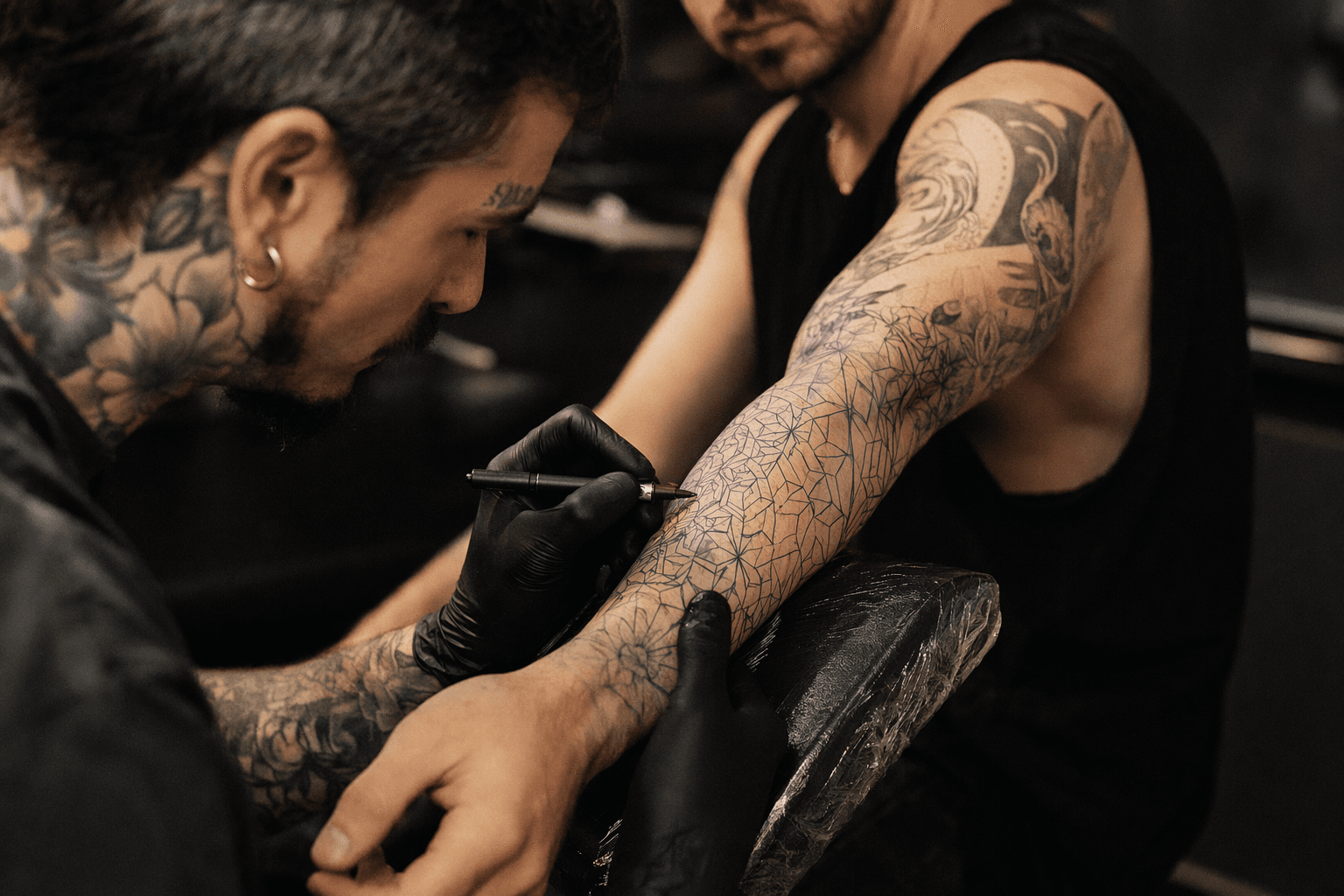
A geometric sleeve does not reward improvisation. The arm has to be treated like one connected visual system, with every angle, symmetry line, and transition mapped before the first needle pass. That is what keeps the work from turning into an expensive patchwork of shapes that never quite lock together.
That caution is not a new idea, even if the style feels modern on social feeds. Tattooing is at least 5,000 years old, and the oldest direct evidence on a body comes from the 5,200-year-old Iceman found on the Italian-Austrian border in 1991. Polynesian tattoo traditions also developed highly elaborate geometric designs over millennia, which puts today’s sleeve culture into a much longer visual lineage than most first-time collectors realize.
How the sleeve gets built
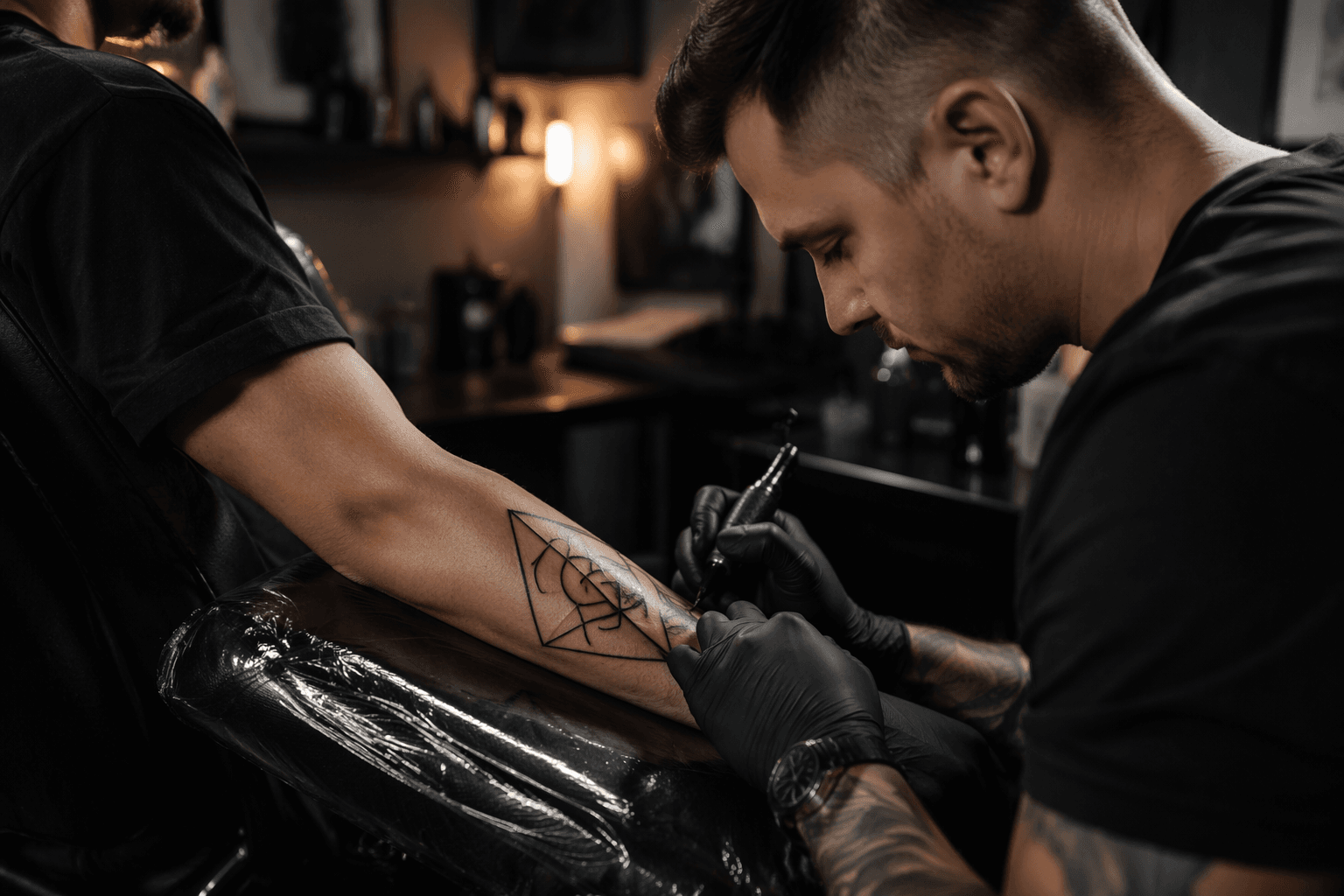
The best geometric sleeves begin with layout, not with the temptation to fill space. Before you chase pattern, you need to understand where the shoulder rounds, where the elbow breaks the flow, and how the forearm narrows toward the wrist. That is why consultation matters so much: a strong artist will plan the sleeve as a series of symmetry checkpoints and contour matches, not as isolated motifs stacked one after another.
Stencil planning is the quiet make-or-break step here. A geometric sleeve often depends on precise alignment from the deltoid to the wrist, and that means the design has to be built around body movement as much as around static front-facing views. A good map also accounts for negative space, because the skin left open is part of the composition and often what keeps dense pattern from collapsing into visual noise.
The motif families that hold up on skin
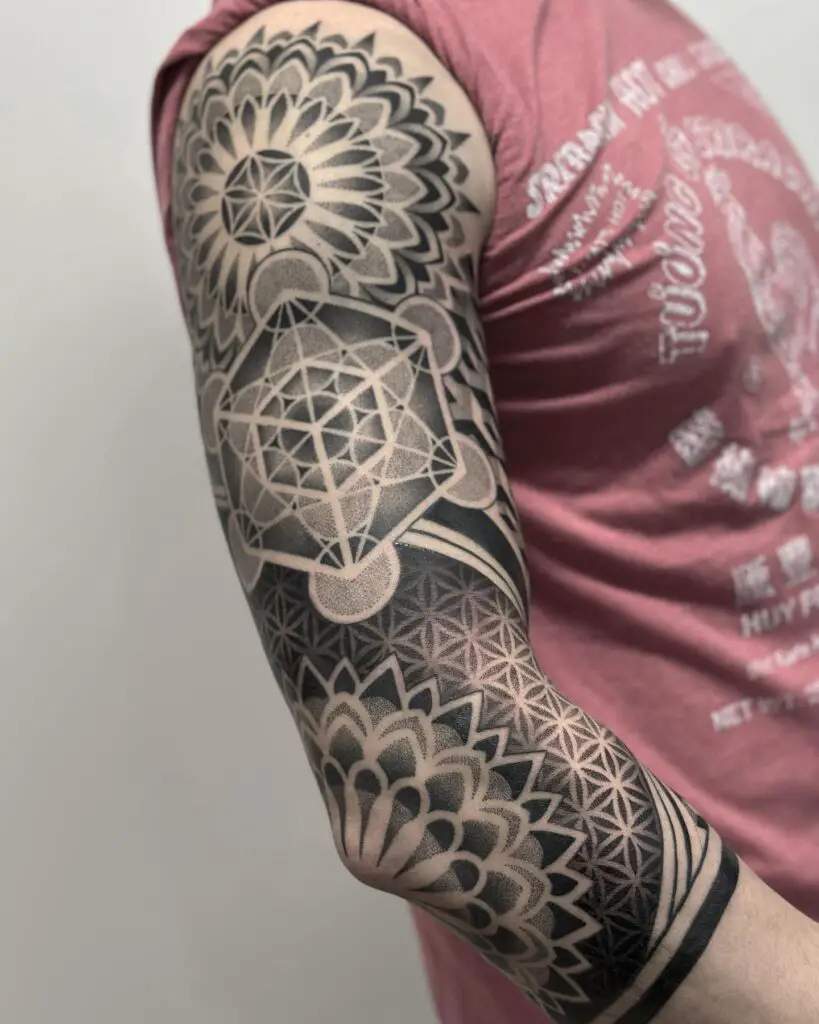
Sacred geometry is one of the most common directions, and it works because it brings structure with meaning. Sacred geometry is broadly understood as assigning symbolic or sacred meaning to shapes and proportions, which is why it attracts collectors who want more than decoration. A sleeve built from Flower of Life, Metatron’s Cube, and Sri Yantra elements can feel coherent if the connecting linework is disciplined and the spacing is handled like architecture.
The Sri Yantra is a particularly precise reference point, because in Hindu tradition it is built from nine interlocking triangles and a central bindu. That kind of internal logic is exactly why geometric sleeves can feel so powerful when they are planned correctly. If the triangles, lines, and centers do not echo one another cleanly, the whole structure loses the clarity that made the pattern worth choosing in the first place.
Mandala chains are another strong direction, especially when you want the sleeve to read as a progression instead of a set of separate medallions. Repeated radial forms linked by fine geometric bridges can carry the eye from shoulder to wrist in a way that feels continuous. The trick is to let each mandala breathe enough that the next one can relate to it without crowding.
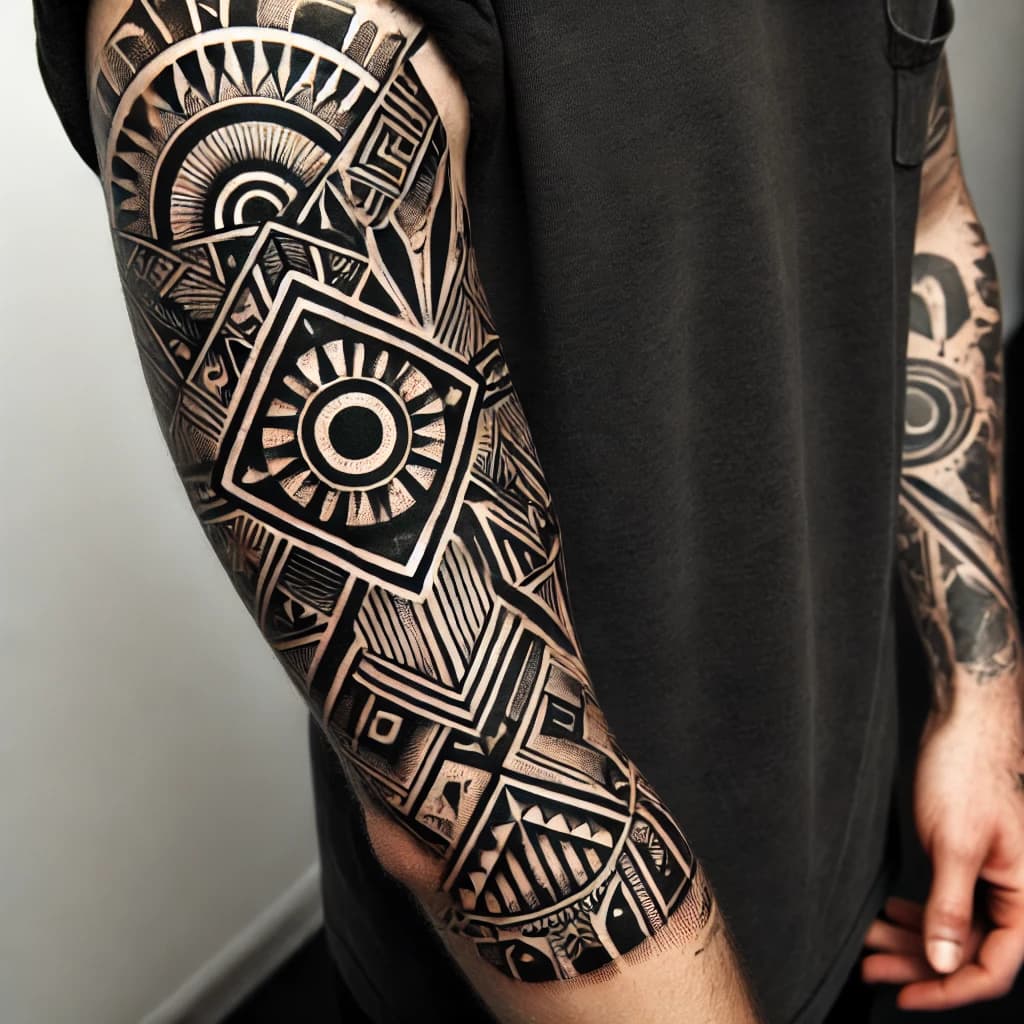
Low-poly animal sleeves offer a different kind of discipline. Wolves, bears, and eagles become faceted angular forms, which gives you recognizable imagery without abandoning the geometry. Architectural linework sleeves push that idea further by treating the arm like a vertical cityscape or ruin study, while blackwork geometric blocks use dense triangles and rectangles for maximum contrast and a heavier visual weight.
Why ornamental and geometric work overlap so naturally
Tattooing 101 describes geometric tattoos as “clean, bold” and says they show off the structure of the body. That is the core reason sleeves work so well in this style: the arm gives geometry a long runway, and geometry gives the arm a sense of order. The same source also places geometric and ornamental tattooing close together, which makes sense, because both depend on symmetry, decorative patterning, and line precision.
That overlap is useful when you are choosing the final language of the sleeve. If you want a more sacred or symbolic feel, sacred geometry may be the right frame. If you want something more graphic and architectural, ornamental geometry or blackwork may fit better. The design should not simply be decorative, it should match the way you want the sleeve to move, read, and age.
Why specialist artists matter more here than almost anywhere else
This is one of those styles where “I can do tattoos” is not enough. Tattooing 101 presents tattoo design as a rule-based planning process, not improvisation, and geometric sleeves make that obvious fast. The artist has to understand stencil logic, spacing, symmetry, and how to adapt the design when the arm changes from shoulder cap to elbow crease to forearm taper.
That is why artists known for precision linework and large geometric compositions matter so much. DotsToLines identifies Chaim Machlev as a Los Angeles-based geometric and line-art tattoo artist, while other tattoo coverage has profiled symmetry-driven specialists like Ilya Cascad in New York. Their reputations reflect the same truth: geometry asks for patience, exactness, and a feel for how repeated shapes behave across a living body.
How to avoid an expensive bad sleeve plan
The biggest mistake is treating the sleeve as a collection of favorite elements instead of a single composition. If you change direction halfway through, the symmetry can drift, the motifs can fight each other, and the negative space that should keep everything crisp starts to disappear. Once that happens, even technically clean linework can look muddy because the overall structure no longer makes visual sense.
A solid plan usually has a few nonnegotiables:
- A full-arm stencil map before you commit
- Clear symmetry checkpoints at the shoulder, bicep, elbow, forearm, and wrist
- A decision on whether the sleeve is sacred, ornamental, architectural, or hybrid
- Enough negative space to keep contrast and readability
- An artist who specializes in geometric flow, not just general tattooing
The point is not to control every millimeter forever. The point is to make sure the design has enough structure that small real-world shifts do not ruin it.
Longevity, healing, and why crisp lines depend on aftercare
Precision tattoos are only as strong as their healing. The Mayo Clinic warns that tattoos carry real risks, including infection and allergic reactions, and stresses the importance of healthy healing. NHS-style aftercare guidance for medical tattooing adds the kind of practical caution geometric work needs: do not pick scabs, keep the area dry as instructed, and watch for redness or pus as possible signs of infection.
That matters because line-heavy work depends on visual sharpness. If healing goes badly, fine edges blur, spacing becomes less readable, and the sleeve can lose the clean structure that made it work in the first place. A geometric sleeve is built with discipline, and it stays legible only when that discipline continues through aftercare.
The sleeve that lasts is the sleeve that was designed to belong there
The best geometric sleeves do not look accumulated. They look inevitable, as if the body and the design were planned together from the start. That is what separates a thoughtful sleeve from a costly mistake: mapped contours, deliberate symmetry, smart use of negative space, and an artist who understands geometry as a system, not a sticker sheet.
This article was produced by Prism’s automated news system from verified source data, official records, and press releases, then run through automated quality and moderation checks before publishing. The system is built and supervised by the people who set the standards it runs under. Read our full AI policy.
Did this article answer your question?