Geometric Tattoo Directory Reveals a Growing Hybrid Style Landscape
Geometric tattooing now reads like a set of dialects, not one style, and the smartest booking choice starts with knowing which language fits your body and your idea.
A directory that maps a style shift
The iNKPPL geometric tattoo directory makes one thing plain: geometric tattooing is no longer a single look. It now spans black geometric, ornamental, dotwork, linework, fineline, minimalism, abstract, whipshading, blackwork, micro realism, and even watercolor blends, which turns the page into a snapshot of a much larger hybrid landscape.
That breadth matters because the directory is not just listing names. It shows location, rating, and style tags, which makes it easier to separate an artist who builds dense black structure from one whose work leans delicate, airy, or highly ornamental. For a style that depends on control, symmetry, and spacing, that kind of sorting is not a nice extra. It is the difference between a tattoo that lands cleanly and one that starts to wobble once it is on skin.
What each geometric language is really saying
Sacred geometry is the lane most people picture first: repeating forms, mathematical balance, and a strong central structure that often wants to sit where the body can hold symmetry well, such as the sternum, forearm, spine, or calf. The strongest results usually come from artists whose portfolios show a steady hand with alignment and a clear sense of negative space, because sacred geometry is unforgiving when the center drifts even a little.
Dotwork mandalas live nearby, but they ask for a different kind of patience. These pieces depend on consistent dot spacing, gradual shading, and a smooth build from the center outward, so they tend to reward artists who can keep texture even across larger surfaces. If you want a mandala that reads crisp at a glance and soft up close, the directory’s style tags help narrow the field fast.
Abstract linework and fineline geometry are the most adaptable languages in the group. They can wrap around ribs, hands, shoulders, and ankles in a way heavier black geometric pieces cannot always do as gracefully. These tattoos usually look best when the artist understands flow as much as structure, because the lines still need to feel intentional even when the composition is looser than a mandala or grid.
Why ornamental sits so close to geometric
Ornamental symmetry is one of the clearest signs that geometric tattooing has become hybridized. Ornamental work borrows the discipline of geometry but softens it with jewelry-like shapes, lace-like rhythm, and decorative balance, which is why so many clients now move between the two styles without seeing them as separate worlds.
That overlap also helps explain why body placement matters so much. Ornamental geometry often shines on areas that already have a natural frame, like the chest, throat, collarbone, thigh, or back, where the design can echo the body’s architecture instead of fighting it. By contrast, compact fineline geometry can work beautifully on smaller placements where a heavy black system would feel crowded.
Large-scale patterning needs a different kind of artist
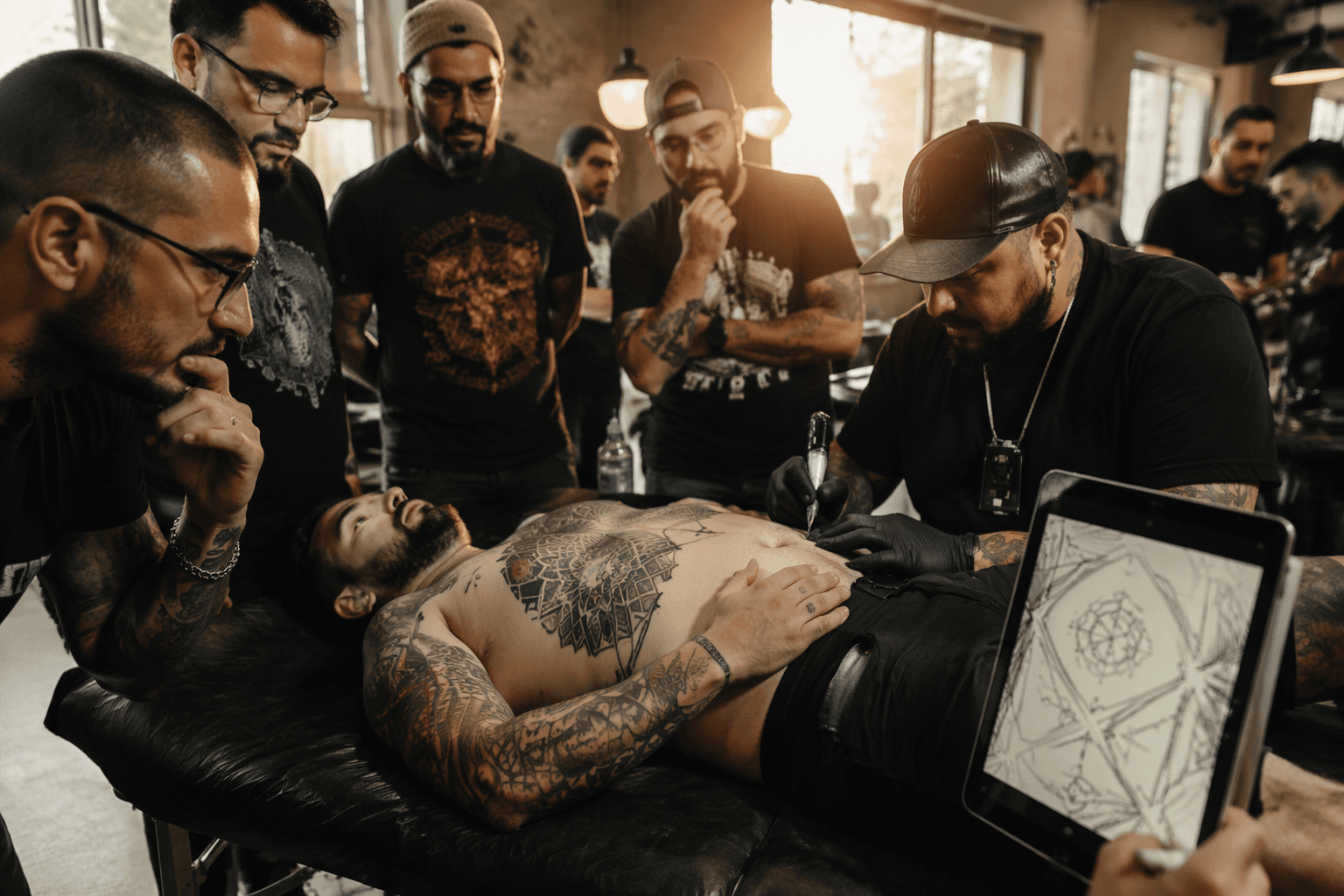
Large-scale patterning is where the directory becomes especially useful. Not every tattooer who can draw a perfect small mandala can carry a sleeve, back piece, or full-leg composition without losing rhythm, and the hybrid tags help reveal who actually has that range.
If the goal is a large black geometric piece, look for artists whose work shows strong line confidence, even fills, and an ability to maintain proportion over distance. If the goal is a lighter pattern that stretches across the body like fabric, an artist with abstract or linework strengths may be the better fit. The point is not just to find someone who “does geometric.” It is to find someone whose structural instincts match the scale you want.
The technical demands behind the aesthetic
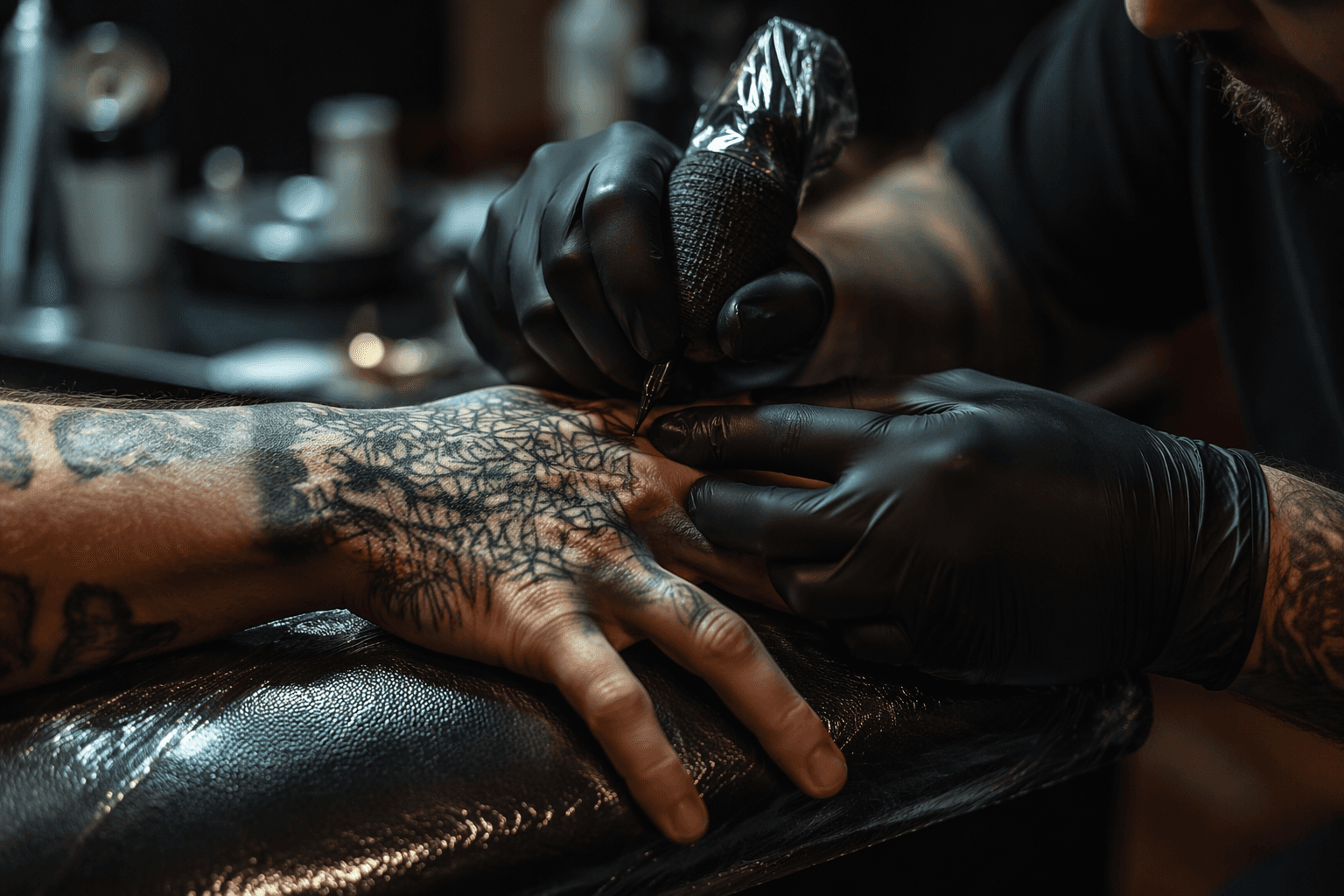
A professional geometric tattoo artist, Chase Nolan, describes the style as demanding precision, balance, longevity, clean linework, and consistent dot spacing. That is the real reason the style can split into so many subtypes without losing its identity. Every version still lives or dies on execution.
That technical reality also explains why location and rating matter in a directory like iNKPPL’s. When a style is this exacting, a client is not only choosing a motif. The choice is also about process, discipline, and the artist’s ability to repeat the same control across different parts of the body. Geometric tattooing looks simple when done well, which is exactly why it is so hard to do well.
An old visual language with a modern search function
The style may feel newly modular, but its roots go back much farther than the current directory boom. The World Health Organization’s tattoo research material defines tattooing as the intradermal injection of pigments, and it also notes that viral infections linked to poor hygiene conditions are an established risk. That context matters because geometric work often depends on sharp lines and fine spacing, which make clean procedure and careful aftercare part of the final design, not separate from it.
The historical record also shows that geometry in tattooing is anything but a new impulse. Ötzi the Iceman carried geometric and abstract tattoos, and Smithsonian reporting on ancient mummies describes dotted patterns, lines, and diamond motifs. In other words, the visual grammar behind today’s sacred geometry and dotwork tattoos has been resurfacing for thousands of years, even as the tools and aesthetics have changed.
Why health and ink quality belong in the design conversation
The public-health side is impossible to separate from the style discussion. The U.S. Food and Drug Administration says about 30% of Americans, and 40% of adults ages 18 to 34, have at least one tattoo. The agency also makes clear that tattoo inks are regulated as cosmetics in the United States, and it has issued guidance aimed at helping the industry avoid contaminated inks and protect consumers.

The Centers for Disease Control and Prevention has documented tattoo-associated nontuberculous mycobacterial skin infections linked to contaminated inks and nonsterile water used to dilute ink. For geometric work, that is not a background concern. When the entire aesthetic depends on clarity, cleanliness, and uniform spacing, hygiene affects both safety and how crisp the tattoo will look when it settles.
How to choose the right artist for the style you want
The directory’s real value is that it helps you match the visual language to the person who speaks it best. Use it like a filter, not a gallery.
- For sacred geometry, look for symmetry, disciplined centers, and controlled negative space.
- For dotwork mandalas, study how the artist handles density, gradient, and dot consistency.
- For abstract linework or fineline geometry, check how the pieces flow around joints and contours.
- For ornamental symmetry, look for decorative balance and a sense of jewelry-like rhythm.
- For large-scale patterning, make sure the artist can hold proportion across a sleeve, back, or leg without the design collapsing at distance.
The bigger shift is not just that geometric tattoos are more popular. It is that they have become a set of recognizable design languages, each with its own specialists, strengths, and ideal placements. The smartest clients are already reading the directory that way, and that is where the style is headed next.
This article was produced by Prism’s automated news system from verified source data, official records, and press releases, then run through automated quality and moderation checks before publishing. The system is built and supervised by the people who set the standards it runs under. Read our full AI policy.
Know something we missed? Have a correction or additional information?
Submit a Tip