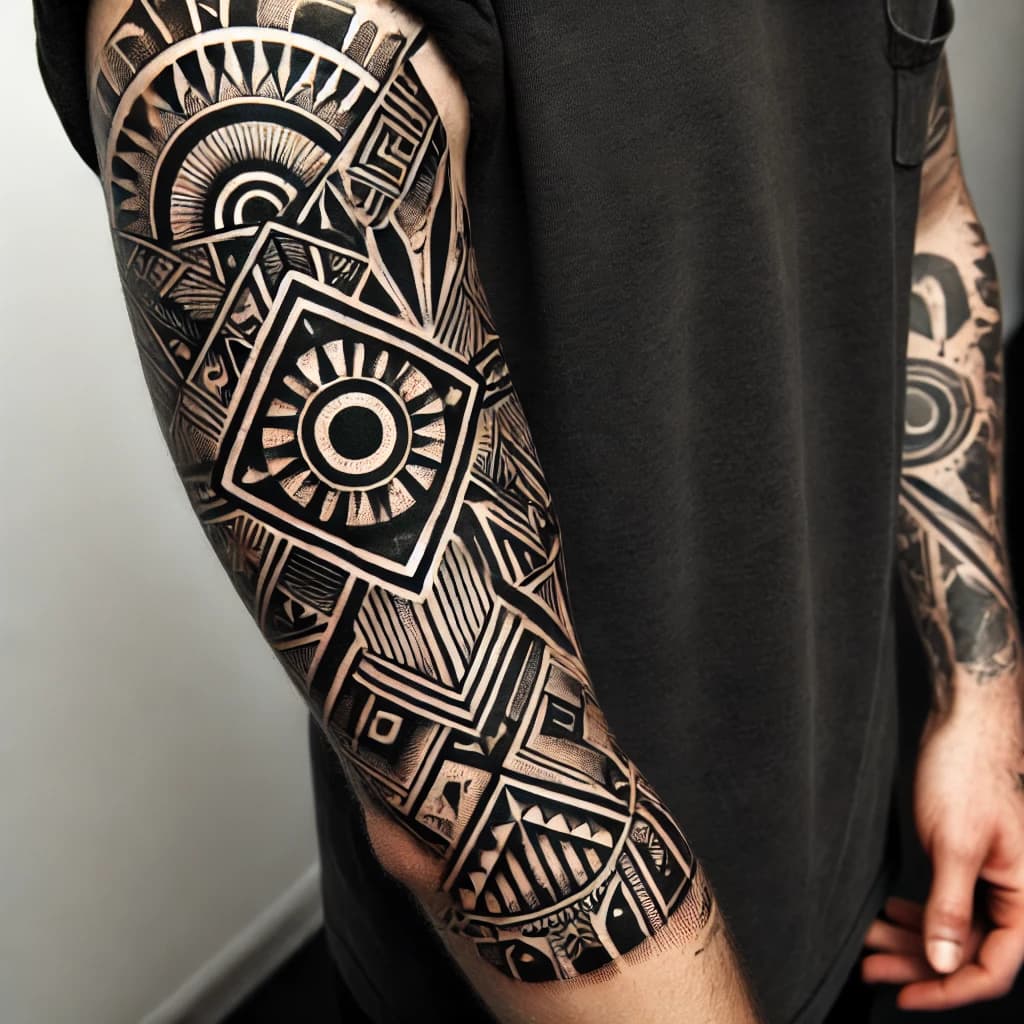
Geometric travel tattoos turn coordinates, compasses, and routes into memory marks
A travel tattoo works best when it preserves a route, not a souvenir. Coordinates, flight paths, and slim compasses turn memories into marks that age cleanly.

The best travel tattoos are memory systems, not postcards
The strongest travel tattoos do not try to trap a whole trip in one tiny picture. They hold onto the part that still matters years later: a route, a place, or the moment a life changed direction. That is why a dashed flight-path line on an inner wrist can feel more intimate than a landmark sketch, especially when it marks something as specific as a Kyiv-to-Barcelona journey.
That same logic is what makes geometric travel tattoos so effective. Clean structure lets the memory stay legible without turning into clutter, and the most successful designs carry texture and context instead of falling back on a city name or a generic souvenir image. The guide behind these ideas organizes more than 50 options by symbol, style, and placement, which turns the whole process into a practical design decision rather than a simple scroll-through of inspiration.
Route lines work when the trip itself mattered
A route-line tattoo is at its best when the journey is the point. A dashed flight path, a thin line that bends across the skin, or a minimal map trace can preserve movement without over-explaining it. That makes this style ideal for relocations, long-distance reunions, first solo trips, or any journey that feels like a before-and-after line in your life.
Geometrically, route-based tattoos work because they already have structure built in. A line can be straightened, angled, broken into dashes, or nested inside a frame, and the result still reads as travel rather than decoration for decoration’s sake. When the memory is tied to transit, distance, or departure, the cleanest compositions are often the ones that leave the most open space around the path.
When a route line makes the strongest mark
- A move between two cities
- A trip tied to a turning point
- A journey you want to remember exactly as it unfolded
- A single connection that reshaped your sense of home
The emotional advantage here is longevity. A route line does not need the exact skyline to stay meaningful, and it does not depend on a trend-heavy travel symbol to make sense. Years later, it still points back to motion, which is often the part of the story that matters most.
Coordinates are the most personal option
If a route line captures movement, coordinates pin memory to a single point on earth. That is why they land as the most personal travel tattoo choice in the guide. The numbers do not just identify a city or a country. They mark one precise place that belongs to the wearer alone.
For geometric tattoo fans, coordinates are especially satisfying because they already arrive as a system. The visual language is clean, ordered, and quietly mathematical, which means the tattoo can stay elegant even when it is small. It is the rare travel motif that feels intimate without needing an illustration to explain it.
Coordinates also age well because they resist over-description. A landmark tattoo can start to feel like a brochure image, but a coordinate set stays abstract enough to read as design and specific enough to carry private meaning. That balance is exactly why they fit so naturally into geometric work.
Why coordinates translate so well to skin
- They are precise without being loud
- They work in small spaces like the wrist, ribcage, or collarbone
- They pair easily with linework, dots, or minimal framing
- They make sense even when only the wearer knows the story
The best coordinate tattoos are usually the least fussy ones. Once the numbers are chosen, the design can stay stripped back and still feel complete, which is a major reason this motif has such staying power.
Compasses are classic, but the shape matters
The compass remains one of the most recognizable travel motifs in tattooing, but the guide is blunt about the risk of overuse. A generic eight-point rose can read tired fast if it leans too decorative or too literal. The modern versions that hold up best are the ones that respect the compass as a geometric form first and a travel symbol second.
That means fine-line compasses, vintage cartographic compasses, or a Vegvisir-style design drawn in delicate linework. Each version keeps the circular logic of the compass intact while softening the heaviness that can make older versions feel cliché. The appeal is not nostalgia for its own sake, but structure that still feels current.
Placement matters here as much as design. Circular compasses sit naturally on the inner forearm, sternum, or back of the hand, where the shape can follow the body instead of fighting it. Those placements help the tattoo read as a deliberate composition rather than a decal dropped onto the skin.
What to look for in a compass design
- Fine-line work if you want the piece to stay airy
- Vintage cartographic detail if you want a sense of travel history
- Vegvisir-inspired linework if you want the symbol to feel more sculptural
- Circular placement that lets the geometry breathe
The compass works best when it feels like direction, not ornament. In geometric tattoo terms, that means clarity, balance, and enough restraint to let the circle do the work.
Placement is part of the story, not an afterthought
One of the guide’s most useful ideas is that placement changes the meaning of a travel tattoo as much as the symbol does. A tiny dashed route line on the inner wrist feels immediate and private. A compass on the sternum or back of the hand feels more like an emblem. A coordinate line can become almost architectural when it follows the body cleanly.
That is why the article reads like a planning tool. Instead of asking only what the tattoo should be, it asks where it should live and how that placement will affect the way the design ages. A travel tattoo with clean linework and simple structure has a much better chance of staying elegant if the body placement supports its geometry from the start.
This is where the guide’s broader point becomes clear: travel tattoos are being designed less like tourist badges and more like individualized maps of identity. The best ones hold emotional meaning without relying on visual clutter, and that restraint gives them room to age into something more refined rather than more literal.
Choose the version of the memory you still want later
The cleanest travel tattoos are not always the most obvious ones. A landmark can be a fine idea if the place itself is inseparable from the story, but coordinates, route lines, and compasses usually offer more flexibility, more privacy, and more geometric integrity. They leave space for the memory to deepen instead of freezing it into a postcard.
That is the real decision behind these designs: whether you want a souvenir or a system. The strongest geometric travel tattoos work like compact maps of identity, built from line, structure, and a single point of meaning that still makes sense long after the trip is over.
This article was produced by Prism’s automated news system from verified source data, official records, and press releases, then run through automated quality and moderation checks before publishing. The system is built and supervised by the people who set the standards it runs under. Read our full AI policy.
Did this article answer your question?