Geometric Tattoos Guide Readers from Design Ideas to Perfect Placement
Geometric tattoos look simple until the body, the curve, and the artist’s precision all start making the decisions. The smartest choice is matching style path to placement.

Geometric tattoos are where clean design meets real skin, and that is where the choices get interesting. A pattern that looks perfect in a sketch can change completely once it lands on a forearm, sternum, shoulder blade, or flank, which is why Tattoos.com works best as a decision hub instead of a pure inspiration gallery. It helps readers move by style, placement, meaning, artist, and shop, so the first question is not just what looks good, but what will still look good once it is healed and living on the body.
Start with the style path, not the flash image
Geometric tattooing is not one look. Tattoodo groups it into a much wider family that includes sacred geometry, dotwork patterns, mathematical shapes, symmetrical compositions, mandalas, platonic solids, and geometric animal designs, which tells you immediately that the category can be quiet, symbolic, architectural, or boldly decorative. The style rose into a more defined contemporary lane in the early 2010s and became especially popular in the late 2010s, so it now reads as a mature design language with room for a lot of interpretation.
Sacred geometry
This is the path for people who want meaning to sit inside the pattern itself. Mandalas, platonic solids, and other shape systems give the tattoo a sense of order that feels deliberate rather than purely ornamental, and that makes this lane a strong fit if you want the piece to feel meditative or conceptual. Sacred geometry also tends to reward consultation, because the relationship between symbol, size, and placement matters as much as the linework.
Linework
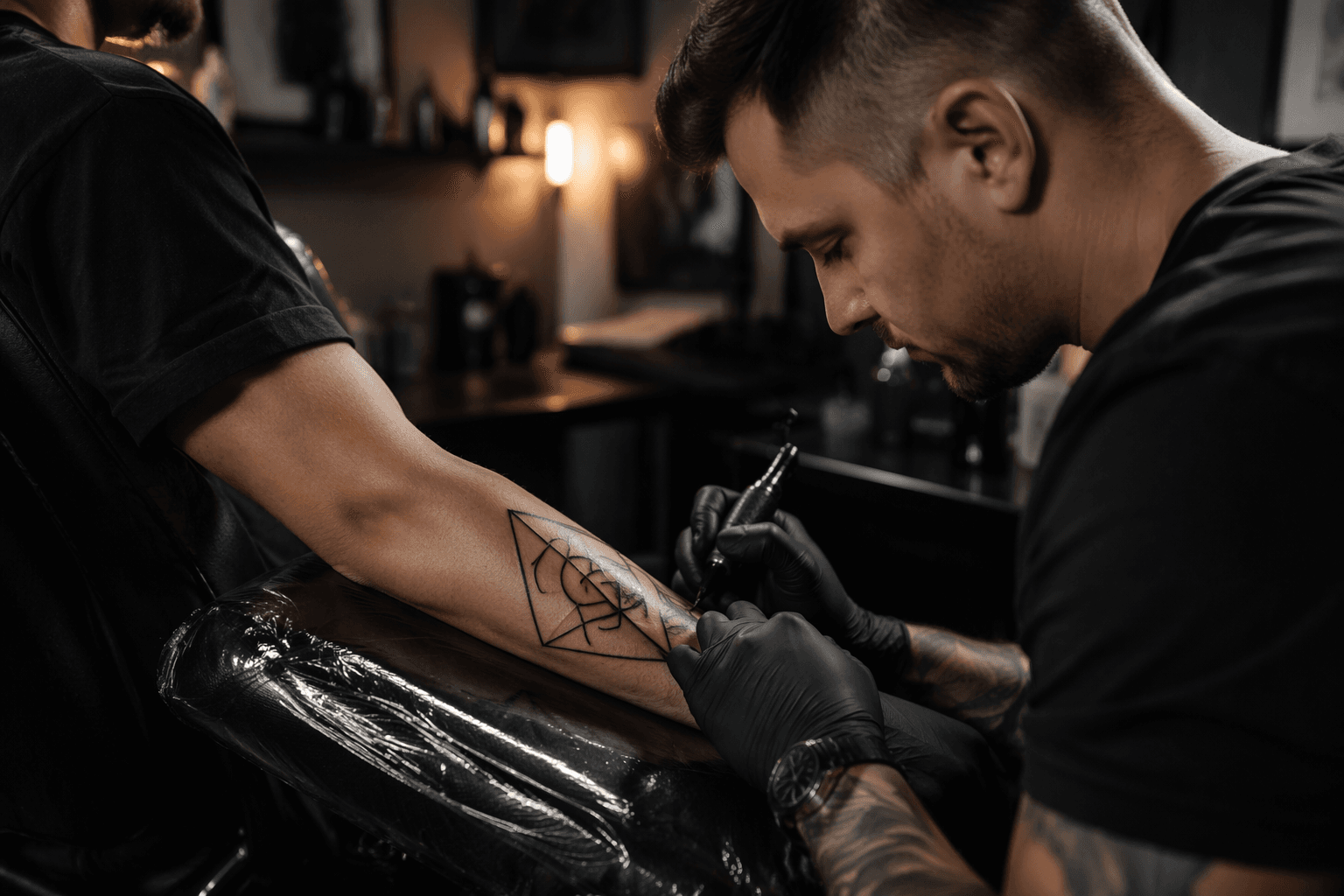
If you like geometry for its clarity, linework is the cleanest expression of that instinct. It suits people who want crisp edges, readable symmetry, and a design that does not depend on heavy shading to carry the idea. This is also the path where healed line consistency matters most, because even a small wobble or uneven stroke can disrupt the entire composition.
Dotwork
Dotwork gives geometric tattoos texture without forcing them into solid black. It works well when you want gradients, depth, or a softer visual rhythm inside a structure that is still mathematically organized. Because dotwork can age differently from hard linework, the artist’s control and spacing become part of the design itself, not just the fill technique.
Illustrative geometric blends
This is the lane for people who want geometry to frame something more recognizable, like an animal, a botanical form, or a more narrative image. The geometric structure keeps the piece disciplined, while the illustrative elements make it feel personal instead of purely abstract. This path usually needs the most customization, because the best version is rarely a template that can simply be scaled up.
Blackout hybrids
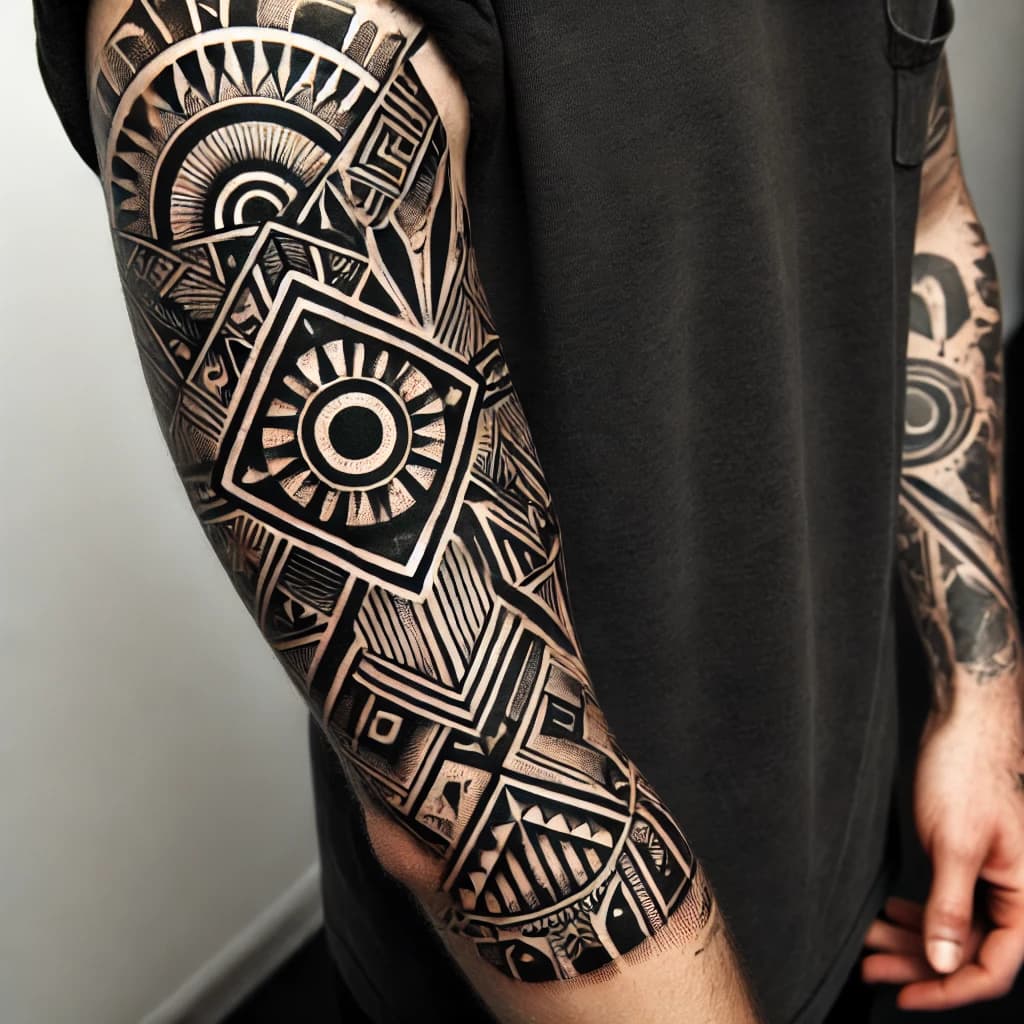
Blackout hybrids are the boldest fork in the road, the one that leans into heavy contrast and body-dominant composition. They work for people who want geometry to feel less like an outline and more like a visual field, with solid black areas making the shapes and negative space do the work. In this lane, precision is not optional, because large dark sections magnify any imbalance in spacing or symmetry.
Placement is where geometric tattoos either lock in or fall apart
Tattooing 101 makes the point plainly: placement can make or break a tattoo, because even a great design can look awkward if it does not flow with the body. That warning matters especially for geometric work, since symmetry can be disrupted by movement, muscle shape, and curvature. A design built for a flat image may need to be resized or rebalanced before it lands on the shoulder, sternum, or forearm.
The Tattoos.com hub highlights a wide spread of placement options, including the forearm, inner arm, upper arm, calf, shoulder, wrist, bicep, chest, thigh, upper back, hand, hip, shoulder blade, sternum, sleeve, and flank. Each of those areas changes the tattoo’s reading in a different way. Forearms and calves can support clean vertical or wraparound geometry, while chest, upper back, and sleeve placements give room for larger compositions. Shoulder blades, hips, sternums, and flanks ask more of the artist because the design has to account for curve and motion, not just symmetry on paper.
Small placements like the wrist or hand demand restraint. The more compact the area, the more the design has to simplify without losing its identity, and that is exactly where template-style thinking starts to fail. Bigger zones like the thigh or upper back offer more breathing room, but they also tempt artists to overbuild, so scale still needs discipline.
What to compare before you book a studio
Tattoos.com is useful because it does not stop at design ideas. It pushes readers toward artists, shops, costs, first-tattoo planning, and aftercare, which matches the reality that a geometric tattoo is a planning project as much as an art choice. Healthline’s tattoo guidance reinforces that design, artist choice, placement, and aftercare all shape the final result, especially when the goal is to reduce regret and heal well.
When you compare studios, look for a few specifics:
- Precision in linework and spacing, especially in repeated shapes
- Healed examples, not only fresh photos
- Symmetry on curved body areas like shoulders, sternums, and shoulder blades
- Evidence that the artist adjusts a design to your body instead of dropping in a stock pattern
- Range beyond templates, especially if you want sacred geometry, dotwork, or an illustrative blend
That last point matters more than it seems. Geometric tattoos can look simple on the surface, which sometimes makes artists seem interchangeable, but the best results usually come from someone who understands how small adjustments change the whole reading of the piece.
Plan the tattoo the way the style demands
The practical side of tattoo planning still starts with the tattoo itself, because a tattoo is created when ink is inserted into the dermis with a needle. That basic fact is why aftercare is not an afterthought here. A geometric tattoo depends on crisp structure, and any healing problem that blurs lines or softens contrast can change the whole effect.
So the smart path is straightforward: choose the style lane first, map it to the body second, and choose the artist last, after comparing how they handle precision, healed line consistency, curved placement, and customization. Geometric tattoos reward people who plan like designers, not impulsive shoppers. When those pieces are done well, they do more than look clean. They keep their structure as the body moves, which is the real test of the style.
This article was produced by Prism’s automated news system from verified source data, official records, and press releases, then run through automated quality and moderation checks before publishing. The system is built and supervised by the people who set the standards it runs under. Read our full AI policy.
Did this article answer your question?