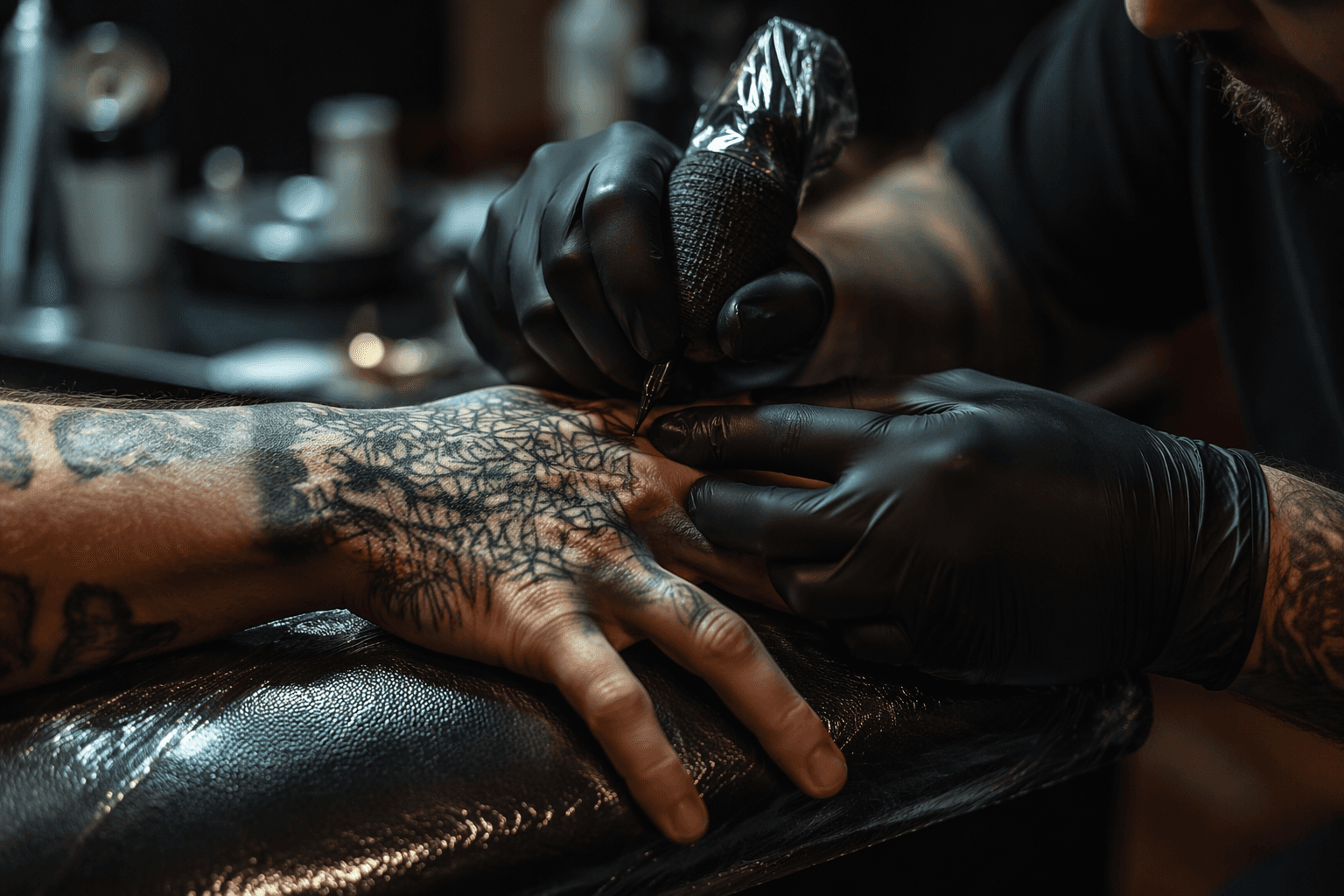
Think Tank Tattoo’s geometric arm guide maps anatomy, placement, and style choices
Think Tank Tattoo’s arm guide treats the limb like architecture, not a blank page. The payoff is cleaner flow, better healing, and geometric work that still reads years later.
The arm is an active surface, not a flat backdrop
Think Tank Tattoo’s geometric arm guide starts with the right warning: do not choose a pattern as if the arm were a poster board. A bicep curves, an elbow hinges, a forearm rotates, and a wrist keeps moving, so a design that looks perfect in a flat mockup can lose its balance fast once it meets skin. The strongest geometric pieces are built for that motion from the start, with spacing, symmetry, and line weight adjusted to the body instead of pasted onto it.
That approach matters because geometric work is especially unforgiving. A clean triangle, honeycomb grid, or mandala can look precise on paper and still fall apart if the artist ignores how the arm flexes or how the eye reads the tattoo from multiple angles. The guide’s core message is simple and useful: treat the arm like an architectural surface, and plan the tattoo the same way you would plan a structure, with load, curve, and future expansion in mind.
The eight directions the guide maps
The spread of styles in the guide shows how broad geometric tattooing has become without losing its visual language. It can stay calm and centered, or it can turn optical and high-impact, depending on how the shapes are built and where they sit. That range gives collectors real options, whether they want a first piece or the start of a larger sleeve.
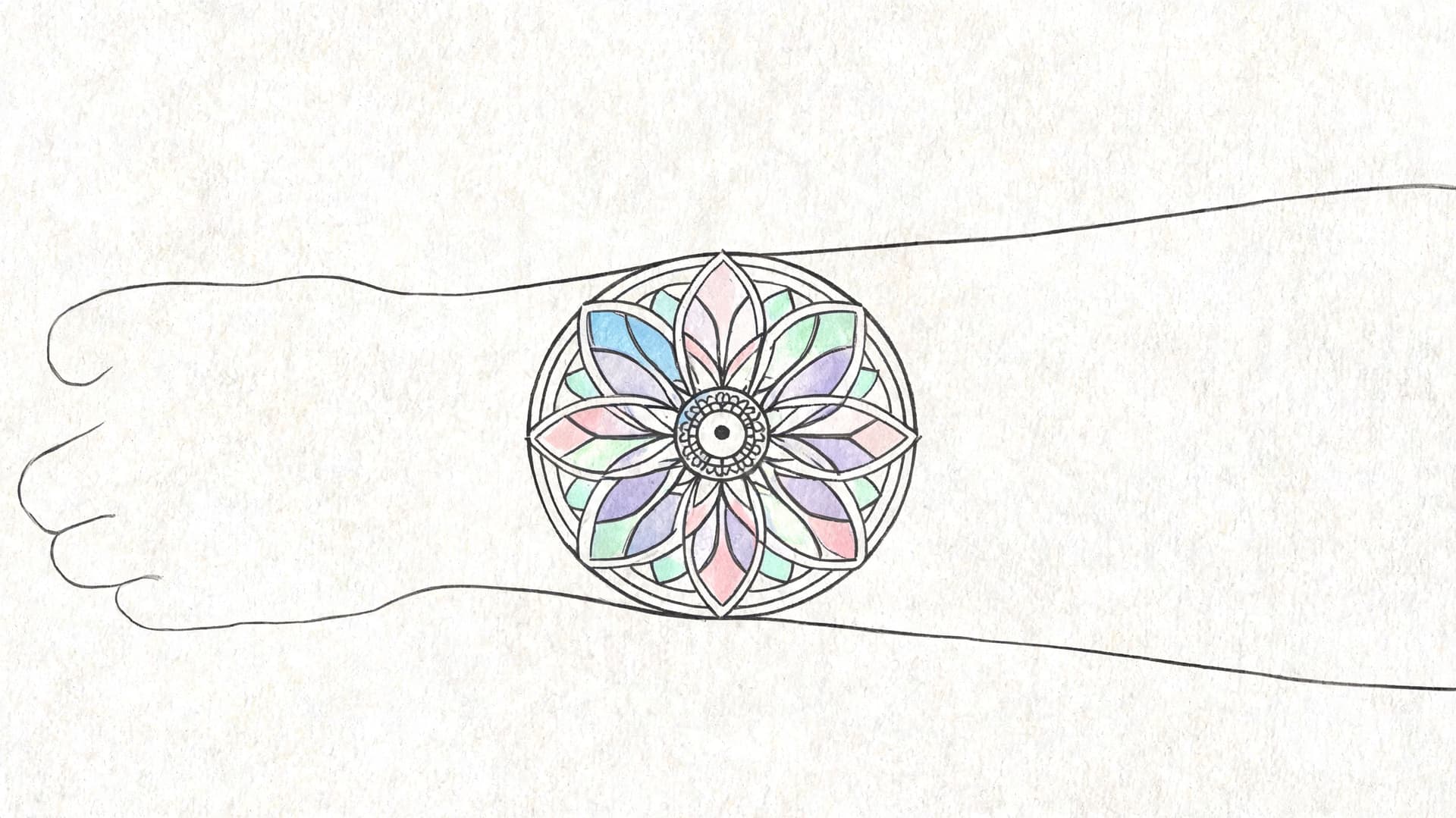
Mandala arm geometry
Mandala work gets special attention because its radial symmetry gives the eye a clear center. It is one of the most reliable entry points into geometric tattooing, especially when the composition is sized to the body part instead of crammed into a small space. The guide is blunt about that tradeoff: if the design is too small and overloaded with detail, the symmetry starts to fight the arm instead of working with it.
Sacred geometry triangles
Triangles bring structure and direction, which makes them useful when you want a design that feels sharp and intentional. They also demand clean spacing, because crowded triangle stacks can turn heavy very quickly on curved skin. On the arm, they work best when the artist uses the angle of the limb to reinforce the geometry rather than forcing the pattern to stay rigid in a place that naturally moves.
Hexagon and honeycomb patterns
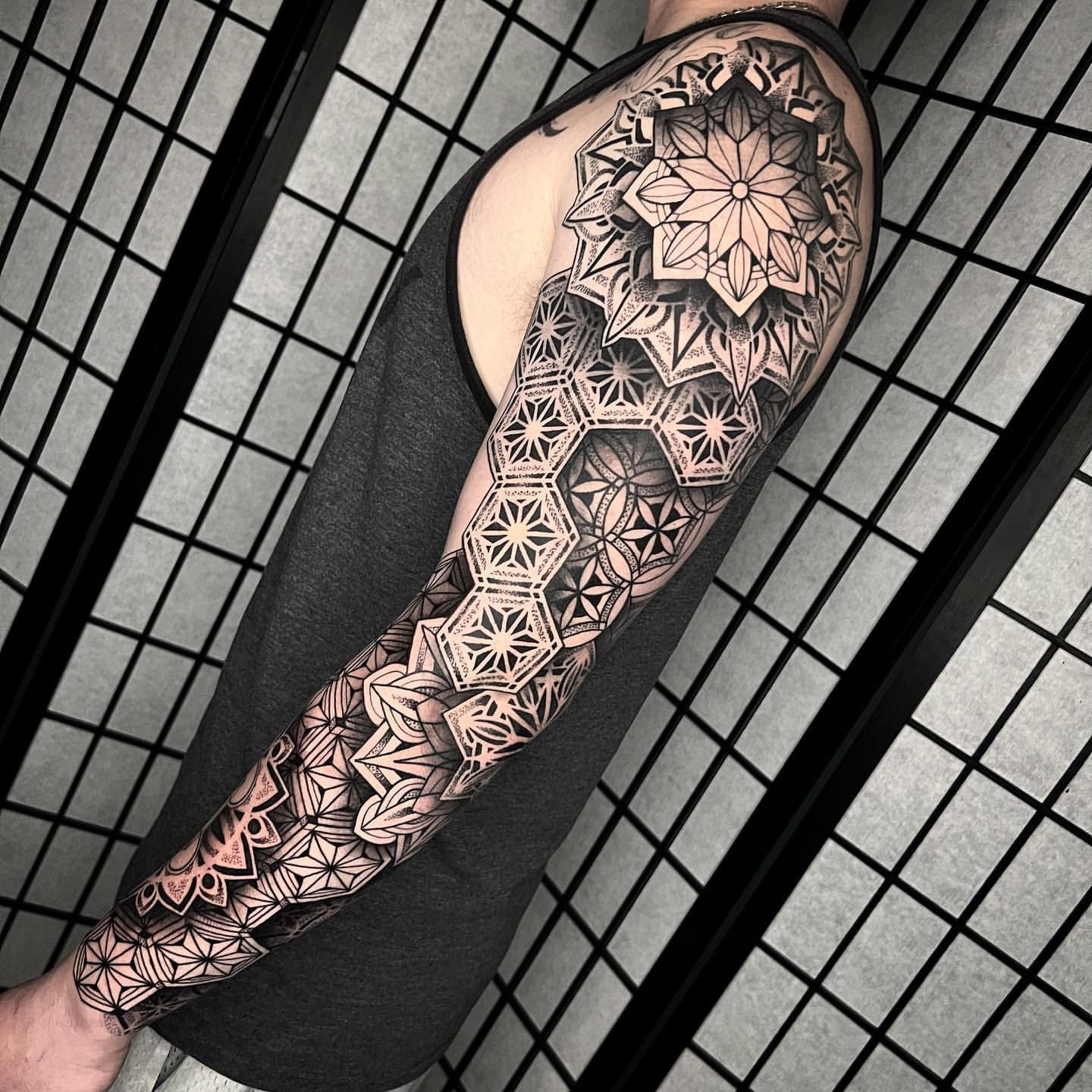
Hexagon and honeycomb layouts are built for repetition, so they reward consistency and punish distortion. They can create a strong wraparound effect on the forearm or upper arm, but only when the grid is laid out with the arm’s sweep in mind. If the pattern is not planned for expansion, the repeated cells can become awkward to extend into a sleeve later.
Flower of Life compositions
Flower of Life pieces carry both visual order and symbolic weight, which is part of why they remain a staple in geometric tattooing. The overlapping circles depend on precision, and that means the placement has to protect the pattern from warping across joints or narrow sections. When the spacing is right, the result feels balanced and layered rather than crowded.
Geometric animals and forms
Geometric animals and abstract forms push the style into something more personal. The guide’s takeaway here is that the subject should still respect the arm’s shape, because a faceted wolf, fox, or other form can lose clarity if it is forced around a bend with no breathing room. These pieces work best when the silhouette reads cleanly first, with the geometry supporting the image instead of burying it.
Geometric line work with negative space
This is where restraint does a lot of the heavy lifting. Negative space helps geometric tattoos stay readable over time, especially when the pattern needs room to breathe on a moving part of the body. The guide stresses line discipline because the balance between inked space and open skin is what keeps the design from feeling cluttered.
3D geometric illusions
3D illusions are the most dependent on perspective, which is why they are also the easiest to ruin if the artist ignores anatomy. The guide repeatedly returns to line weight and spacing here, because the illusion only works when the shape is built around the arm’s angles and the way the eye will approach it. A strong 3D piece should feel engineered, not simply shaded.
Dotwork and stippling patterns
Dotwork softens the geometry without weakening it. It can build gradients, texture, and depth while still keeping the overall structure intact, which makes it useful for collectors who want detail without harsh black mass. On the arm, dotwork also gives the artist another tool for easing transitions around curves and joints.
Placement changes everything on the arm
The guide makes a strong case for matching the design to the site. Forearm, outer upper arm, and shoulder cap placements tend to work best when the size fits the space, and forearm mandalas are strongest when the center lands on a section that can hold symmetry cleanly. That is a practical rule, not a style preference, because the cleaner the site, the easier it is for the geometry to stay legible.
The elbow is the place where many geometric tattoos start to unravel if they are treated like a dead center instead of a transition point. The same goes for the bicep, which gives artists more room but also more curvature, so a pattern that looks crisp from one angle can drift as the arm turns. At the wrist, the challenge is different: the canvas narrows, movement is constant, and any design that ignores that compression risks feeling cramped almost immediately.
For anyone planning a sleeve, the most important decision is not the individual shape but the system behind it. The guide’s best advice is to think in layers and routes, not isolated islands, so the finished work can expand naturally around the arm instead of hitting dead ends when more pieces are added later. That is how a single tattoo becomes a coherent sleeve plan instead of a collection of separate shapes.
Why geometric work keeps growing
Geometric tattooing sits inside a broader mainstream moment. Pew Research Center found in 2023 that 32% of U.S. adults have at least one tattoo, and 22% have more than one. Among tattooed adults, 69% said they got ink to remember or honor someone or something, and 47% said it was to make a statement about what they believe. That helps explain why geometric work remains so compelling: it is visual, but it is also symbolic.
The style also draws from older artistic and spiritual traditions, especially mandalas and sacred geometry motifs such as circles, triangles, hexagons, the Flower of Life, and Metatron’s Cube. Those references give geometric tattoos a language that can feel meditative, mathematical, or protective depending on how the piece is built. In that sense, the arm guide is not just about design choice, but about how meaning travels across the body.
Why the technical side cannot be ignored
Tattooing is still a medical-risk process as much as it is an art form. The U.S. Food and Drug Administration says tattoos and permanent makeup can carry risks including infections and allergic reactions, and the Centers for Disease Control and Prevention has documented tattoo-related outbreaks linked to contaminated inks and nonsterile water, including a report on nontuberculous mycobacterial skin infections. A 2023 PubMed-indexed Danish survey found that 10.2% of participants with at least one tattoo reported skin reactions beyond the first three weeks after tattooing.
That is especially relevant for geometric work because the style often depends on fine linework, tight spacing, and dense patterning. A PubMed-indexed study notes that tattoo ink is deposited at a similar depth as eccrine sweat glands, about 3 to 5 mm under the skin, which underscores why technique and aftercare matter so much. Blanca Meret’s advice fits the same lesson: the tattoo has to fit the body, movement, and anatomy of the client, not just the sketch.
Geometric arm tattoos last best when the artist plans for motion, not just symmetry. That is what turns a pretty pattern into a piece that still looks intentional after healing, after years of wear, and after the arm keeps doing what arms do.
This article was produced by Prism’s automated news system from verified source data, official records, and press releases, then run through automated quality and moderation checks before publishing. The system is built and supervised by the people who set the standards it runs under. Read our full AI policy.
Know something we missed? Have a correction or additional information?
Submit a Tip