Kaitlin Green frames geometric tattoos as body-aware ornamentation
Kaitlin Green’s profile shows why strong geometry follows anatomy, not just a stencil, with dotwork, blackwork, and ornament doing the real work.

Kaitlin Green’s profile is the kind geometric-tattoo collectors should slow down for. It does not sell geometry as a sterile pattern exercise or a trendy filter on skin. Instead, it treats ornament as something that should work with the body, which is exactly where the best geometric tattoos live.
What Green’s profile signals
Green is listed as a Denver artist at Landmark Tattoo, and the profile says she has been tattooing since 2010. That matters because geometric work punishes sloppy hands fast: the eye catches uneven spacing, drifting symmetry, and weak transitions immediately. A long run in the craft suggests more than stamina; it suggests the kind of repetition that sharpens placement, line discipline, and control over healed results.
Her listed specialties also tell you a lot about how she thinks. Dotwork, blackwork, ornamental, geometric, neotribal, and trash polka are not random tags. Together they point to an artist who is comfortable with contrast, texture, structure, and bold visual rhythm rather than a one-note approach to clean lines alone.
Why body flow is the real test
The most useful line in Green’s profile is her idea of “geometric ornamentation” designed to highlight the body’s natural form and beauty. That is the phrase serious collectors should grab onto. Geometric tattooing is strongest when it follows anatomy instead of flattening it, because the body is curved, moving, and asymmetrical in ways a sketchbook page never is.
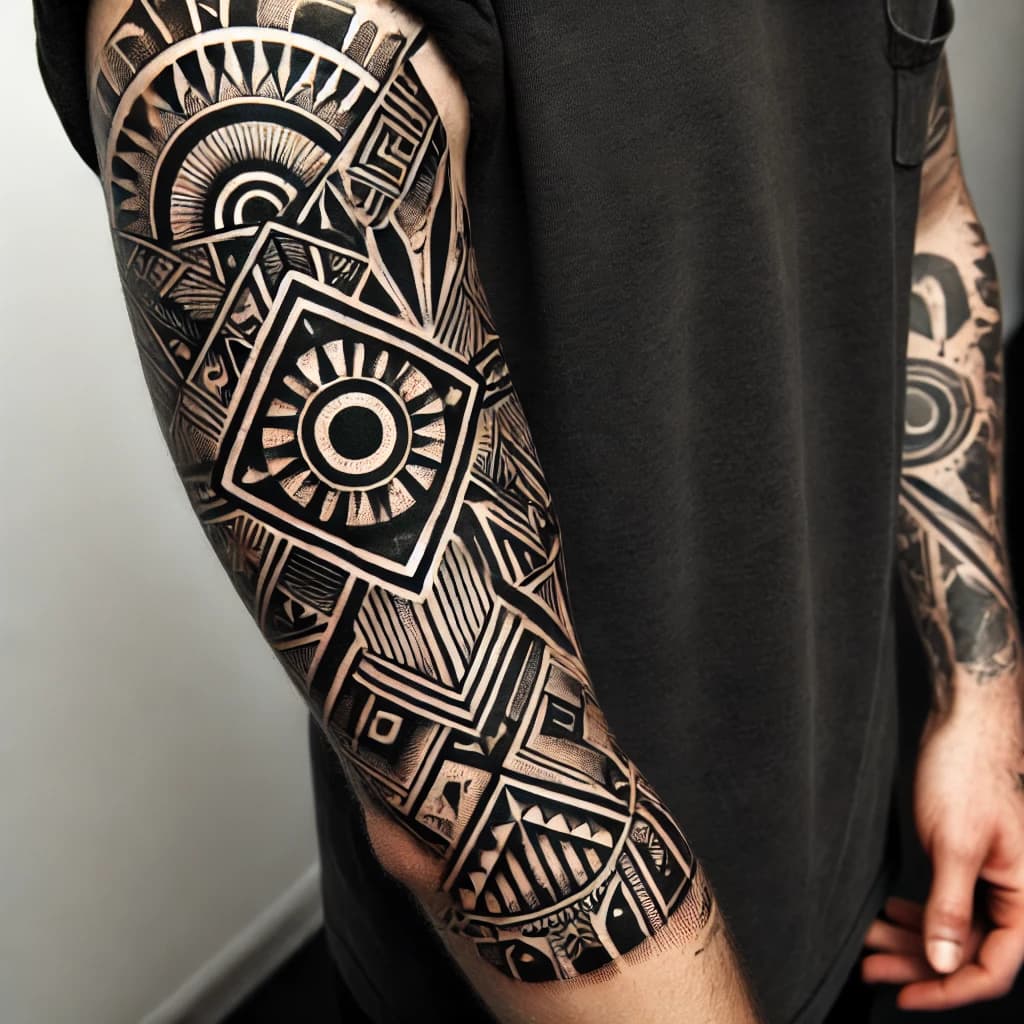
In practice, that means the best pieces do not just look balanced in a photo. They track shoulders, ribs, forearms, sternum, knees, or spine with intent. A good geometric artist knows where a mandala can breathe, where a pattern needs to taper, and where a heavy black shape can anchor the composition without fighting the wearer’s movement.
What to look for in a geometric artist profile
When you are evaluating a profile like Green’s, the details that matter are the ones that hint at control, not just style vocabulary. You want to see evidence of body-aware placement, layered technique, and enough range to keep the work from feeling repetitive.
- Dotwork alongside blackwork: that combination usually means the artist understands both softness and density. Dotwork can create gradual shading and texture, while blackwork gives a piece weight, contrast, and permanence of shape.
- Ornamental design language: ornamental work often shows whether an artist can build rhythm across the body. Repeating motifs, balanced spacing, and careful negative space are the stuff that makes geometric pieces feel intentional instead of pasted on.
- Neotribal and trash polka in the mix: these tags suggest comfort with bolder visual decisions. That is useful because a lot of geometric tattoos need more than neat geometry to land well on skin; they need punch, movement, and confidence.
- A long tattooing timeline: “since 2010” is not just a résumé line. It implies years of refining how a design actually heals, stretches, and reads after the redness fades.
Why her style blend works for collectors
Green’s mix of dotwork, blackwork, ornamental, geometric, neotribal, and trash polka points to something important: geometric tattooing rarely exists in isolation. The strongest pieces often borrow from adjacent languages. Dotwork can soften transitions. Blackwork can lock in structure. Ornament can add cadence. Neotribal elements can push the design toward body adornment rather than illustration.
That blended technical space is often where the most interesting geometric tattoos come from. It is also where originality lives. If you want a piece that feels personal, not mass-produced, you want an artist who can move between crisp geometry and richer texture without losing the underlying structure.
Green’s profile also says she draws inspiration from the art of many world cultures. That broad reference point matters, because geometric tattooing has deep roots and wide visual ancestry. The work feels more grounded when the artist is thinking beyond a single trend cycle and understands that line, pattern, and ornament have long histories in tattooing and in other visual traditions.
Why the blackwork context matters
Tattoodo’s blackwork guide places blackwork in a broader family that includes tribal roots as well as contemporary geometric, dotwork, illustrative, engraving, and calligraphic forms. That wider definition helps explain why Green’s profile reads the way it does. Her work is not just “black ink tattoos”; it sits inside a lineage where pattern, density, and graphic force all overlap.
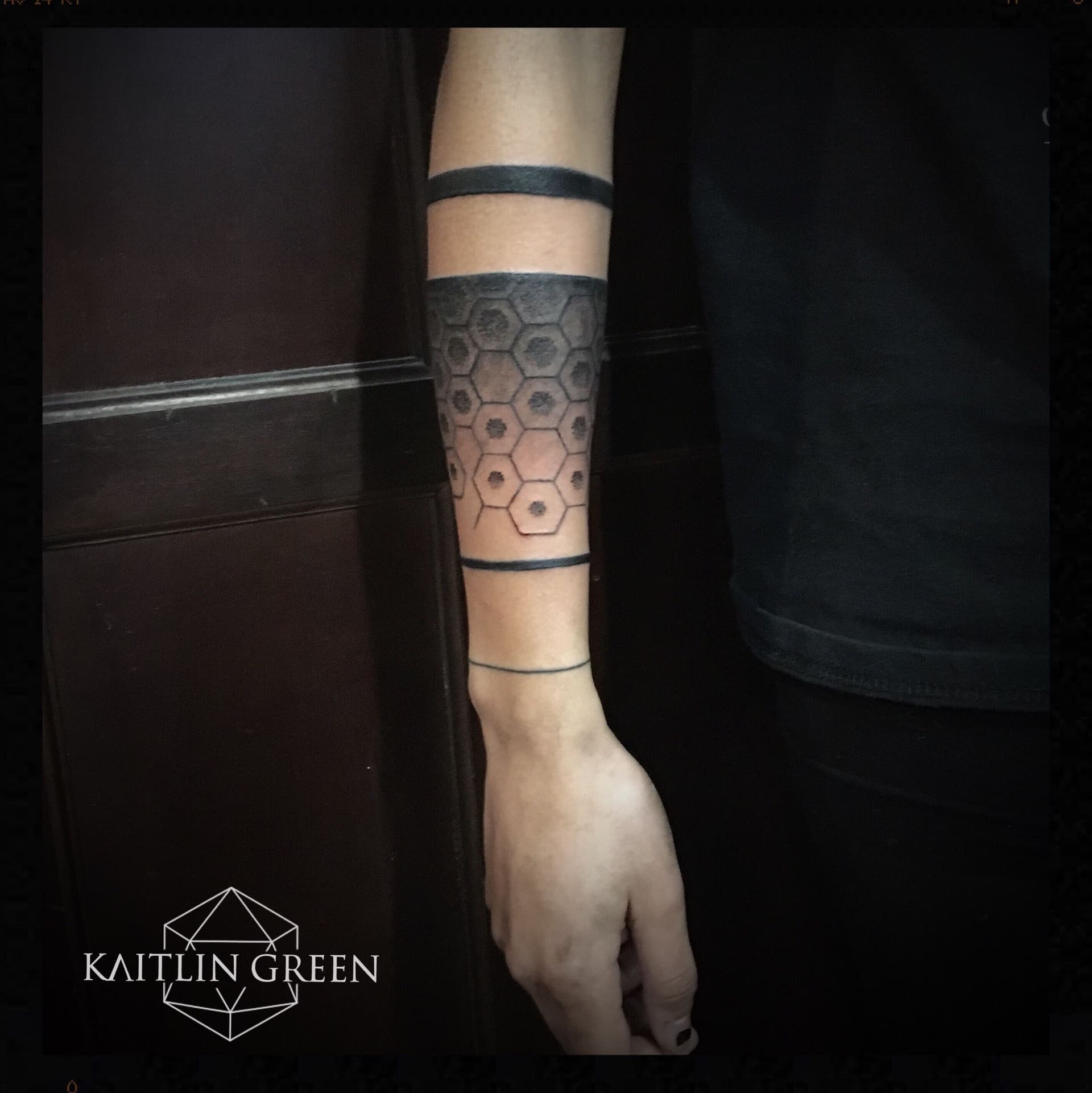
For collectors, that matters because blackwork is not only about filling skin with ink. It is about how black shapes anchor a composition, how they interact with skin tone, and how negative space keeps the piece from becoming a slab. In geometric work, that balance is everything. The best artists know when to let the skin breathe and when to commit to full density.
Safety, placement, and the long view
The body-aware framing also lines up with the safety and longevity side of tattooing. The Food and Drug Administration says tattoos are made by inserting colored ink into the skin, and that they are meant to last a lifetime and are difficult to remove. The agency also warns that contaminated inks can cause infection and serious health injuries, which is why precision in the studio should never be separated from hygiene.
The Centers for Disease Control and Prevention has documented tattoo-associated nontuberculous mycobacterial skin infections, including 22 cases across four states in a 2012 investigation. In that outbreak, dilution of tattoo inks with nonsterile water was identified as a potential source of infection. That is a blunt reminder that the quality of the work is not only about the pattern on the surface; it also depends on how seriously the studio handles the materials behind it.
Dermatology research places tattoo pigments in the dermis, the layer beneath the epidermis. That helps explain why placement and healing matter so much in geometric tattooing. What looks symmetrical on day one still has to live inside skin that moves, stretches, and ages, which is why experienced artists obsess over flow, contrast, and the way a design will hold up after healing.
Why this profile stands out
Green’s Denver base at Landmark Tattoo, her tattooing history since 2010, and her layered style mix all point in the same direction: reliability over hype. She looks like an artist who understands that clean execution is not an accessory in geometric tattooing. It is the whole point.
For serious collectors, that is the standard worth chasing. The best geometric tattoos do not sit on the body like decals. They belong to the body, and Green’s profile makes that priority clear from the first read to the last line.
This article was produced by Prism’s automated news system from verified source data, official records, and press releases, then run through automated quality and moderation checks before publishing. The system is built and supervised by the people who set the standards it runs under. Read our full AI policy.
Did this article answer your question?