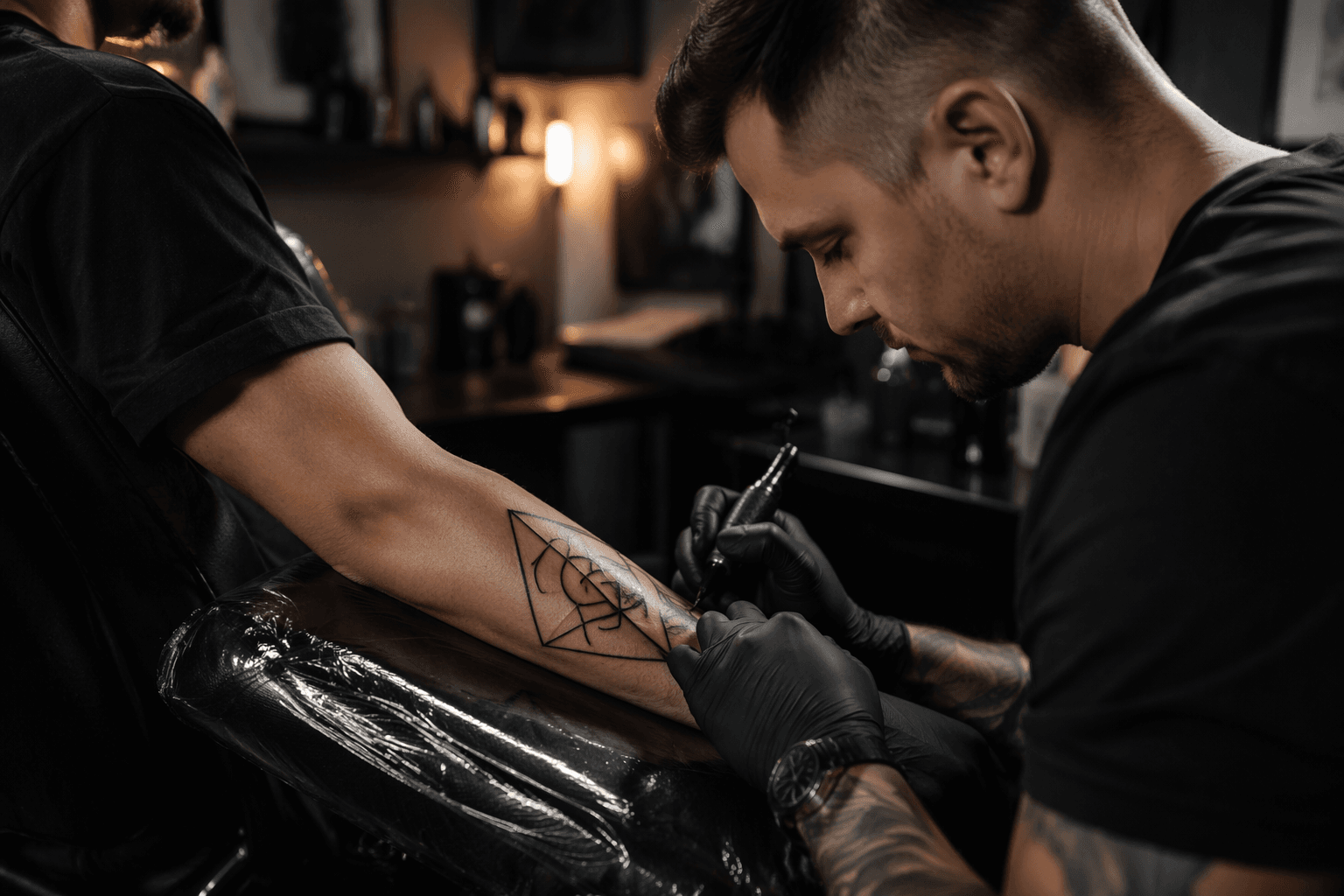
Outer Bicep Offers Ideal Canvas for Geometric Tattoos, Artists Say
The outer bicep gives geometric work a flatter, more readable stage, so symmetry lasts longer and the design still looks intentional as the arm moves.
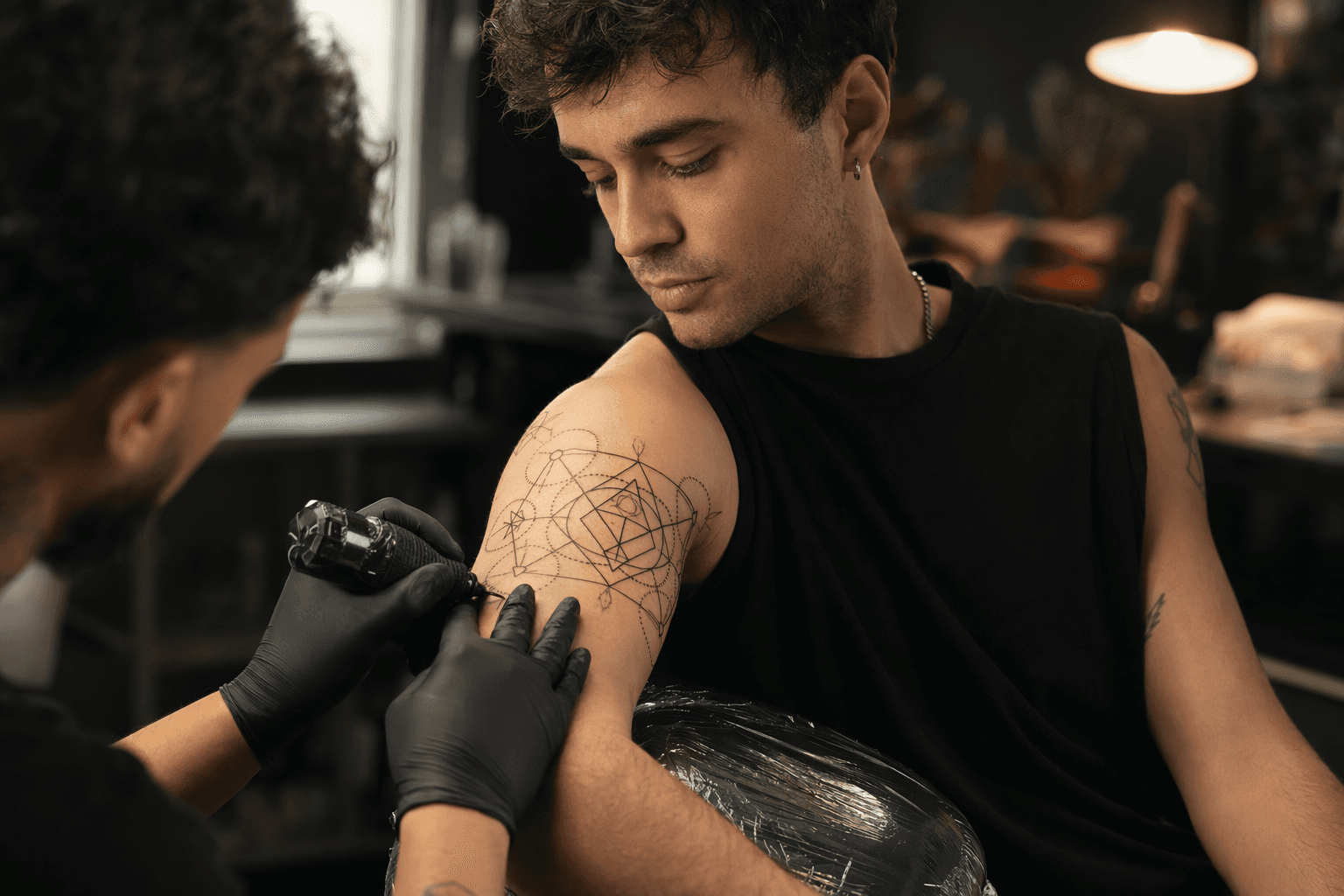
Why the outer bicep makes geometric work look cleaner
The biggest misconception about a first geometric tattoo is that the safest placement is the most boring one. The outer bicep proves the opposite: it is visible when you want it to be, easy to cover when you do not, and flat enough to keep a pattern from warping before it even leaves the stencil stage. For men weighing a first geometric piece, that combination matters because the arm is not just skin, it is moving structure, and the design has to work with that structure instead of fighting it.
The shape beneath the skin helps explain why the area works so well. The biceps brachii is a large, thick, fusiform muscle on the upper arm, which gives the outer bicep a natural platform for precise linework and structured patterning. That matters because geometric tattoos depend on balance, repetition, and crisp edges. When the canvas has enough firmness and size to hold a full composition, the design reads more clearly from a distance and keeps its architecture intact up close.
What the upper arm gives a geometric tattoo that other placements do not
The upper arm is not a neutral patch of skin. It is a highly mobile functional unit with many nerves, blood vessels, and muscles, which means placement has to account for contour, movement, and how the tattoo will sit when the arm flexes or relaxes. That is where the outer bicep earns its reputation. Compared with a rounded shoulder cap or the more active inner arm, the outer bicep offers a flatter plane that supports straight lines and tighter symmetry with fewer visual distortions.
That structural advantage becomes obvious in geometric work. Interlocking forms, sacred geometry, and pattern-heavy compositions depend on line fidelity, and line fidelity depends on a surface that does not fold the design into itself every time the arm turns. Tattoo placement also affects how a piece heals and ages, so the outer bicep’s combination of stable shape and everyday flexibility gives it a practical edge for a first piece that is meant to stay sharp over time.
Which motifs hold precision on the outer bicep
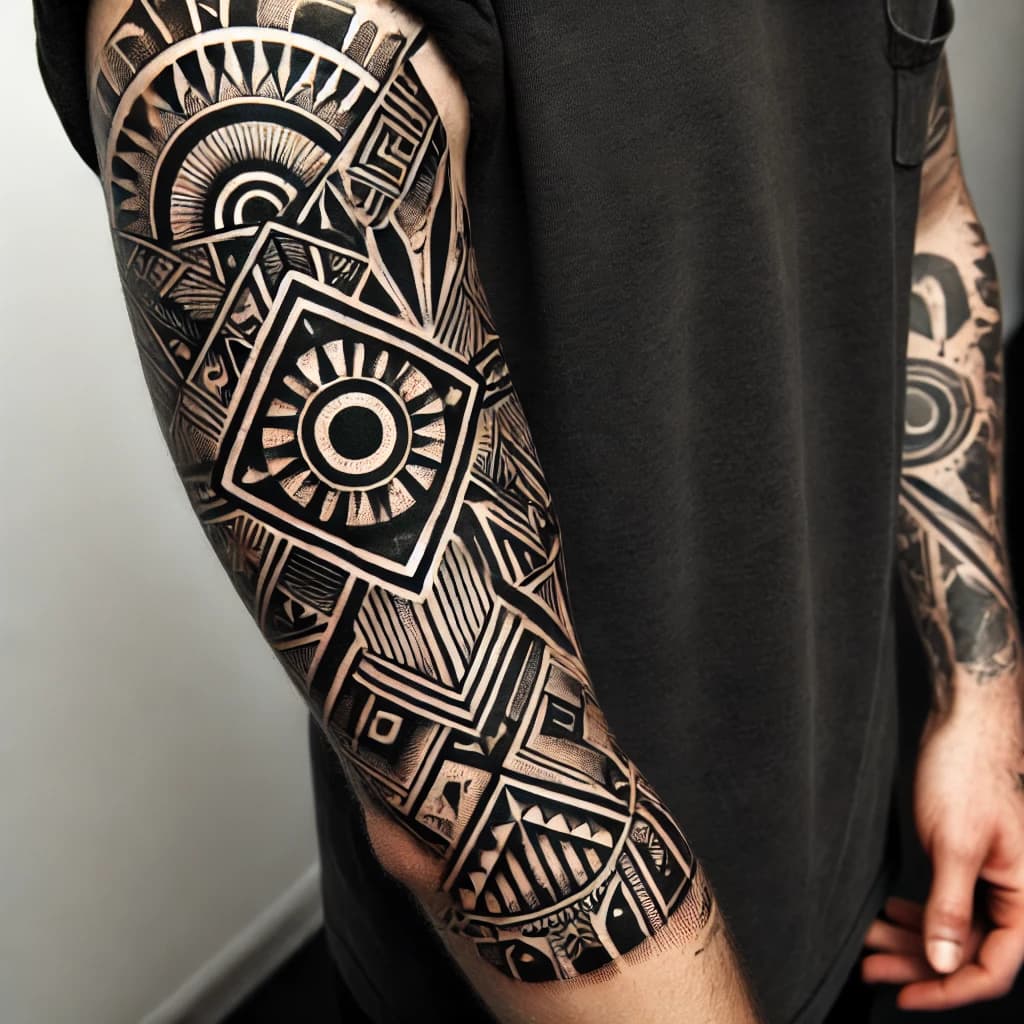
The outer bicep is especially strong for designs that already think in clean borders and repeating units. A geometric composition that fills the outer bicep can use interlocking shapes, mirrored forms, and carefully spaced blackwork without feeling cramped. Sacred geometry also sits naturally here because the muscle gives the eye a broad enough field to follow a central structure without the composition breaking apart at the edges.
Mandalas are another natural fit, as long as the design is scaled to the arm rather than copied straight from paper. Britannica describes a mandala as a symbolic diagram used in Hindu and Buddhist Tantrism as an instrument of meditation, and that meditative center-out logic translates well to the outer bicep’s shape. The placement gives the mandala room to breathe, so its radial balance can stay legible as the arm rotates.
Geometric animal portraits can also work well when the artist understands how to simplify. A wolf, lion, or stag built from angular facets can look strong on the outer bicep because the muscle gives the portrait enough width for the face to hold together. The key is restraint: the best results usually favor bold planes and deliberate negative space over overpacked detail.
Which ideas need simplification before they reach the skin
Not every geometric idea is equally suited to the upper arm in its most complex form. Designs that rely on extreme micro-detail, delicate symmetry, or long uninterrupted circles often need to be adjusted for the way the bicep moves. A tattoo that looks perfect on a flat sketch can lose clarity if it wraps too hard around a curve or tries to do too much across a changing surface.
That is why a consultation matters before the first session. Placement should guide the design, not the other way around. If a motif is built around precise geometry, ask whether it can survive on the outer bicep without collapsing into visual noise once the arm bends. Some pieces need to be simplified into stronger blocks, cleaner borders, or a more open composition so the tattoo still reads as intentional after healing.
Why tribal bands still show up in upper-arm conversations
The tribal band remains one of the most traditional upper-arm tattoo concepts for a reason. Bold black geometric patterns wrapping the upper arm naturally echo the arm’s shape, and the format has stayed durable across many tattooing cultures that use the arm as a canvas. It is one of the clearest examples of how a design can be both decorative and structural at the same time.
That history also raises a bigger point about meaning. Tattoos have been practiced in many parts of the world for thousands of years, and body markings have historically served religious, protective, and status-related functions. Smithsonian Magazine has noted that ancient ink could express religious faith, relieve pain, protect wearers, and indicate class. In other words, geometry on skin is rarely just geometry. Even when the final piece looks modern, it often sits inside older systems of symbolism.
The cultural side of ornamental and geometric work
Geometric and ornamental styles often pull from sacred geometry, mandalas, and related symbolic traditions, which makes origin part of the conversation, not an afterthought. Some ornamental tattoo guides caution about cultural appropriation and advise learning a design’s roots before making it permanent. That advice matters even on something as apparently neutral as a clean black pattern, because a design can carry meaning beyond its visual balance.
For a first geometric tattoo, that does not mean every pattern needs to become a lesson in art history. It does mean the best choices are the ones that feel structurally right and culturally considered. When a design has a clear lineage, a readable shape, and a placement that respects the arm’s anatomy, the result feels more confident and less forced.
How to judge the outer bicep before you book
The outer bicep works best when you think of it as a design tool. It is large enough for a full composition, flat enough for detail, and visible enough to show off clean symmetry without demanding attention every minute of the day. That mix is exactly why artists keep steering geometric tattoos toward it.
- Does the design depend on straight lines that need a stable surface?
- Will the pattern still make sense when the arm bends?
- Can the motif be simplified without losing its identity?
- Does the placement support the piece now and as it heals and ages?
A useful way to judge your first piece is to ask a few simple questions:
If the answer is yes, the outer bicep is probably doing its job. For geometric work, that matters more than novelty, because the best first tattoo is not the loudest one. It is the one that still looks deliberate every time the arm moves.
This article was produced by Prism’s automated news system from verified source data, official records, and press releases, then run through automated quality and moderation checks before publishing. The system is built and supervised by the people who set the standards it runs under. Read our full AI policy.
Did this article answer your question?