Ryan Stacks’ Tattoos Reflect a Life Built on Intention and Purpose
Ryan Stacks turns a tattoo collection into a personal blueprint, showing how geometry, spacing, and meaning can make body art feel deliberately unified.

A life that reads like a composition
Ryan Stacks stands out because nothing about his story feels accidental. Born and raised in Walla Walla, Washington, now living in Salt Lake City, Utah, he moves through the world as a photographer, romance author, content creator, and wrestling coach, while carrying a tattoo collection that reflects the same sense of purpose. He has traveled to 26 countries and counting, and that kind of range matters here because it gives his body art the feel of a record, not a pile of isolated decisions.
That is the deeper lesson for geometric tattoo readers: a strong collection rarely comes from chasing whatever looks good in the moment. It comes from building a visual identity over time, where each piece speaks to the others through repetition, balance, and restraint. Stacks’ profile works because it presents tattoos as part of a larger personal architecture, the kind of body art that looks intentional because the life behind it is intentional.
Why this story hits so hard in geometric tattoo culture
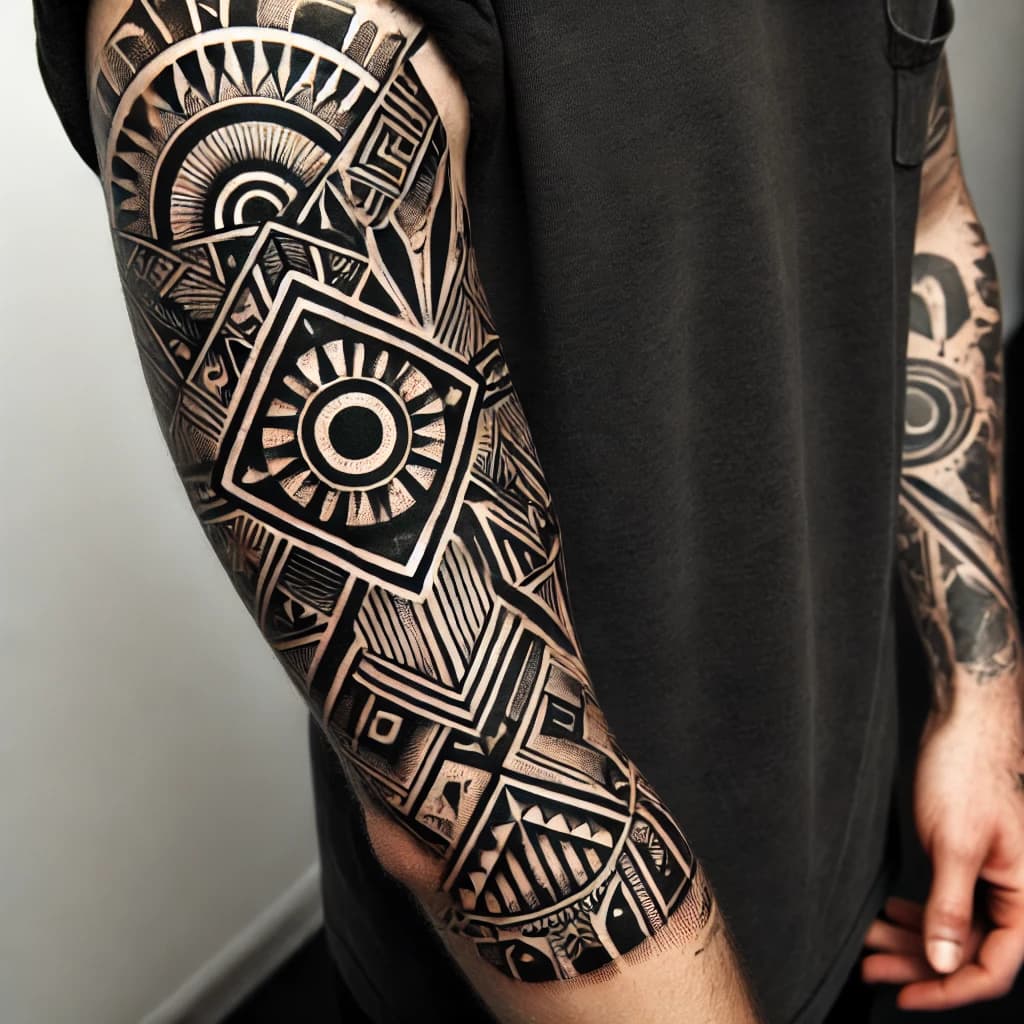
Geometric tattoo fans already know that precision is the point. Clean linework, symmetry, spacing, and contrast are what separate a cohesive body from one that feels crowded or random. Inked has previously described geometric tattoo work as depending on impeccable placement, original design, and flawless lines, and Stacks’ profile fits that mindset even without centering one specific motif.
What makes the story compelling is not a single sleeve or one standout back piece. It is the way his tattoos are framed as part of a bigger philosophy: live deliberately, and let your body art reflect that discipline. In geometric work, that usually means thinking in systems rather than singles. A person might repeat shapes, echo line weights, or leave negative space between pieces so the eye can move across the body without visual noise. Stacks’ story reinforces that same logic through personality and life choices rather than through a technical tattoo breakdown.
The decision logic behind a unified collection
If you are building a geometric collection, the most useful takeaway from Stacks is not about subject matter alone. It is about how each choice supports the next one. A tattoo can be meaningful on its own and still feel out of place if it ignores the rest of the body, the existing contrast, or the overall rhythm of placement.
- repeat a limited visual language, such as symmetry, linework, dotwork, or blackwork
- let spacing breathe so each piece can stand on its own
- balance dense areas with open skin so the composition does not collapse into clutter
- make sure new work relates to the body’s natural movement, not just the artist’s stencil
The most cohesive collections usually rely on a few simple ideas:
That is why Stacks’ profile resonates. His tattoos are presented as part of a life shaped by movement, work, travel, and self-definition. The collection feels earned because it matches the rest of the identity around it.
From ancient geometry to modern self-authorship
The appeal of geometric tattooing is not new, and that history gives this profile extra weight. Smithsonian Magazine notes that Polynesian tattoo traditions developed over millennia and often featured highly elaborate geometric designs that could cover the whole body. That matters because it places today’s precision-heavy tattoo culture inside a much older lineage of pattern, symbolism, and body mapping.

The historical record goes even farther back. Smithsonian Magazine also points to Ötzi the Iceman, whose 61 tattoos are about 5,200 years old, with markings that included dots and small crosses placed near areas corresponding to joint strain. Those details remind us that patterned tattooing has long been tied to function, meaning, and the body itself, not just ornament.
For readers drawn to sacred geometry, linework, and structured compositions, that history matters. It suggests that the impulse to organize the body through shape is deeply human. Stacks’ modern tattoo story fits that same instinct: use the skin as a place to record experience with intention rather than clutter.
Why his broader identity makes the ink feel more powerful
Stacks is not presented as a single-note personality, and that is exactly why the profile works. He is a photographer, romance author, content creator, and wrestling coach. Those roles create tension in the best way, mixing physical discipline, storytelling, travel, and visual culture into one identity that feels lived-in rather than branded.
That blend matters to tattoo readers because it mirrors how collections often evolve in real life. People do not collect geometric tattoos in a vacuum. They bring in chapters from travel, work, relationships, and personal reinvention. When those chapters are reflected through carefully chosen shapes and placement, the result feels like a visual autobiography instead of a random patchwork.
Stacks has traveled to 26 countries and counting, which adds another layer to that idea. Travel changes taste. It changes what people are willing to wear permanently, and it often sharpens their eye for proportion, pattern, and restraint. In that sense, his story speaks directly to the kind of collector who wants every new piece to add structure, not noise.
What tattoo psychology adds to the picture
The profile also lines up with what tattoo psychology has been saying for years. A review in PubMed says tattooing has become a mainstream phenomenon in Western culture and can be a way to explore personal meaning and self-identity. Another study in PMC describes tattoos as a vehicle for projected identity of the self. Put simply, body art is not just decoration anymore. It is a language people use to describe who they are becoming.
That idea gives Stacks’ story its real weight. His tattoos are not framed as rebellion for rebellion’s sake or toughness for its own sake. They are part of a deliberate self-authored narrative, one that connects place, work, movement, and taste. For geometric tattoo readers, that is the model worth watching: build a collection that says something clear, and let every new piece strengthen the message.
In the end, Ryan Stacks’ tattoos work because they belong to a life that already has structure. The result is a collection that feels less like decoration and more like design, a reminder that the strongest geometric tattoo stories are the ones where every line earns its place.
This article was produced by Prism’s automated news system from verified source data, official records, and press releases, then run through automated quality and moderation checks before publishing. The system is built and supervised by the people who set the standards it runs under. Read our full AI policy.
Did this article answer your question?