Tatspark gallery showcases 500 geometric tattoo ideas with 3D try-on
Tatspark’s geometric tattoo gallery turns 500-plus ideas into a planning tool, with 3D try-on helping you lock down placement before the needle hits.
Tatspark’s geometric tattoo gallery works less like a mood board and more like a filter for bad decisions. With more than 500 ideas on one page, plus 3D virtual try-on, it pushes you to test structure, scale, and placement before you commit to the kind of symmetry that fails loudly when it is off by a few millimeters.
A massive library, but not a random one
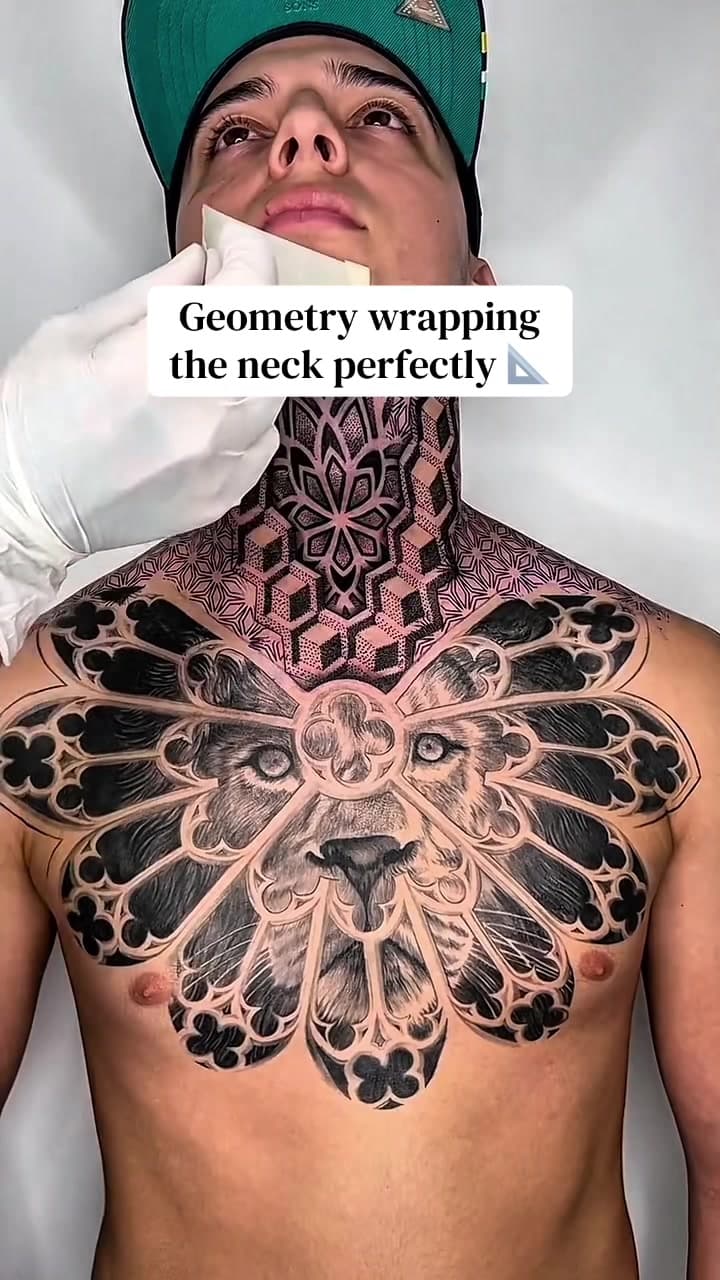
The strength of the gallery is how clearly it frames the category. Geometric tattoos sit at the intersection of mathematics and art, and Tatspark leans into that with a collection centered on sacred geometry, dotwork, and minimalist line work. That matters because geometric work is not just about filling skin with shapes. It is about repetition, balance, negative space, and the way a design reads once it is anchored to a shoulder cap, forearm, calf, chest, or back.
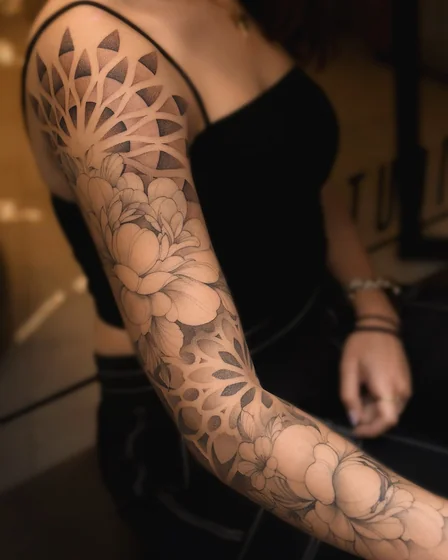
The page also makes room for the full spread of the style. You are not boxed into a single aesthetic lane here. The library covers tiny line-based pieces, dense patterned sleeves, and spiritual designs that borrow from sacred geometry, which is exactly how the real-world category behaves. If you are trying to narrow the field, the gallery gives you enough variety to decide whether you want something precise and airy or something heavy, layered, and almost architectural.
Placement is the first decision, not the last
This is where geometric tattoos separate from looser illustrative work. Tattooing 101 is blunt about placement: even a great tattoo can look awkward in the wrong spot. Its placement guide singles out the forearm as one of the most popular areas, the leg as a strong home for very intricate geometric tattoos, and sleeve work as something that often has to be mapped piece by piece so the flow lines up with the body.
That advice lines up with how the Tatspark gallery should be used. A pattern that looks clean in a thumbnail may stretch too much over the ribs or lose its symmetry when it bends around the forearm. If you are building a brief for an artist, start with where the piece lives on the body, then decide whether it should be compact, vertical, wraparound, or designed to connect across multiple sessions.
Fine-line and blackwork are not interchangeable
A lot of people lump every geometric tattoo into the same bucket, but the execution changes the whole read. Tattooing 101 describes modern geometric tattoos as designs broken down into basic geometric shapes, with shading used to show how light bounces off each plane. That gives you one end of the spectrum: crisp line work, subtle shading, and enough breathing room for the structure to stay legible.
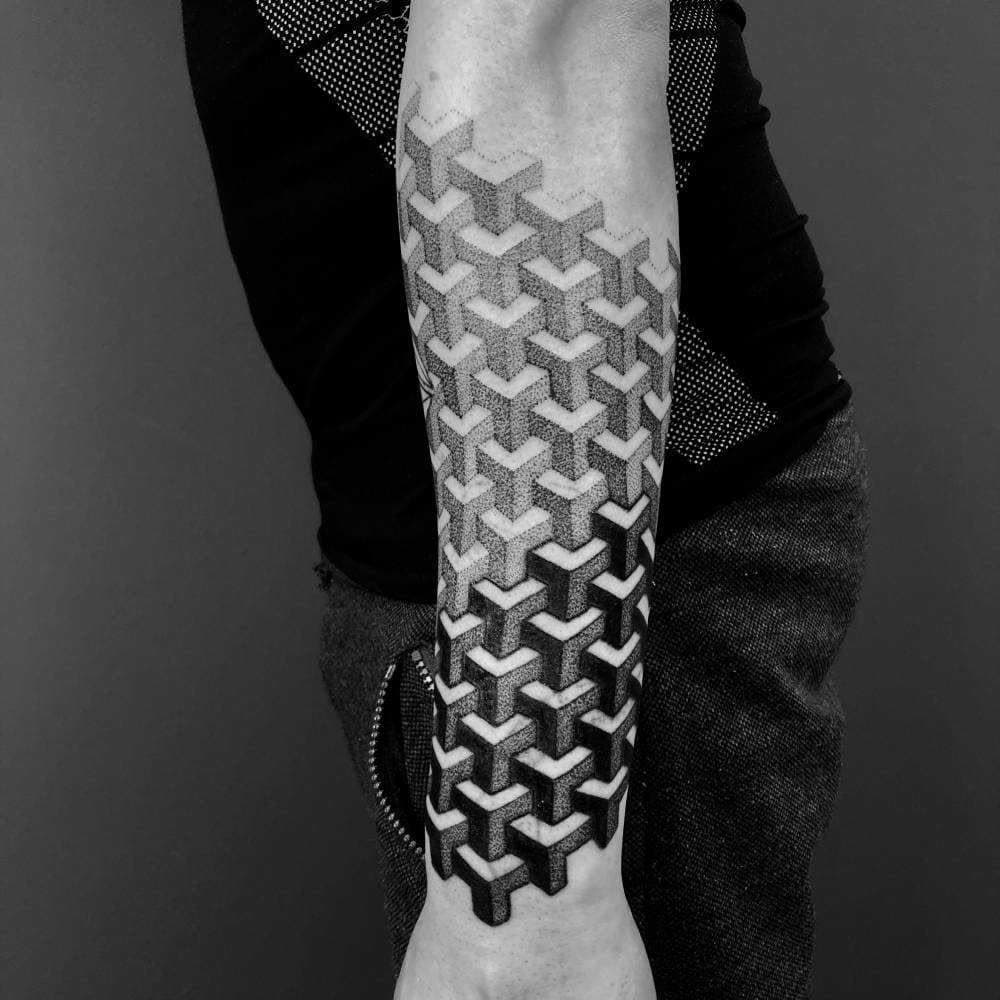
On the other end is blackwork, where contrast does more of the heavy lifting. Inked Magazine has highlighted Alex Arnautov for blackwork pieces built on sacred geometry and dotwork, and that combination tells you exactly why the style hits so hard when it is done well. Dense black fields can make circles, grids, and tessellated forms feel locked in place, but they also demand cleaner planning, because any wobble in spacing shows up fast.
Sacred geometry or abstract patterning
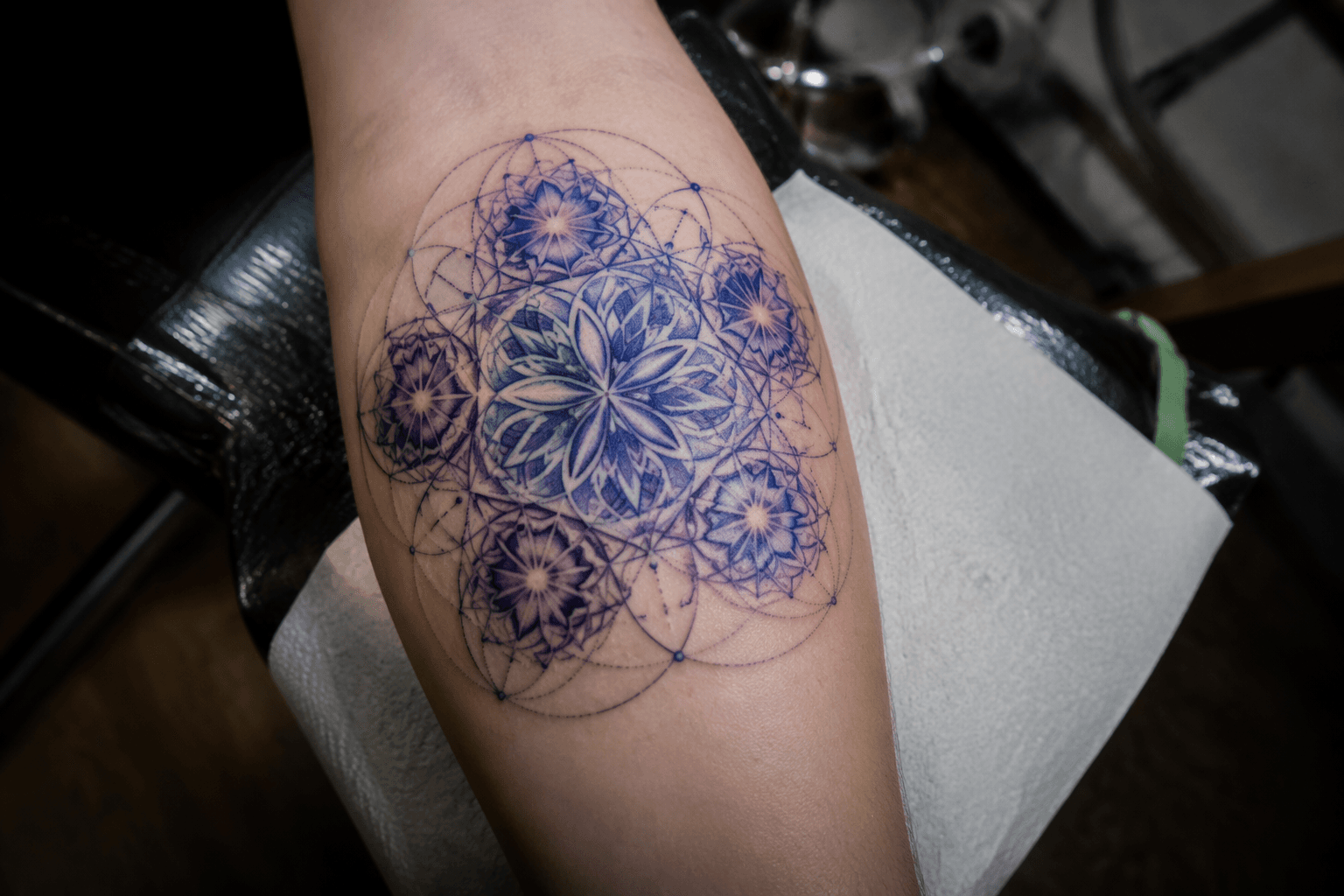
This is the choice that usually decides whether the tattoo feels spiritual, technical, or purely graphic. Sacred geometry pulls from forms that carry symbolic weight, which is why artists like Dillon Forte, one of the leading tattooers in sacred geometry, are so closely tied to the style. The visual language can suggest mandalas, star patterns, and repeated motifs that feel intentional beyond decoration.
Abstract patterning is looser, but it is not any less demanding. It still needs symmetry, rhythm, and a strong sense of proportion. The Tatspark gallery’s range is useful because it shows how far the category can stretch without losing its identity. You can move from a meditative, sacred-geometry piece to a more minimal, shape-driven composition and still stay inside the same broad family of work.
The 3D try-on is the practical advantage
The standout feature here is the 3D virtual try-on. That is not a gimmick for geometric tattoos, it is the difference between guessing and checking. A design that looks balanced on a screen can distort once it wraps around a forearm, sits on a calf, or spans a chest panel, and geometric work is especially unforgiving when the body changes the proportions.
Tatspark also folds in AI design support and body simulation, which makes the whole process more iterative. Instead of picking a motif once and hoping it survives contact with skin, you can browse, resize, test placement, and refine the composition. For a style built on exact spacing and visual order, that workflow is the real selling point.
How to turn the gallery into a usable brief
- small fine-line geometry for a first tattoo or a subtle placement
- forearm or calf pieces with enough structure to read from a distance
- blackwork and dotwork for heavier contrast and stronger visual weight
- sacred geometry if you want symbolism and symmetry to carry the design
- abstract patterning if you want the shape language without spiritual references
The easiest way to use a library this large is to narrow it in layers. Start with placement, then complexity, then execution style. A clean brief usually lands in one of these lanes:
That kind of sorting reflects how the broader tattoo culture has changed. Pew Research Center found that 32% of Americans had at least one tattoo in 2023, and 22% had more than one, based on a survey of 8,480 adults conducted from July 10 to July 16, 2023. Add in the scale of the North America laser tattoo and striae removal market, which Grand View Research estimated at USD 739.4 million in 2020 with a projected 17.2% CAGR through 2028, and the message is clear: people are making tattoo decisions with more caution, more planning, and more appetite for revision.
A style with deep roots and modern tools
Geometric tattooing may look contemporary, but the visual language is ancient. Smithsonian Magazine has traced tattooing back thousands of years across cultures, and it points out that Ötzi’s tattoos were geometric and abstract. Tatspark’s gallery sits inside that long arc, but the useful part is how it translates it into a modern planning system.
That is the real shift here. The gallery is not asking you to browse forever. It is pushing you toward a choice that fits the body, the scale, and the line weight you actually want. When geometry is this precise, the best design is the one that survives the try-on and still feels right when it is mapped to skin.
This article was produced by Prism’s automated news system from verified source data, official records, and press releases, then run through automated quality and moderation checks before publishing. The system is built and supervised by the people who set the standards it runs under. Read our full AI policy.
Did this article answer your question?